HOA Karen Smashed Her Produce-Washing Station—Then the Farm Owner Stepped Out
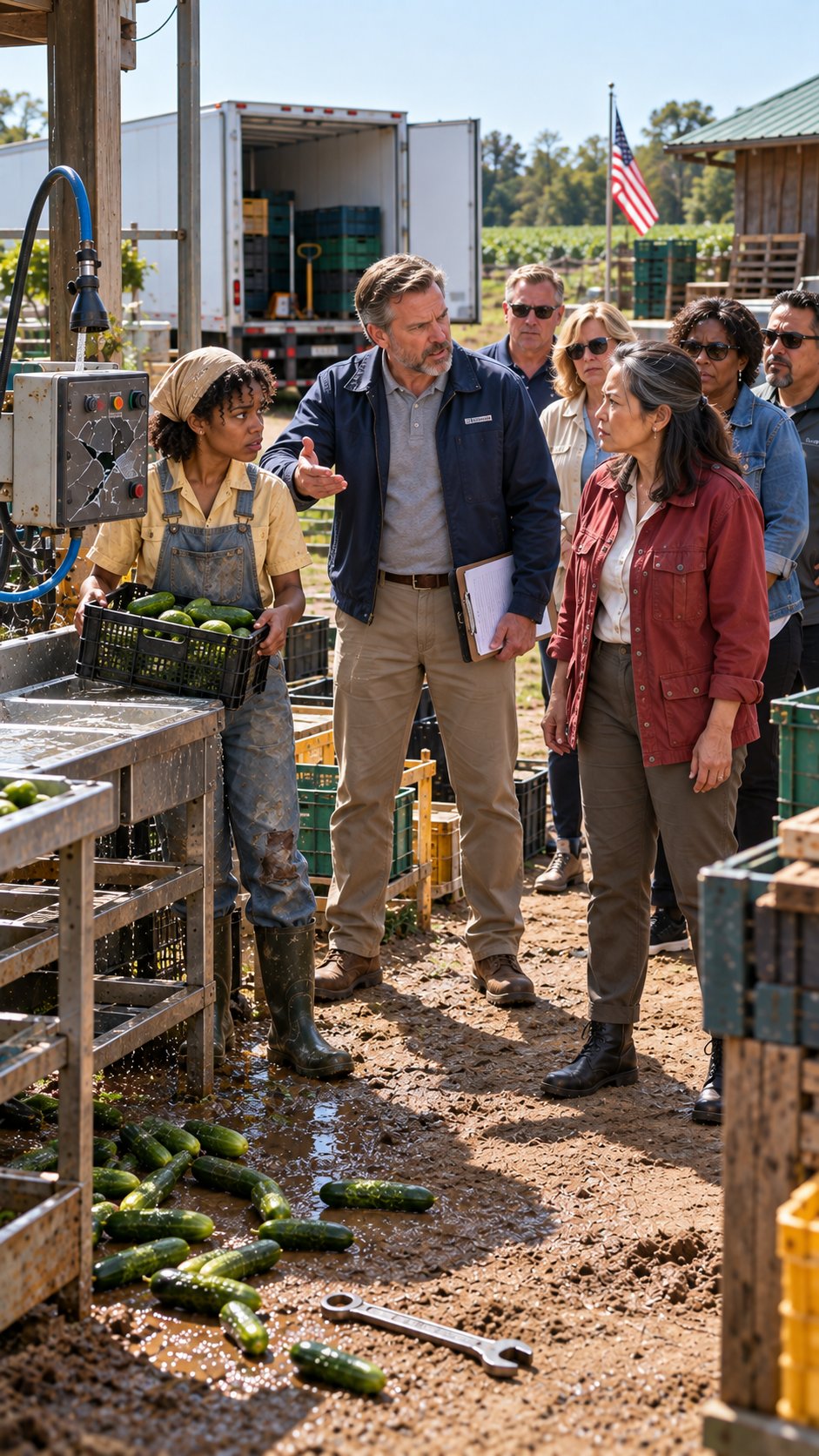
The wrench hit the control box before Emma Parker could get across the packing shed.
CRACK!
The plastic cover split.
The green indicator light went dark.
Water pressure dropped instantly.
A stainless-steel spray bar sputtered twice—
then stopped.
Dozens of freshly harvested cucumbers sat beneath it.
Emma froze.
“What did you just do?”
Denise Holloway still held the wrench.
Behind her stood four members of the Briarwood Hills HOA.
All five had walked through the open side of the farm's packing area less than three minutes earlier.
Now Denise pointed the wrench at the silent washing station.
“NO MORE PLAYING FARMER!”
The group laughed.
Emma stared at her.
She was eighteen years old.
Mud still clung to the knees of her faded canvas overalls.
Her dark hair was tied back.
Her rubber boots were wet from the wash floor.
Twenty minutes earlier, she'd been sorting cucumbers for a restaurant order.
Now five adults were standing inside her family's packing station acting as though they'd arrived to shut down a child's lemonade stand.
“Put the wrench down.”
One of the men beside Denise laughed.
His name was Greg Talbot.
Emma recognized him from the neighborhood walking trail.
Greg reached toward a harvest basket.
“Seriously?”
Emma stepped forward.
“Don't touch that.”
He looked directly at her.
Then shoved the basket.
CLATTER!
Cucumbers rolled across the stainless-steel table.
Several hit the concrete.
One disappeared beneath a pallet.
Greg spread his arms.
“GO BUY VEGETABLES LIKE EVERYONE ELSE!”
More laughter.
Emma looked at the cucumbers.
Then at the broken control box.
Her hands tightened.
“This is my family's packing station.”
Denise tossed the wrench onto the wet floor.
CLANG.
“NOT ANYMORE!”
Emma's face went still.
She looked toward the small office at the end of the shed.
“Mom?”
Denise rolled her eyes.
“Oh, good. Go get an adult.”
The office door opened.
A woman stepped out.
Forty-six years old.
Sun-browned face.
Dark hair pulled into a low knot.
Work boots.
Dusty jeans.
And a forest-green canvas jacket embroidered over the left chest:
PARKER FAMILY FARM — OWNER
Laura Parker looked at her daughter.
Then at the cucumbers scattered across the floor.
Then at the broken washing-station control.
Finally, she looked at the wrench.
“Emma?”
Emma pointed.
“She did it.”
The laughter stopped.
Laura walked closer.
Denise recovered first.
“You're the owner?”
Laura didn't answer immediately.
She picked up one cucumber.
Looked at the dirt now stuck to its wet skin.
Then placed it in a red reject bin.
“Yes.”
Denise straightened.
“Good.”
She sounded relieved.
As if the appearance of an adult meant the real negotiation could finally begin.
“We've been trying to address this agricultural operation for months.”
Laura looked around her own packing shed.
“Have you?”
“Yes.”
“With whom?”
“The HOA.”
Laura waited.
Denise frowned.
“The Briarwood Hills HOA.”
“I know who you are.”
“Then you know this farm is creating unacceptable conditions beside our community.”
Laura nodded toward the damaged control box.
“And you thought breaking my equipment would improve those conditions?”
Denise's face changed.
Only slightly.
Greg stepped in.
“Nobody broke anything.”
Emma stared at him.
“I watched her hit it with a wrench.”
Greg shrugged.
“Maybe it was already broken.”
Laura looked at Denise.
Then at Greg.
Then at the ceiling.
Emma followed her eyes.
A small security camera was mounted above the packing line.
A red status light glowed beside the lens.
Denise saw it.
Her face lost color.
Laura said:
“That's useful.”
Nobody laughed.
But the camera wasn't Denise's biggest problem.
The biggest problem was that Briarwood Hills had been built eleven years after Parker Family Farm began operating.
And six months earlier, Denise had received a letter from the HOA's own attorney explaining exactly where the association's authority ended.
At the farm's property line.
She had ignored it.
Now she was standing nearly three hundred feet beyond that line.
Inside a working produce-packing area.
Beside damaged equipment.
With four witnesses.
And a wrench carrying her fingerprints lying on the floor.
Laura pointed toward the driveway.
“Everybody out.”
Denise folded her arms.
“We're not finished.”
Laura's expression didn't change.
“No.”
She looked at the camera again.
“You are.”
Parker Family Farm sat on thirty-seven acres outside Charlottesville, Virginia.
The Parker family had worked the land for three generations.
Not continuously in the romantic way people liked to imagine.
There had been hard years.
Leased acreage.
Equipment loans.
A period when Laura's father worked nights at a distribution warehouse because the farm couldn't support the family by itself.
A drought.
Two floods.
A recession.
One disastrous tomato season.
A divorce.
A barn fire that destroyed tools but, by luck, no animals or people.
Family farming, Emma had learned early, looked much less like a sunset photograph when you were actually responsible for paying the bills.
The farm grew vegetables.
Cucumbers.
Tomatoes.
Summer squash.
Peppers.
Green beans.
Leafy greens in cooler seasons.
Herbs.
Pumpkins in fall.
A few acres rotated through cover crops.
They sold through a farm stand, two farmers markets, several local restaurants, a small produce distributor, and a community-supported agriculture program.
Nothing about the operation was enormous.
Nothing about it was pretend.
Emma had grown up in it.
At five, she washed radishes.
At eight, she learned how to tell the difference between a cucumber ready for harvest and one that should stay on the vine.
At twelve, she began helping at farmers markets.
At fifteen, she could prepare restaurant orders.
At seventeen, she redesigned the farm's harvest tracking spreadsheet because the old paper system drove her insane.
At eighteen, she was spending the summer before college working full-time beside her mother.
And yes—
she learned things online.
Lots of things.
She watched agricultural extension webinars.
Read university publications.
Compared food-safety equipment.
Studied irrigation systems.
Followed market-garden growers.
Read research.
Asked questions in farming forums.
She also learned from her mother.
Her grandfather.
Their employees.
Other growers.
Their produce distributor.
Their mechanic.
Their customers.
The idea that learning from the internet made someone fake was particularly funny to Emma because her mother used YouTube whenever the tractor developed a problem the manual didn't explain clearly enough.
Laura simply called that “research.”
The washing station Denise destroyed had been installed eighteen months earlier.
It wasn't fancy.
But it mattered.
The farm had expanded its restaurant accounts.
That meant more produce moving through the packing shed.
Their old process depended heavily on hoses, tubs, manual handling, and a patchwork arrangement Laura had tolerated for too long.
Emma hated it.
One winter evening, she sat at the kitchen table with a notebook.
“We're wasting time.”
Laura continued eating soup.
“We've been wasting time since 1998.”
“I'm serious.”
“So am I.”
Emma slid the notebook across the table.
She had mapped the workflow.
Harvest enters.
Initial sort.
Wash where appropriate.
Drain.
Final sort.
Pack.
Cold storage.
Outgoing orders.
Laura looked at the arrows.
“You made my barn look like an airport.”
“Packing shed.”
“Same roof.”
“We're crossing clean product with incoming product.”
Laura stopped joking.
Emma pointed.
“And we're moving baskets back and forth unnecessarily.”
“How unnecessarily?”
Emma had timed it.
Of course she had.
Laura stared at the numbers.
“You timed us?”
“For three days.”
“That's disturbing.”
“We can cut handling.”
“With what money?”
That was the actual question.
Emma had expected it.
She turned the page.
Used equipment.
A refurbished pump.
Food-grade hoses.
A simple stainless table.
Wash controls.
Drainage improvements.
Not cheap.
Possible.
Laura read everything.
Then looked at her daughter.
“You've been thinking about this awhile.”
“Since last summer.”
“You could've mentioned it.”
“I did.”
“When?”
“Every time I complained about the old wash line.”
“That was complaining?”
“Yes.”
“I thought that was your personality.”
Emma threw a napkin at her.
Laura laughed.
Then approved the project.
Mostly.
She cut the budget.
Emma complained.
Laura cut it again.
They compromised.
By the following spring, the new washing station was running.
It wasn't a miracle.
It didn't triple revenue.
It didn't turn the Parker farm into an industrial facility.
It simply made work cleaner, more organized, and more efficient.
Laura considered that a victory.
Emma considered it version one.
Briarwood Hills began at the eastern edge of the Parker property.
The subdivision contained 212 homes.
Stone entrance columns.
Curving streets.
Walking paths.
Clubhouse.
Pool.
Small playground.
Decorative pond.
HOA.
When the development was proposed, Laura's father was still alive.
He worried about it immediately.
“People like farms until they live next to one.”
Laura thought he was being cynical.
For the first several years, she believed she'd been right.
Most Briarwood residents were good neighbors.
Many shopped at the Parker farm stand.
Parents brought children to the pumpkin patch.
Residents bought tomatoes.
Some volunteered during a community harvest event.
The HOA once hired the farm to provide pumpkins for an autumn festival.
Then Denise Holloway moved in.
Denise was fifty-seven.
She'd spent most of her career in corporate property management.
That background gave her useful skills.
Budgets.
Contracts.
Meetings.
Vendor negotiations.
Unfortunately, it also gave her enormous confidence in situations where her actual authority was limited.
She joined the Briarwood board after eighteen months in the neighborhood.
A year later, she became president.
At first, residents liked her.
Meetings became more organized.
Late dues were handled consistently.
Landscaping contracts were reviewed.
A neglected drainage issue near the clubhouse finally received attention.
Denise got things done.
Then success created a problem.
She began treating every nearby inconvenience as something the HOA should control.
Garbage cans.
Basketball hoops.
Fence colors.
Parking.
Lawn height.
Contractor vehicles.
Those were at least connected to properties inside the association.
Then she looked beyond it.
At Parker Family Farm.
Her first complaint concerned tractor noise.
Laura received an email at 6:42 one morning.
FARM EQUIPMENT OPERATIONS BEFORE 8:00 A.M. VIOLATE BRIARWOOD HILLS QUIET-HOUR RULES.
Laura read it while drinking coffee.
Then read it again.
She forwarded it to Emma.
Emma was upstairs.
Thirty seconds later, she came down.
“Is she serious?”
“Apparently.”
“We aren't in their HOA.”
“I noticed.”
“What are you going to say?”
Laura typed:
Parker Family Farm is a separate agricultural parcel and is not subject to Briarwood Hills HOA covenants. If you believe a public noise ordinance applies, please identify it and we will review the concern.
Emma looked over her shoulder.
“That's too polite.”
“That's why you're not answering.”
Denise replied before breakfast.
YOUR ACTIVITIES DIRECTLY AFFECT OUR HOMEOWNERS.
Laura answered:
I understand. That does not make our property subject to your private covenants.
Then she went to work.
The second complaint concerned farm trucks.
The third concerned a compost pile that couldn't actually be seen from Briarwood without standing in a very specific location on the walking path.
The fourth concerned temporary row cover.
The fifth concerned “unsightly agricultural containers.”
Emma stared at that phrase.
“They mean harvest bins?”
Laura nodded.
“Apparently.”
“They're complaining that a farm has farm bins?”
“Yes.”
“What's next? Dirt?”
Two weeks later, Denise complained about mud near the farm entrance after a storm.
Emma printed the email and taped it to the office refrigerator.
WHAT'S NEXT? DIRT?
Laura made her remove it when a restaurant buyer visited.
The real conflict began when the farm upgraded its packing area.
The packing shed had existed for years.
The new wash station changed its appearance slightly.
Stainless tables.
New drainage.
A covered produce staging area.
From one section of the Briarwood walking trail, you could see the roof and side opening through trees.
Denise called it an “industrial processing facility.”
Laura nearly choked on her coffee.
The county did not.
Laura had already handled the relevant permitting and food-safety requirements for the work being performed.
She kept records.
She always kept records.
Her father had taught her that.
A farmer with paperwork is still a farmer. A farmer without paperwork becomes somebody else's version of what happened.
Laura used to tease him.
Then she became the person keeping folders.
Denise sent a formal-looking notice.
It carried the Briarwood Hills logo.
CEASE UNAPPROVED COMMERCIAL PROCESSING ACTIVITY.
Laura forwarded it to the HOA management company.
The property manager called that afternoon.
“Ms. Parker, I'm sorry.”
“For what?”
“That letter should not have been sent.”
“Is my property in your association?”
“No.”
“Has that changed?”
“No.”
“Then we're fine.”
The manager hesitated.
“President Holloway believes the association may have rights under an older development agreement.”
“If she sends the document, I'll have my attorney review it.”
“She hasn't provided one.”
“Then there's nothing to review.”
The manager sounded relieved.
Laura was reasonable.
Reasonable people make professional managers' lives easier.
The HOA's attorney eventually reviewed the matter.
The answer was straightforward.
Parker Family Farm's parcel was not part of the Briarwood Hills HOA.
The association's private architectural and use restrictions did not govern the farm merely because the farm adjoined the subdivision.
Public laws and regulations could apply.
Private HOA covenants did not leap across property lines.
The attorney's letter advised the board to avoid representing otherwise.
Denise received it.
So did the other board members.
Laura received a copy through her attorney.
Emma read it.
“So that's over.”
Laura looked at her daughter.
“No.”
“Why?”
“Because Denise doesn't think this is about documents anymore.”
“What does she think it's about?”
“Winning.”
Laura was right.
Denise stopped sending official notices.
Instead, she began bringing neighbors to the walking trail.
She photographed tractors.
Produce bins.
Delivery vans.
Employees.
The packing shed.
Once, Emma saw Denise standing near the property boundary with three people.
Denise pointed toward the farm as if conducting a tour.
Emma waved.
Denise did not wave back.
Another time, Denise approached a seasonal worker near the edge of the property.
“Do you have permission to work here?”
The employee stared at her.
“Yes?”
“From whom?”
“Laura.”
“Laura who?”
The employee pointed toward the farm office.
“The woman whose name is on my paycheck?”
Denise left.
Emma laughed for ten minutes when she heard.
Laura didn't.
“Don't encourage this.”
“I wasn't there.”
“You're encouraging it emotionally.”
“What does that mean?”
“I don't know. Stop.”
Then Denise began talking about food safety.
That got Laura's attention.
Not because Denise knew anything specific.
Because vague accusations involving food could damage a farm quickly.
Denise posted in a neighborhood group:
Residents deserve transparency regarding produce washing and chemical use occurring immediately adjacent to our homes.
No direct accusation.
Just enough implication.
Emma was furious.
“She makes it sound like we're washing cucumbers in radioactive waste.”
Laura said:
“Don't respond angry.”
“Can I respond factual?”
“Yes.”
They drafted a short statement for the farm's public page.
No mention of Denise.
No fight.
Just information about the farm's washing practices, food-safety procedures, water source, and customer handling.
They also invited customers to an open-farm morning later that month.
Denise interpreted that as weakness.
It wasn't.
The four HOA members who accompanied her into the packing station were Greg Talbot, Sheila Barnes, Ron Whitaker, and Melissa Crane.
Greg was the man who knocked over the cucumbers.
He was fifty-two and served on the HOA's landscaping committee.
Sheila was sixty.
She chaired the social committee.
Ron was forty-nine and actually sat on the board.
Melissa was fifty-five and had recently joined a “community standards working group” Denise created.
None had authority to enter the Parker property and inspect equipment.
But Denise told them they were going to “document an active violation.”
Ron later admitted he assumed she had arranged permission.
Greg admitted he never asked.
Sheila said she believed the packing shed sat inside a disputed buffer zone.
Melissa said she was simply following the group.
Laura would later tell Emma:
“Four different explanations from four adults means nobody actually knew why they were there.”
That afternoon, Emma had been washing cucumbers harvested from the north field.
A restaurant order was due.
Two CSA pickups were scheduled the next morning.
The washing station was running normally.
Emma noticed Denise's group when they entered through the side lane.
She shut off one spray section.
“Can I help you?”
Denise held a wrench.
That should have been the first clue.
Emma looked at it.
“Why do you have that?”
“Inspection.”
“Inspection by who?”
“The HOA.”
“You're not inspectors.”
Denise walked past her.
Emma stepped sideways.
“You need to go to the office.”
Greg laughed.
“She thinks she's in charge.”
Emma said:
“My mother owns the farm.”
Denise replied:
“Then get her.”
“I will. Don't touch anything.”
Denise looked at the wash line.
“What is this?”
“A produce washing station.”
“You're running industrial equipment.”
Emma almost laughed.
It was a pump, spray system, controls, stainless surfaces, and drains.
Industrial sounded much more exciting.
She said:
“Please go to the office.”
Denise lifted the wrench.
“What happens if this stops?”
Emma's stomach tightened.
“Put that down.”
Denise struck the control box.
CRACK!
Everything changed.
When Laura ordered them out, Ron moved first.
He looked embarrassed.
“Denise, we should leave.”
Denise turned.
“We're here as an HOA committee.”
Laura said:
“No committee of yours has authority inside my packing shed.”
Greg pointed at the wash station.
“That equipment is affecting residential property.”
“How?”
“Noise.”
Emma stared.
The pump had been quieter than his voice.
Laura asked:
“Do you have a sound measurement?”
Greg didn't answer.
“County complaint?”
Nothing.
“Inspection report?”
Nothing.
Laura looked at Ron.
“You're on the board, correct?”
Ron nodded.
“Did the board authorize entry onto my property?”
He hesitated.
Denise answered:
“We don't need authorization to investigate a nuisance.”
Laura looked back at Ron.
“I asked you.”
Ron swallowed.
“Not specifically.”
Denise snapped:
“Ron.”
Laura said:
“Thank you.”
Then she pointed toward the exit.
“Leave.”
Sheila had already started walking.
Melissa followed.
Greg remained beside Denise.
Denise said:
“We're not done.”
Laura pulled out her phone.
“I've asked you to leave private property. The camera recorded you damaging equipment. If you stay, I'll call law enforcement and report that you are refusing to leave.”
Denise looked at the camera.
Then at the wrench.
Then at Emma.
Finally, she walked.
Greg followed.
Emma waited until their vehicles disappeared.
Then she exploded.
“WHAT WAS THAT?”
Laura crouched beside the control box.
“Get me the breaker status.”
“Mom!”
“Emma.”
“She smashed it!”
“I know.”
“She walked into our building with a wrench!”
“I know.”
“Why are you acting like this is normal?”
Laura stood.
Her face was pale.
That was when Emma realized her mother wasn't calm.
She was controlling herself.
Different thing.
Laura said:
“Because we have produce on the line and I need to know what still works.”
Emma breathed.
Then nodded.
Work first.
They shut down the affected section.
Isolated power.
Moved the produce.
The damaged cucumbers that had touched the floor went into the reject stream.
The remaining product was rehandled appropriately.
Laura called their equipment technician.
Then their attorney.
Then the sheriff's non-emergency line.
In that order.
Emma asked:
“Why the technician first?”
“Because tomorrow's orders still exist.”
That was Laura Parker.
Conflict did not cancel payroll.
Deputy Marcus Bell arrived forty minutes later.
He did not walk into the shed announcing arrests.
He asked what happened.
Laura showed him the damage.
The wrench.
The camera.
Emma gave her account separately.
Laura gave hers.
The deputy asked whether anyone was injured.
No.
Whether anyone had threatened physical harm.
No.
Whether the group had been told to leave.
Yes.
Whether they eventually left.
Yes.
He documented the information and explained that additional review would determine how the incident would be handled.
Emma wanted something more dramatic.
She wanted him to drive to Briarwood and bring Denise back in handcuffs.
He didn't.
Later, she admitted that was probably good.
The camera wasn't going anywhere.
Neither was the damaged machine.
Evidence could afford patience.
The equipment technician arrived before sunset.
His name was Caleb Morris.
He removed the broken cover.
Inspected the controls.
“Could be worse.”
Emma folded her arms.
“That doesn't make me feel better.”
“Usually makes your mother feel better.”
Laura said:
“It does.”
A control switch was damaged.
The housing was cracked.
Wiring needed inspection.
The station could be repaired.
Not instantly.
Caleb bypassed nothing unsafe.
He helped them set up a temporary manual process for the next day's urgent orders.
It was slower.
Much slower.
Emma worked until almost midnight.
So did Laura.
At 10:40 p.m., Emma was rinsing the last restaurant order manually when she said:
“I hate her.”
Laura kept sorting.
“No.”
“Grandma says hate is a strong word. I'm using it intentionally.”
Laura almost smiled.
“Fine.”
“She thinks this is a game.”
Laura stopped sorting.
“No.”
“What?”
“I don't think she does.”
“Then why?”
Laura considered.
“Because she believes if she can make the farm inconvenient enough, we'll change.”
“Change what?”
“Hours. Equipment. Maybe eventually how much we operate near Briarwood.”
Emma stared.
“Why should we?”
“That's the point.”
The security footage was clear.
Painfully clear.
Denise entering with the wrench.
Emma directing the group toward the office.
Denise approaching the control.
Emma saying:
“Put that down.”
The strike.
CRACK.
Denise shouting:
“NO MORE PLAYING FARMER!”
Greg pushing the basket.
“GO BUY VEGETABLES LIKE EVERYONE ELSE!”
Laughter.
Emma:
“This is my family's packing station.”
Denise:
“NOT ANYMORE!”
Then:
“Mom?”
Laura appearing.
The owner jacket.
The silence.
Emma watched the clip twice.
Then reached for her phone.
Laura said:
“No.”
“I didn't say anything.”
“You're about to post it.”
“How do you know?”
“You're eighteen.”
“That's age discrimination.”
“Put the phone down.”
“Mom.”
“No.”
“This would destroy her.”
“That's exactly why you're not posting it tonight.”
Emma stared.
“She's already been posting about us.”
“And we're going to handle this with people who matter before we turn it into entertainment.”
Emma hated that answer.
Mostly because she knew it was right.
The HOA management company received the footage the next morning.
So did the association's attorney.
The response was immediate.
Not because Denise had insulted Emma.
Not because Greg wasted cucumbers.
Because the footage created liability questions.
The board president appeared to be invoking HOA authority while damaging equipment on property the association's own attorney had already identified as outside the HOA.
That was not a situation the management company wanted misunderstood.
An emergency board meeting was scheduled.
Denise objected.
She claimed the video lacked context.
So Laura provided context.
The entire relevant recording.
Beginning to end.
No edits.
No captions.
No dramatic music.
No social-media cut.
Context did not help Denise.
Ron Whitaker called Laura that evening.
“Ms. Parker?”
“Yes.”
“This is Ron from Briarwood.”
“I know.”
“I want to apologize.”
Laura waited.
“I shouldn't have gone onto your property.”
“No.”
“I believed Denise had authority to conduct an inspection.”
“Why?”
Silence.
“I assumed.”
Laura said:
“That's the problem.”
“I understand.”
“Do you?”
Ron sighed.
“I'm beginning to.”
He told her Denise had described the visit as an observation of a potential nuisance condition.
She had not told them she planned to touch equipment.
Ron claimed he didn't know why she brought the wrench.
Laura believed part of that.
Not all of it.
Then Ron said:
“I should've left the moment your daughter told us to go to the office.”
“Yes.”
“I also should've stopped Denise.”
Laura didn't respond.
He added:
“And Greg.”
“Yes.”
Ron apologized to Emma separately two days later.
Emma accepted the apology.
She did not tell him everything was fine.
It wasn't.
Greg was harder.
He initially claimed the cucumber basket had been unstable.
The camera disagreed.
He then said he'd moved it out of the way.
The camera disagreed again.
Finally, he admitted he'd knocked it over.
“Why?” an investigator asked.
Greg reportedly answered:
“I was frustrated.”
That explanation fascinated Emma.
She told Laura:
“Imagine if I knocked over his grill because I was frustrated.”
“Don't.”
“I said imagine.”
“Don't imagine loudly.”
The washing station was repaired in three days.
The financial loss was manageable.
Repair bill.
Labor disruption.
Discarded produce.
Delayed work.
Documentation time.
No catastrophic shutdown.
No ruined farm.
Laura was almost grateful for that.
Emma wasn't.
She wanted the consequences to feel as large as the disrespect.
Laura told her:
“Consequences aren't measured by how angry we are.”
Another sentence Emma hated.
Another sentence she remembered.
The emergency HOA meeting was closed for part of its discussion because legal advice and personnel/governance issues were involved.
Residents still heard quickly.
Briarwood was a neighborhood.
Privacy had limits.
Rumors spread.
One version claimed Denise had tried to shut down the entire farm.
Another claimed Emma had attacked HOA members with a hose.
Another claimed the farm was suing every homeowner.
False.
Emma wanted to correct all of it.
Laura posted one statement.
Parker Family Farm experienced an incident involving unauthorized visitors in a nonpublic work area. Equipment was damaged. The matter has been documented and is being addressed through the appropriate channels. Our farm remains open and operating normally. We appreciate the community's support.
That was it.
No names.
No video.
Customers flooded the comments anyway.
Glad you're okay.
See you Saturday.
Best cucumbers in the county.
Tell Emma not to let anybody mess with her wash line.
Emma showed Laura that one.
“Can I like it?”
“You can like whatever you want.”
Progress.
The HOA board removed Denise from the president's role pending internal review.
That did not mean the board could decide criminal liability.
It couldn't.
It could decide who represented the association.
Ron voted in favor of the change.
Denise was furious.
She accused the board of surrendering to “commercial interests.”
Several homeowners disagreed.
One stood during the open portion of the next meeting and asked:
“Why are we spending association resources fighting a farm that isn't in the association?”
Another asked:
“Did our insurance carrier know board members were entering neighboring property?”
A third said:
“I buy produce from the Parkers every week. What problem are we actually solving?”
Those were difficult questions because they required a concrete answer.
Denise's strongest arguments had always lived in abstraction.
Standards.
Values.
Protection.
Impact.
Once residents asked:
What specifically are we trying to stop?
the campaign weakened.
Laura attended one later meeting by invitation.
She did not bring Emma.
Emma objected.
“I was the one there.”
“You were.”
“So why can't I go?”
“You can.”
“Then?”
Laura sighed.
“I'm asking you not to.”
“Why?”
“Because you're still angry enough to make Denise the center of the meeting.”
Emma stared.
“And you aren't?”
“Oh, I'm furious.”
“You don't look furious.”
“I have forty-six years of practice.”
That sounded familiar.
Emma stayed home.
Barely.
Laura's statement at the meeting lasted four minutes.
She didn't discuss Denise's personality.
Didn't call the HOA corrupt.
Didn't accuse every board member.
She explained that Parker Family Farm was a neighboring parcel.
It respected legitimate public requirements.
It wanted good relations with Briarwood residents.
But HOA representatives could not enter farm work areas and interfere with equipment.
Then she said:
“My daughter was mocked because she is eighteen.”
The room became quiet.
“She works on our farm. When she tells an unauthorized visitor not to touch equipment, her age does not make that instruction optional.”
Several residents nodded.
Laura continued:
“You do not have to like our farm. You do not have to shop there. You may report legitimate concerns to the appropriate authorities. But private disagreement does not create a right to walk into our packing station with a wrench.”
Then she sat down.
Four minutes.
Emma later watched a resident's recording.
“You should've said more.”
Laura asked:
“What?”
“I don't know.”
“Exactly.”
The association adopted new procedures.
Board members could not conduct off-property “inspections” without clear legal authority and appropriate authorization.
Questions involving neighboring parcels had to go through management and counsel.
Official notices required verification that the property was actually subject to association covenants.
Denise hated the rules.
Laura liked them.
Emma called them boring.
Laura said:
“Boring rules prevent exciting stupidity.”
Emma wrote that one down.
The legal aftermath moved more slowly.
There were property-damage issues.
The entry onto the farm.
The equipment.
Greg's conduct.
Insurance questions.
Attorneys.
Statements.
Evidence.
Laura did not receive a giant movie-style settlement.
Denise did not lose everything.
Greg was not dragged from his home.
Reality was less theatrical.
Costs associated with the documented damage and disruption were addressed through the relevant parties and insurance arrangements.
The law-enforcement process proceeded based on the evidence and applicable law.
Laura followed her attorney's advice.
Emma learned an important lesson.
Justice involves paperwork.
So much paperwork.
She told her mother:
“Nobody puts this part in movies.”
“What?”
“Emails.”
Laura laughed.
Then something happened neither expected.
Business increased.
Not because they released the video.
They still hadn't.
Because Briarwood residents became curious.
Some came to the farm for the first time.
They bought produce.
Asked questions.
Saw the washing station.
Saw employees.
Saw the fields.
The mysterious “industrial processing operation” turned out to be people washing cucumbers.
One Briarwood father brought his two children.
His son watched Emma sort squash.
“Is this the machine the lady broke?”
The father turned red.
Emma looked at Laura.
Laura pretended not to hear.
Emma crouched.
“It was damaged.”
“Why?”
“Someone made a bad decision.”
“Did she go to jail?”
His father nearly died.
Emma smiled.
“That's not something you need to worry about.”
The boy pointed at the spray bar.
“Can I see it work?”
That was a better question.
Emma showed him.
The farm held its open morning later that summer.
Laura almost canceled it.
Emma insisted.
“If we cancel, Denise wins.”
Laura said:
“This isn't a war.”
“Fine. If we cancel, cucumbers win.”
“That makes less sense.”
“We're doing it.”
They did.
More than two hundred people came.
Families toured the packing area in controlled groups.
Emma explained produce handling.
Water.
Sorting.
Cooling.
Traceability.
Why damaged produce was separated.
Why some vegetables were washed differently from others.
Why food safety involved procedures rather than vague claims about cleanliness.
An older Briarwood resident raised her hand.
“Did you design this station?”
Emma said:
“Part of it.”
“How old are you?”
“Eighteen.”
The woman smiled.
“That's impressive.”
Emma felt something strange.
Months earlier, Denise had used her age to make her smaller.
Now praise based on her age made Emma uncomfortable too.
She answered:
“It's a team system. My mom approved it. Our technician helped. We changed things after installation.”
Laura heard.
She smiled.
Emma was learning.
She left for Virginia Tech that fall to study agricultural systems technology.
Laura cried after dropping her off.
Emma pretended not to notice.
The first month was miserable.
She missed the farm.
Her roommate stayed awake until two in the morning.
Her chemistry class felt designed by someone who hated happiness.
She called Laura.
“I made a mistake.”
“Probably.”
“Mom.”
“What?”
“I should've stayed.”
“No.”
“You don't even know what I was going to say.”
“Yes, I do.”
“I hate it here.”
“Good.”
“What?”
“Not permanently good. Useful good.”
Emma groaned.
Laura continued:
“You knew the farm. You need to learn somewhere you aren't the owner's daughter.”
Emma hated that too.
So she stayed.
College changed her.
Not by teaching her that everything she'd learned at home was wrong.
By showing her how much she didn't know.
Postharvest physiology.
Water management.
Equipment design.
Food-safety systems.
Data.
Engineering.
Economics.
Labor.
Supply chains.
She discovered that washing produce wasn't simply “make vegetables clean.”
Commodity mattered.
Market mattered.
Water quality mattered.
Temperature mattered.
Handling mattered.
Equipment mattered.
Documentation mattered.
She called Laura after one lecture.
“We've been doing something inefficient.”
Laura sighed.
“Hello to you too.”
“The cucumber line.”
“What now?”
Emma explained.
Laura listened.
Then said:
“Test it when you're home.”
No defensiveness.
No:
We've always done it this way.
That was why the farm survived.
Denise resigned from the Briarwood board before Emma finished her first semester.
She remained in the neighborhood.
For months, she avoided the farm.
Then, almost a year after the incident, she appeared at the farm stand.
Laura saw her first.
Denise carried no wrench.
That was progress.
She approached the counter.
“Is Emma here?”
“College.”
“Oh.”
Laura waited.
Denise looked older.
Not dramatically.
Just tired.
“I wanted to speak to both of you.”
“You can speak to me.”
Denise nodded.
She struggled for several seconds.
Then:
“I was wrong.”
Laura said nothing.
“I had no right to enter the packing area.”
Correct.
“I had no right to touch the equipment.”
Correct.
“I shouldn't have spoken to your daughter that way.”
Correct.
Denise looked toward the shed.
“I convinced myself your operation was going to keep expanding until it affected everything around us.”
Laura asked:
“Why?”
Denise looked toward Briarwood.
“When we bought our house, we were told the neighborhood would be quiet.”
Laura almost laughed.
“You bought beside a farm.”
“I know.”
“Was the farm hidden?”
“No.”
“Was it here?”
“Yes.”
“Then?”
Denise looked embarrassed.
“I thought eventually the land would be developed.”
That surprised Laura.
There it was.
The real issue.
Denise had never wanted to live beside a farm.
She had assumed the farm was temporary.
Something waiting to become more subdivision.
When it didn't disappear, every sign of investment bothered her.
New equipment.
Improved packing.
Continued production.
The washing station didn't look like decline.
It looked like permanence.
Denise had interpreted permanence as threat.
Laura finally understood.
Understanding did not excuse the wrench.
But it explained the obsession.
Denise said:
“When I saw the new packing equipment, I thought you were turning this into a larger processing business.”
“You could've asked.”
“I know.”
“You could've contacted the county.”
“I know.”
“You could've spoken to me.”
“I know.”
“Instead you hit my equipment with a wrench in front of my daughter.”
Denise looked down.
“Yes.”
Laura waited.
Then Denise said:
“I am sorry.”
No “but.”
No explanation afterward.
Laura appreciated that.
She didn't hug her.
Didn't say everything was fine.
She said:
“Thank you for apologizing.”
That was enough.
Emma came home two weeks later.
Laura told her.
“She apologized?”
“Yes.”
“To you.”
“Yes.”
“Not me.”
“She wanted to.”
“But I wasn't here.”
“Yes.”
Emma crossed her arms.
“Convenient.”
Laura smiled.
“You don't have to forgive her.”
“I know.”
“She may come back.”
“I know.”
“She might not.”
“I know.”
Emma looked toward the washing station.
Then said:
“I still want the wrench.”
“What?”
“The wrench she used.”
“Why?”
“Frame it.”
Laura laughed.
“Absolutely not.”
“Coward.”
Denise did return.
Three months later.
Emma was home for winter break.
Denise walked into the farm stand and stopped when she saw her.
Emma's body tightened automatically.
Denise noticed.
She stayed several feet away.
“Emma.”
“Denise.”
“I spoke with your mother.”
“I know.”
“I owe you the apology more than anyone.”
Emma didn't make it easy.
“Okay.”
Denise took a breath.
“I mocked you because of your age.”
“Yes.”
“I treated your work like a game.”
“Yes.”
“I damaged equipment after you told me not to touch it.”
“Yes.”
“I was wrong.”
Emma waited.
Denise continued:
“And I'm sorry.”
Silence.
Then Emma asked:
“Why did you bring the wrench?”
Denise looked surprised.
Nobody had asked her that directly.
“I thought the control panel could be shut off.”
“You planned to shut it down before you arrived?”
Denise's face changed.
“Yes.”
That answer mattered.
It meant the damage hadn't been a spontaneous burst of anger.
She had arrived intending to interfere.
Emma felt her anger rise again.
Denise saw it.
“I told myself I was documenting whether the system could be stopped.”
“That doesn't make sense.”
“I know.”
“You were trying to prove you could control us.”
Denise didn't answer.
Emma realized she'd hit the truth.
Finally Denise said:
“Probably.”
That was the most honest thing she'd said.
Emma looked at her for a long time.
Then:
“I accept the apology.”
Denise exhaled.
Emma added:
“That doesn't mean what happened is okay.”
“I understand.”
“Good.”
Denise left.
Emma stood behind the counter.
Laura emerged from the office.
“You were listening?”
“No.”
“You absolutely were.”
“I own the building.”
Emma laughed.
Years passed.
Emma graduated.
She didn't return immediately.
She worked for a produce-equipment company in North Carolina.
Laura encouraged it.
“Learn on somebody else's payroll.”
Emma did.
She worked with small farms.
Packing houses.
Wash systems.
Cooling systems.
Conveyors.
Sensors.
Water-management equipment.
She saw facilities that made Parker Family Farm look tiny.
She also saw farms smaller than theirs doing brilliant work with almost nothing.
The more she learned, the less impressed she became by expensive equipment alone.
Good systems were about fit.
Scale.
Maintenance.
People.
A million-dollar machine could be useless in the wrong operation.
A carefully designed thousand-dollar improvement could transform the right one.
That reminded her of the washing station.
Version one.
Broken control box.
Cucumbers rolling across concrete.
Laura turned fifty-four.
Then fifty-seven.
The farm changed.
A neighboring farmer retired and leased Parker Family Farm another twelve acres.
Restaurant sales expanded.
The CSA remained.
Wholesale increased slightly.
Laura refused to grow faster than the business could support.
Emma respected that more as she got older.
When she was eighteen, growth sounded automatically good.
At twenty-eight, she understood growth could destroy a business as effectively as decline.
She returned to Virginia.
Not because Laura demanded it.
Because she wanted to.
They created a formal transition plan.
Emma bought into the operating business gradually.
An accountant helped.
An attorney structured it.
Laura retained ownership interests.
Responsibilities shifted.
Nothing was handed over during a sentimental sunset conversation.
There were spreadsheets.
Taxes.
Insurance.
Debt.
Succession documents.
Emma joked:
“This is the least cinematic family legacy ever.”
Laura said:
“Good.”
One spring morning, Laura handed Emma a new jacket.
Forest green.
Canvas.
Embroidered:
PARKER FAMILY FARM — OWNER
Emma stared.
“You're kidding.”
“No.”
“You had one of these.”
“Still do.”
“Am I supposed to walk dramatically out of the office now?”
Laura laughed.
“Only if somebody brings a wrench.”
Emma put it on.
The sleeves were slightly stiff.
She looked in the mirror.
For one second, she saw her mother at forty-six.
Office door opening.
Denise standing beside the broken machine.
Laughter gone.
Emma had believed the jacket was power.
It wasn't.
Laura's ownership had mattered legally and practically.
But the jacket itself was fabric.
The real power that day came from something else.
Documentation.
Boundaries.
Evidence.
Refusing to be intimidated.
And continuing to run the farm after everyone went home.
The old washing station eventually needed replacement.
Emma resisted.
Laura noticed.
“You're sentimental.”
“No.”
“The pump is twelve years old.”
“Still works.”
“The controls are obsolete.”
“We can retrofit.”
“Emma.”
“What?”
“You want to keep it because Denise hit it.”
“That makes no sense.”
“Exactly.”
Emma stared at the machine.
The replacement control cover installed after the incident was scratched.
The stainless table had dents.
One support had been reinforced twice.
She remembered being eighteen.
NO MORE PLAYING FARMER!
Then Greg:
GO BUY VEGETABLES LIKE EVERYONE ELSE!
She laughed.
Laura asked:
“What?”
“Nothing.”
They replaced it.
The new system was better.
Not huge.
Not flashy.
Designed for their actual scale.
Emma included features she'd learned through years of work.
Improved ergonomics.
Better workflow separation.
Easier cleaning.
Simpler maintenance access.
More efficient water use where appropriate.
When installation finished, Laura walked around it.
“Too complicated.”
“You say that about email.”
“Email is too complicated.”
“You use email every day.”
“Against my will.”
Emma smiled.
Then she opened a small drawer beneath the office counter.
Inside was something Laura hadn't seen in years.
The wrench.
Laura stared.
“You kept it?”
“The investigator returned it after everything was resolved.”
“And you kept it?”
“Yes.”
“I told you not to frame it.”
“I didn't.”
“That is technically compliance.”
Emma held it.
Ordinary steel wrench.
Nothing special.
She had imagined it as a symbol for years.
Now it looked small.
She put it back.
Closed the drawer.
The new washing station mattered more.
Briarwood changed too.
Denise eventually sold her house.
Her husband's health had declined, and they moved closer to family.
Before leaving, she visited the farm once.
She bought tomatoes.
Actually bought them.
Emma rang her up.
Denise looked toward the packing shed.
“New washing system?”
“Yes.”
“Looks expensive.”
“It was.”
Denise smiled faintly.
“I won't touch it.”
Emma laughed.
“That would be wise.”
Denise picked up her bag.
Then paused.
“I was terrible to you.”
Emma wasn't expecting it.
“You apologized already.”
“I know.”
“Then why say it again?”
Denise looked toward the fields.
“Because I'm leaving.”
Emma waited.
“And because I think I spent years believing that if something near me changed, I needed to control it.”
That was remarkably self-aware.
Emma said:
“The farm wasn't changing because of you.”
“I know that now.”
Denise looked back.
“You were eighteen.”
“Yes.”
“I should've known better.”
“Yes.”
Denise smiled.
“You still don't make apologies easy.”
“No.”
“Good.”
Then she left.
That was the last time Emma saw her.
No dramatic reconciliation.
No friendship.
Just two people leaving an old conflict where it belonged.
In the past.
Greg apologized too.
Much later.
He came to buy pumpkins with his granddaughter.
The girl was about seven.
She picked the ugliest pumpkin in the field.
Greg tried to persuade her to choose another.
She refused.
Emma watched.
Eventually Greg carried the ugly pumpkin to the register.
He recognized Emma.
She recognized him.
His granddaughter saw cucumbers in a basket.
“Grandpa, I hate cucumbers.”
Greg laughed awkwardly.
Emma almost did.
Then he said:
“I owe you an apology.”
His granddaughter looked up.
“For what?”
Greg froze.
Emma rescued him.
“Your grandpa knocked over some vegetables once.”
The girl gasped.
“On purpose?”
Children are ruthless.
Greg sighed.
“Yes.”
“Why?”
“I was being stupid.”
She considered.
Then:
“Did you pick them up?”
Emma laughed.
Greg closed his eyes.
“No.”
His granddaughter looked horrified.
“You're supposed to pick up stuff you knock over.”
“Yes.”
She pointed at him.
“You should've.”
Greg looked at Emma.
“I've been told.”
Emma smiled.
“Apology accepted.”
His granddaughter carried the ugly pumpkin away.
Greg followed.
Emma thought that was enough punishment.
Laura retired gradually.
First one day off a week.
Then two.
Then she stopped attending the Saturday market.
Then she stopped pretending she wasn't retired.
She still appeared at the farm constantly.
Emma complained.
“You don't work here.”
Laura pointed at the jacket hanging in the office.
“My name is still on the sign.”
“That's not how employment works.”
“I own land.”
“Go home.”
Laura smiled.
“You sound like me.”
“That's why I'm worried.”
One summer, a group of local high-school students visited through an agricultural education program.
Emma led them through the packing area.
She explained workflow.
Harvest intake.
Sorting.
Washing where appropriate.
Packing.
Cooling.
Records.
One eighteen-year-old girl named Jasmine asked:
“Did you always know you wanted to do this?”
Emma looked at her.
“No.”
“You grew up here, though.”
“Yes.”
“So you knew farming.”
“I knew our farm.”
“What's the difference?”
Emma smiled.
“A lot.”
She explained.
Growing up around something gives familiarity.
Not automatic expertise.
Experience matters.
Education matters.
Curiosity matters.
Humility matters.
And sometimes the most dangerous sentence in any business is:
We've always done it this way.
Jasmine nodded.
Then pointed at the new washing station.
“Did you design that?”
“Partly.”
“Where did you learn?”
Emma laughed.
“My mother.”
“College.”
“Work.”
“Other farmers.”
She paused.
“And the internet.”
The students laughed.
Emma smiled.
This time, nobody meant it as an insult.
After the tour, Jasmine stayed behind.
“My family has five acres.”
“What do you grow?”
“Mostly nothing right now.”
“That's a crop too.”
Jasmine laughed.
“My dad wants to start vegetables.”
“Start small.”
“He watches farming videos constantly.”
“Good.”
“He thinks he knows everything now.”
“Bad.”
Jasmine laughed again.
Emma said:
“Online information is a tool. So is a wrench.”
The words came out before she realized what she'd said.
She looked toward the office drawer.
A tool.
A wrench could repair equipment.
Or destroy it.
Information wasn't much different.
Authority wasn't either.
What mattered was how people used it.
Years later, Emma's own daughter, Lucy, began helping at the farm.
At six, she washed radishes.
Exactly as Emma had.
At nine, she complained about getting wet.
At eleven, she became obsessed with strawberries even though Parker Family Farm grew very few.
At thirteen, she announced she didn't want to be a farmer.
Emma said:
“Okay.”
Lucy looked suspicious.
“That's it?”
“Yes.”
“You aren't mad?”
“No.”
“But it's the family farm.”
“It's a farm. Not a prison sentence.”
Laura, now Grandma Laura, heard that and laughed for nearly a minute.
Emma pointed at her.
“Don't.”
“You were much worse.”
“I know.”
At sixteen, Lucy became interested in marketing.
At seventeen, she redesigned the farm's online ordering page.
At eighteen, she still didn't know whether she wanted agriculture.
Emma didn't push.
She had learned something from Laura.
Ownership should be chosen.
Not inherited as obligation.
One afternoon, Lucy found the wrench.
She opened the office drawer looking for batteries.
“Mom?”
“Yeah?”
“Why is there a wrench in here?”
Emma looked.
For a second, she was eighteen again.
Wet floor.
Cucumbers.
Laughter.
Broken control.
“Long story.”
Lucy held it up.
“Is this the famous wrench?”
Emma frowned.
“Who told you?”
“Grandma.”
“Of course.”
Lucy smiled.
“So this is what that HOA lady used?”
“Yes.”
“Why keep it?”
Emma considered.
For years, she thought she knew.
Evidence.
Symbol.
Reminder.
Anger.
Then she realized none of those answers fit anymore.
“I don't know.”
Lucy shrugged.
“Can I use it?”
“For what?”
“Loose bolt on the cart.”
Emma stared.
Then laughed.
“Yeah.”
Lucy walked away carrying it.
Emma watched through the office window.
Her daughter crouched beside a produce cart.
Adjusted the bolt.
Tested the wheel.
Then put the wrench in the tool rack with all the others.
Not back in the drawer.
Emma almost called her.
Then stopped.
The wrench didn't need a shrine.
It was a tool.
Let it become one again.
Laura noticed two days later.
“Where's the wrench?”
“Tool rack.”
Her mother stared.
“You let somebody use it?”
“Lucy.”
Laura smiled.
“Good.”
“That all?”
“What do you want? A ceremony?”
Emma laughed.
Apparently mothers became grandmothers without changing very much.
The old security footage remained archived.
Emma hadn't watched it in years.
Then a local agricultural group asked her to speak about conflicts between expanding residential development and working farms.
Emma agreed.
She considered using the video.
Laura said:
“Why?”
“It illustrates the issue.”
“Does it?”
“Yes.”
“Or does it illustrate one woman's bad decision?”
Emma stopped.
Good question.
The broader conflict was complicated.
Residential neighbors could have legitimate concerns.
Noise.
Traffic.
Spray drift.
Drainage.
Road safety.
Odors.
Working farms had responsibilities too.
Denise's behavior was extreme.
Using it as though it represented every HOA or every suburban neighbor would be misleading.
Emma didn't use the clip.
Instead, she talked about boundaries.
Communication.
Documentation.
Public regulation versus private covenants.
Good-neighbor practices.
Clear complaint channels.
And the importance of not turning disagreement into trespass or self-help enforcement.
Laura attended.
Afterward, she said:
“You're becoming boring.”
Emma smiled.
“Learned from you.”
“Terrible.”
At the end of the presentation, someone asked:
“What should you do when neighbors don't understand farming?”
Emma answered:
“Explain what you can.”
“And if they still don't like it?”
“Make sure you're meeting the rules that actually apply to you.”
“And then?”
Emma shrugged.
“They're allowed not to like it.”
That answer surprised people.
But it was true.
Parker Family Farm did not have a right to universal approval.
Briarwood residents didn't have a right to redesign the farm through HOA rules.
Those two ideas could exist together.
Maturity often looked less satisfying than winning.
Laura died many years later.
Not suddenly.
Not young.
She had time.
Time to see Emma become owner.
Time to see Lucy become an adult.
Time to complain about the new washing system.
Time to tell the wrench story far more often than Emma wanted.
At Laura's memorial, someone from Briarwood brought a basket of vegetables purchased from the farm stand.
Emma laughed when she saw cucumbers on top.
She knew her mother would've appreciated that.
After everyone left, Emma walked alone through the packing shed.
The equipment was silent.
Evening light came through the open side.
She stood beside the washing station.
Not the original.
Not even the second one.
Version four.
Maybe five.
She'd stopped counting.
On the wall hung Laura's old green jacket.
PARKER FAMILY FARM — OWNER
Emma touched the sleeve.
The embroidery had faded.
For decades, she'd remembered the first time she saw that jacket as a dramatic moment.
Office door.
Mother stepping out.
Denise going silent.
At eighteen, Emma thought the jacket had rescued her.
At fifty, she understood differently.
Her mother had not rescued her from being laughed at.
Nobody could.
People laugh.
People underestimate.
People misunderstand.
People occasionally walk onto property carrying wrenches because they have convinced themselves authority belongs wherever they want it.
Laura had taught Emma something more useful.
Know where your authority begins.
Know where it ends.
Know what rules actually apply.
Document what happened.
Protect the work.
Repair what breaks.
Then get tomorrow's orders packed.
Emma looked toward the wash line.
She could still hear that old afternoon if she tried.
CRACK!
Water stopping.
Denise shouting:
“NO MORE PLAYING FARMER!”
Greg knocking over the basket.
CLATTER!
Cucumbers rolling everywhere.
“GO BUY VEGETABLES LIKE EVERYONE ELSE!”
Laughter.
Emma looking at the broken control.
“This is my family's packing station.”
Denise throwing down the wrench.
“NOT ANYMORE!”
Then Emma turning toward the office.
Angry.
Embarrassed.
Eighteen.
“Mom?”
The door opening.
Laura stepping outside.
Owner jacket.
Silence.
That was where a short video would end.
Perfect reveal.
Perfect reversal.
But life had continued for decades afterward.
That's where the real story lived.
The farm had not survived because Laura wore a jacket.
It survived because the Parker family adapted.
Because they kept records.
Because they learned.
Because they invested carefully.
Because they made mistakes.
Because they didn't confuse tradition with perfection.
Because Emma left and came back.
Because Laura eventually stepped aside.
Because customers returned.
Because neighboring residents learned the difference between a working farm and a nuisance imagined from a distance.
Because the HOA eventually learned that private authority had boundaries.
And because an eighteen-year-old girl who was told to “go buy vegetables like everyone else” eventually became responsible for producing food other people drove miles to buy.
Not as revenge.
As work.
The following morning, Emma arrived before sunrise.
Lucy was already there.
“You're early.”
“So are you.”
“I own the place.”
Lucy smiled.
“Technically, I own part now too.”
Emma regretted transferring shares immediately.
“Worst decision of my life.”
Lucy laughed.
They walked into the packing area.
A harvest crew arrived twenty minutes later.
Cucumbers came in first.
Basket after basket.
Fresh.
Cool from the morning.
Lucy started the wash system.
Water moved through the line.
Steady.
Controlled.
Normal.
Emma watched the first cucumbers roll onto the sorting table.
Lucy looked at her.
“What?”
“Nothing.”
“You're doing the weird sentimental stare.”
“I don't have a sentimental stare.”
“You absolutely do.”
Emma picked up a cucumber.
Inspected it.
Set it in the correct bin.
Lucy said:
“Grandma would've loved this system.”
“No.”
“What?”
“She would've complained it cost too much.”
Lucy laughed.
“Then secretly loved it.”
“That part is true.”
Outside, morning light spread across the fields.
Beyond the eastern trees sat Briarwood Hills.
More houses than before.
Different residents.
Different board.
Different problems.
The farm was still there.
Not frozen in time.
Not protected from change.
Still adapting.
Still working.
Still washing produce.
Emma looked toward the office.
Laura's jacket hung inside.
She no longer needed to wear it every day.
Neither did Emma.
Ownership didn't need embroidery.
Then Lucy called:
“Mom, pressure's dropping.”
Emma turned immediately.
“Filter?”
“Checking.”
They opened the housing.
Found debris.
Cleaned it.
Restarted.
Pressure returned.
Problem solved.
No drama.
Emma smiled.
That was farming too.
Most days, nobody smashed anything.
Nobody shouted.
Nobody arrived with a committee.
Something simply stopped working—
and you fixed it.
At lunchtime, Lucy found an old photograph.
Eighteen-year-old Emma standing beside the original washing station before the incident.
Clean control box.
New stainless table.
Huge smile.
Lucy held it up.
“You look twelve.”
“I was eighteen.”
“You look twelve.”
“You're fired.”
“You can't fire an owner.”
Emma stared.
“I've created a monster.”
Lucy placed the photograph beside Laura's jacket.
Then asked:
“Were you actually scared that day?”
Emma thought.
“I was angry first.”
“Then?”
“Embarrassed.”
“Because they laughed?”
“Yes.”
“Were you scared?”
Emma looked toward the wash line.
“Yes.”
“Of Denise?”
“Not exactly.”
“Then what?”
Emma searched for the right answer.
“That they could just decide what I was doing didn't matter.”
Lucy listened.
Emma continued.
“I was eighteen. They were adults. There were five of them. They walked in like their confidence was the same thing as authority.”
Lucy nodded.
“And then Grandma came out.”
“Yes.”
“Did that make you feel safe?”
Emma smiled.
“Immediately.”
Lucy smiled too.
Then Emma added:
“But not because of the jacket.”
“What then?”
“Because I wasn't alone anymore.”
There it was.
The part she'd taken decades to understand.
Emma reached toward the old photograph.
“They laughed because they thought I was pretending.”
“Were you?”
“A little.”
Lucy looked surprised.
Emma laughed.
“I was eighteen. I knew enough to work the station. I didn't know enough to run the whole farm.”
“But you do now.”
Emma shook her head.
“I know enough to know that's the wrong sentence.”
Lucy rolled her eyes.
“That sounds like Grandma.”
“Good.”
Emma placed the photograph back.
“Knowing more doesn't mean reaching the point where nobody can teach you anything.”
“So when are you an expert?”
“Ask somebody who likes titles.”
Lucy laughed.
That afternoon, a new employee made a mistake.
He stacked packed cucumbers in the wrong staging area.
Lucy corrected him sharply.
Too sharply.
Emma heard.
Later, she pulled Lucy aside.
“You embarrassed him.”
“He messed up.”
“Yes.”
“It could've affected the order.”
“Yes.”
“So?”
“Correct the work. Don't turn correction into humiliation.”
Lucy became defensive.
“I didn't humiliate him.”
Emma raised an eyebrow.
Lucy thought.
Then looked toward the employee.
“Okay.”
She went back.
Apologized.
Explained the reason for the staging system.
Helped move the boxes.
Emma watched.
Laura would've approved.
Probably without saying so.
That evening, Emma walked through the empty shed one last time.
She shut off lights.
Checked doors.
Looked at the security camera.
Different camera now.
Same corner.
She imagined the old footage stored somewhere deep in the farm's digital archive.
Five adults.
One teenager.
One wrench.
A basket of cucumbers.
A mother stepping through a door.
For years, Emma thought the lesson was:
Don't underestimate the farmer's daughter.
That wasn't wrong.
It just wasn't enough.
The better lesson was about authority.
Denise had a title.
HOA president.
Laura had a title.
Farm owner.
Emma had none.
Yet in that packing shed, eighteen-year-old Emma had been the person who actually understood the equipment, the produce, and the work being interrupted.
Titles mattered in certain contexts.
Property rights mattered.
Legal authority mattered.
Experience mattered.
But none of them replaced facts.
Denise's title couldn't make the farm part of her HOA.
Laura's jacket couldn't magically decide a legal dispute.
Emma's knowledge couldn't give her permission to ignore rules that actually applied.
Everyone had boundaries.
Problems began when someone decided theirs didn't exist.
Emma shut the office door.
Then stopped.
The old wrench was hanging on the tool rack.
Lucy had never returned it to the drawer.
Someone had used it enough that fresh scratches covered the old ones.
Emma picked it up.
Heavier than she remembered.
She thought about putting it back in the drawer.
Instead, she tightened a loose nut on the edge of a worktable.
One turn.
Then another.
The table stopped wobbling.
Emma laughed quietly.
Perfect.
She returned the wrench to the rack.
A tool again.
Nothing more.
The next morning, the farm opened at seven.
By eight, customers were arriving.
At nine, a Briarwood resident bought cucumbers.
At ten, a restaurant van collected its order.
At eleven, Lucy argued with a supplier.
At noon, Emma ate lunch standing up.
At one, the wash line clogged.
At two, it rained.
At three, the sun returned.
At four, a child dropped a tomato.
At five, someone asked whether the farm accepted cards.
Ordinary day.
Emma loved it.
Because ordinary days were what Denise had almost failed to understand.
The farm wasn't a performance.
Emma wasn't “playing farmer.”
The washing station wasn't a prop.
The cucumbers weren't part of a teenage hobby.
They were inventory.
Food.
Revenue.
Work.
A family business.
And the strongest response to somebody dismissing real work as pretend was not always a dramatic speech.
Sometimes it was simply still being there decades later.
Before closing, Emma walked through the packing shed.
Lucy was washing the final cucumbers.
Water ran across stainless steel.
The controls hummed.
Emma leaned against the doorway.
Lucy noticed.
“Again with the sentimental stare.”
Emma smiled.
“Keep working.”
“Yes, boss.”
Emma looked toward Laura's old jacket hanging inside the office.
Then toward the security camera.
Then toward the tool rack.
The wrench hung among pliers, sockets, and screwdrivers.
Exactly where it belonged.
She remembered Denise tossing it down.
CLANG.
“NOT ANYMORE!”
At eighteen, those words had burned.
Now they almost made Emma smile.
Not anymore?
The farm had outlasted the argument.
Outlasted the broken control.
Outlasted Denise's presidency.
Outlasted the rumors.
Outlasted the old washing station.
Outlasted even Laura.
And it would someday outlast Emma.
That was the goal.
Not to prove one angry HOA president wrong forever.
To build something capable of continuing after nobody remembered the argument.
Lucy shut off the water.
“Done.”
Emma checked the order sheet.
“Good.”
They walked toward the office together.
Lucy asked:
“Mom?”
“Yeah?”
“If Grandma hadn't come out that day, what would you have done?”
Emma thought.
At eighteen, she probably would've shouted.
Maybe called her mother anyway.
Maybe called law enforcement.
Maybe cried afterward.
Maybe all three.
“I don't know.”
Lucy seemed disappointed.
“You always know.”
“No, I don't.”
“You act like you do.”
“That is one of the privileges of motherhood.”
Lucy laughed.
Emma opened the office door.
Then looked back at the washing station.
“What I do know is I wouldn't let five people decide whether our work was real.”
Lucy nodded.
Emma smiled.
“And I would've made Greg pick up the cucumbers.”
“That part I believe.”
They closed the door.
Outside, the fields stretched toward the tree line.
Beyond them, Briarwood Hills sat in the evening light.
Homes.
Families.
People who mostly had nothing to do with the conflict anymore.
Emma was glad.
She no longer wanted enemies.
She wanted neighbors who understood boundaries.
Customers who valued the work.
Employees who felt respected.
A daughter free to choose whether she wanted the farm.
Equipment that worked.
Cucumbers that sold.
That was enough.
More than enough.
And whenever Emma told the story, people still loved the same moment.
Karen and four HOA members laughing.
The wrench swinging.
CRACK!
The washing station going silent.
Greg knocking the basket down.
CLATTER!
Cucumbers rolling across the floor.
“GO BUY VEGETABLES LIKE EVERYONE ELSE!”
Emma standing there in wet boots.
Eighteen years old.
Trying not to cry from anger.
“This is my family's packing station.”
Denise throwing down the wrench.
“NOT ANYMORE!”
Then Emma turning.
“Mom?”
The office door opening.
Laura Parker stepping out.
Green canvas jacket.
PARKER FAMILY FARM — OWNER.
Denise stopping.
Greg going silent.
Four HOA members suddenly realizing the teenager they'd mocked wasn't standing in an abandoned shed playing with vegetables.
She was working inside an operating family farm.
Yes.
That was a good moment.
Emma understood why people liked it.
But she always told them what happened afterward.
Because Laura didn't walk out and magically solve everything.
She didn't threaten to destroy Denise.
Didn't claim some secret authority.
Didn't make five people kneel and apologize.
She looked at the damage.
Protected the produce.
Ordered unauthorized visitors off the property.
Preserved the footage.
Called the right people.
Repaired the equipment.
Packed the next day's orders.
Then kept farming.
That was Laura's real reveal.
Not the word OWNER embroidered on her jacket.
Ownership meant responsibility.
And responsibility meant that after the dramatic moment ended—
somebody still had to pick up the cucumbers.
Years later, when Emma became the owner herself, she finally understood.
So whenever a basket tipped over now, whether from an accident, a careless employee, or simply a bad stack, Emma didn't stand around staring at the mess.
She bent down.
Picked up what could be saved.
Separated what couldn't.
Fixed the problem.
And kept the line moving.
Because the people who had once laughed were long gone.
The farm wasn't.
And neither was the girl they told to stop playing farmer.
She had simply stopped needing to prove she wasn't playing.