HOA Karen Ripped Down Her Seedling Shade—Then the Nursery Owner Stepped Out
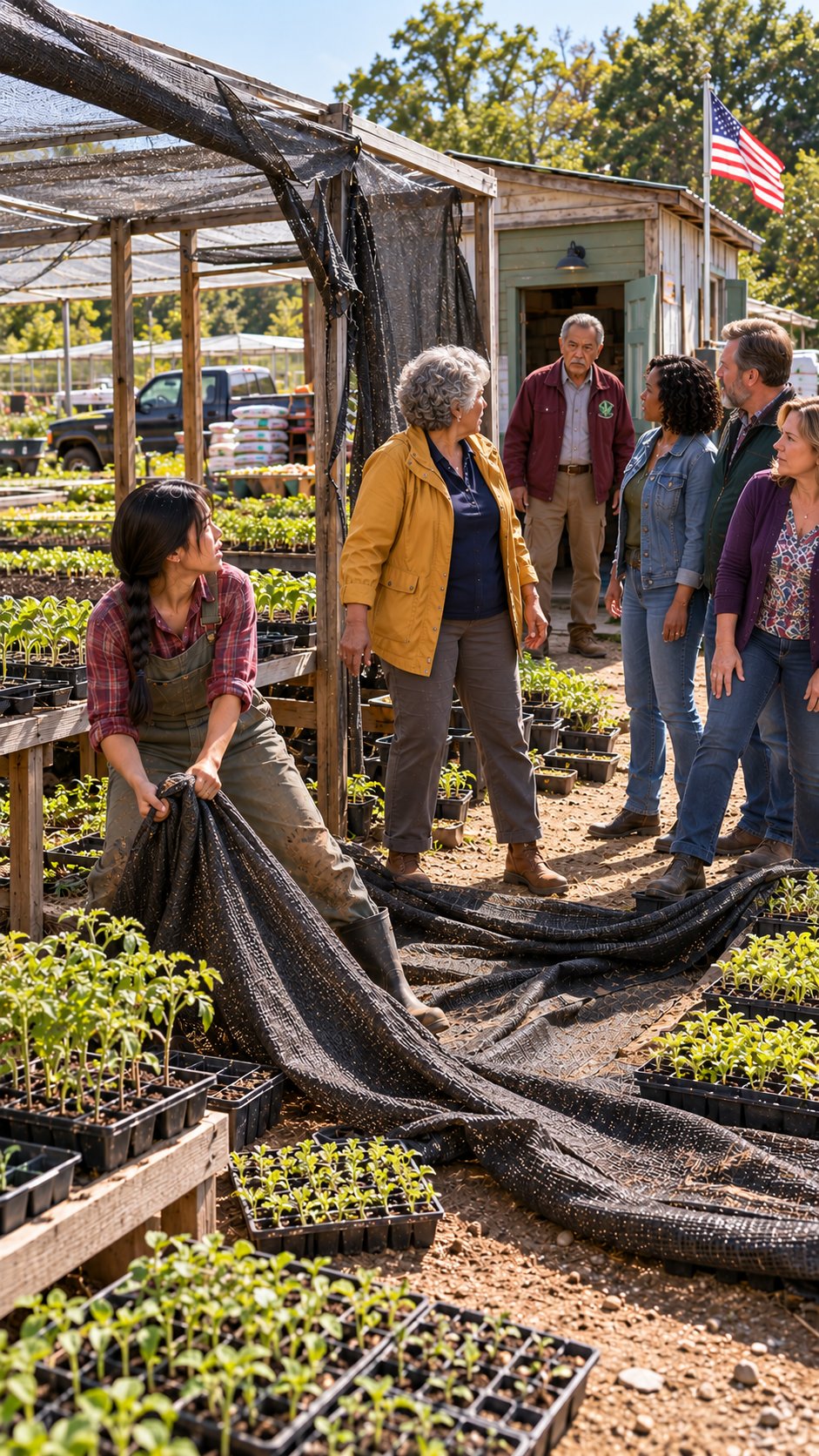
The shade cloth was already tearing when Maya Chen heard the first seedling tray hit the ground.
RRRIP!
She spun around.
“No!”
Three people were standing outside the seedling house.
A fourth was halfway inside.
And Denise Harwood—the newly elected president of the Cedar Hollow Homeowners Association—had both hands wrapped around the edge of the black shade cloth stretched above hundreds of young vegetable seedlings.
Denise yanked again.
RRRIP!
The fabric tore loose from three clips.
A wide section collapsed.
Brilliant Georgia afternoon sunlight poured through the opening.
Rows of tender tomato, pepper, cucumber, squash, basil, lettuce, and flower seedlings that had spent days acclimating beneath filtered light were suddenly exposed.
Maya dropped the watering wand.
“What are you doing?!”
Denise turned.
She was fifty-eight, dressed in a dark mustard field jacket and charcoal pants that looked strangely formal among potting soil and irrigation hoses.
She pointed upward.
“Fixing this.”
“Put it back!”
“Plants need sunlight!”
Behind Denise, one of the neighbors laughed.
Another stepped directly onto the fallen cloth.
His boot pressed it into the damp gravel.
“SHE LEARNED FARMING ONLINE!”
The others laughed.
Maya stared at the boot.
Then at the exposed seedlings.
The laughter disappeared beneath the pounding in her ears.
She crossed the aisle.
Fast.
Grabbed the cloth.
And yanked it from under his foot.
“Get off it.”
The man nearly lost his balance.
“Hey!”
“They're not ready for full sun.”
Denise threw her hands up.
“Oh, listen to the little expert!”
More laughter.
Maya looked toward the nursery office.
The door was closed.
“Grandpa?”
Denise smirked.
“What, you need an adult now?”
Maya didn't answer.
“Grandpa!”
The office door swung open.
A seventy-one-year-old man stepped onto the porch.
Lean.
Weathered.
Silver hair.
Work boots.
Sage-green canvas jacket.
Across the left chest, embroidered in gold thread, were four words:
CHEN FAMILY NURSERY — OWNER
The laughter stopped.
Maya's grandfather looked at the torn shade cloth.
Then at the boot marks.
Then at the exposed seedlings.
Finally, he looked at Denise.
His voice was quiet.
“Who touched my propagation house?”
Nobody answered.
He stepped off the porch.
Denise's smile vanished.
But what she didn't know yet was that the jacket wasn't the real problem.
The real problem was sitting on Grandpa's desk.
A property map.
A folder from the county.
And a letter Denise had already received twice—
telling the HOA that the nursery she had just marched onto wasn't part of Cedar Hollow at all.
Maya Chen was eighteen years old that spring.
Three weeks earlier, she'd graduated from high school.
Most of her classmates were talking about dorm rooms, summer trips, part-time jobs, and which universities had the best freshman housing.
Maya spent her mornings checking soil moisture.
Her afternoons transplanting seedlings.
And her evenings updating a spreadsheet that tracked germination percentages across thirty-six varieties.
She loved it.
That seemed to bother people more than she expected.
The Chen family nursery sat on twelve acres outside Athens, Georgia.
It wasn't a fashionable garden center with polished concrete floors and decorative fountains.
It was a working family nursery.
Gravel lanes.
Weathered greenhouses.
Propagation benches.
Shade structures.
Potting sheds.
Stacks of nursery containers.
A small office built in the 1980s.
A loading area where pickup trucks came and went throughout the week.
Maya's grandfather, Henry Chen, had owned it for thirty-eight years.
Before that, the land had belonged to his uncle.
The nursery sold vegetable starts, herbs, native plants, flowering annuals, small shrubs, and seasonal garden stock.
Some customers came from nearby subdivisions.
Others drove forty minutes.
Several small landscaping companies bought from Henry.
Two independent farm stands purchased vegetable starts each spring.
The business wasn't enormous.
It didn't need to be.
It had survived recessions, droughts, storms, big-box garden centers, rising fertilizer costs, and one spectacularly bad year when a late freeze destroyed nearly half their spring inventory.
Henry was proud of that.
Maya was proud of it too.
She'd grown up there.
At six, she filled pots.
At nine, she learned to identify aphids.
At eleven, she could explain why overwatering killed plants people thought were dying from thirst.
At fourteen, Henry let her manage a small herb bench.
At sixteen, she began handling the nursery's social media page.
At seventeen, she redesigned part of the propagation schedule.
At eighteen, she built the seedling house Denise Harwood decided was proof that a teenager had learned “farming online.”
The funny part?
Maya had learned plenty online.
She'd also learned from agricultural extension publications.
Nursery manuals.
Grower workshops.
Her high-school horticulture teacher.
And approximately eighteen years of following her grandfather around with questions.
Henry had never understood why “learning online” was supposed to be an insult.
“People used to learn from books,” he'd told Maya once.
“Then people who didn't read books complained about that too.”
The seedling house wasn't a greenhouse.
That distinction mattered.
It was a simple open-sided propagation structure.
Wood frame.
Benches.
Irrigation line.
Insect screening where needed.
And adjustable shade cloth across the upper frame.
Maya used it during the hardening process.
Young plants raised under protected conditions couldn't always be moved instantly into intense afternoon sun without stress.
The transition depended on species, growing conditions, weather, and the plants themselves.
Maya didn't treat the shade cloth like a permanent roof.
She adjusted exposure gradually.
Morning sun first.
Longer periods later.
Less protection as the seedlings adapted.
The system wasn't revolutionary.
Commercial growers had been managing light exposure long before Maya was born.
But Denise didn't know that.
More importantly—
she didn't want to know.
Cedar Hollow had been built eight years earlier on former pasture adjoining the nursery's eastern boundary.
The development had 146 homes.
Decorative entrance.
Community pond.
Walking path.
Small clubhouse.
HOA.
When the subdivision was first proposed, Henry worried about it.
Not because he hated neighbors.
Because residential development beside agricultural or nursery operations often created friction.
Noise.
Delivery trucks.
Early morning activity.
Dust.
Odors.
Equipment.
People moved next to working land, then occasionally became surprised that work happened there.
So Henry paid for an updated survey.
He reviewed access rights.
He confirmed boundaries.
He met with the developer.
The developer installed a landscaped buffer along much of the subdivision side.
For several years, things were fine.
Many Cedar Hollow residents became customers.
Henry donated plants for the clubhouse beds once.
Maya helped a group of neighborhood children plant pollinator flowers.
The nursery and the subdivision coexisted.
Then Denise Harwood became HOA president.
Denise had lived in Cedar Hollow for three years.
She'd moved from an Atlanta suburb after her husband retired.
She liked rules.
Not in the ordinary way.
Rules can be useful.
Denise liked the authority she believed rules gave her.
Within two months of joining the HOA board, she'd complained about basketball hoops.
Work trailers.
Garbage cans visible from the street.
A child's treehouse.
A resident's native meadow garden.
Some complaints were legitimate covenant questions.
Others were interpretations Denise presented as established law.
By the time she became president, she'd developed a habit.
If Denise disliked something, she started by calling it a violation.
Then she looked for a rule afterward.
Most homeowners didn't challenge her.
A warning email wasn't worth spending a Saturday arguing about.
That taught Denise the wrong lesson.
She began confusing compliance with correctness.
Then she turned her attention toward the nursery.
The first complaint involved a delivery truck.
A box truck entered the nursery at 7:12 one morning.
Denise emailed Henry.
COMMERCIAL VEHICLE ACTIVITY IS PROHIBITED BEFORE 8:00 A.M. UNDER CEDAR HOLLOW COMMUNITY STANDARDS.
Henry read it.
Then handed his phone to Maya.
She read it twice.
“Grandpa?”
“Yes?”
“We aren't in Cedar Hollow.”
“I know.”
“Then why is she sending this?”
Henry took the phone back.
“Because email is free.”
He replied politely.
Chen Family Nursery is located on a separate parcel outside the Cedar Hollow HOA and is not subject to Cedar Hollow's private covenants. Please direct any questions concerning county ordinances to the appropriate county department.
Denise responded twelve minutes later.
YOUR BUSINESS DIRECTLY IMPACTS OUR COMMUNITY.
Henry didn't answer.
Maya asked:
“That's it?”
“That's it.”
“You're not going to explain?”
“I already did.”
“She doesn't understand.”
Henry smiled.
“Understanding and accepting are different jobs.”
The second complaint involved irrigation runoff after a thunderstorm.
Denise photographed water near the subdivision drainage area and accused the nursery of “illegal discharge.”
Henry contacted the county.
A staff member inspected.
The water was storm runoff moving through the existing drainage pattern.
No violation attributed to the nursery was found.
Denise didn't apologize.
The third complaint involved stacks of empty nursery pots visible through the buffer.
The fourth involved a tractor.
The fifth involved a temporary row cover.
Then came the seedling house.
Maya built it partly as a graduation project for herself.
She wanted a more organized hardening area.
Henry gave her a section behind the main greenhouse.
“Your project,” he said.
“Your budget.”
“How much?”
He named a number.
Maya stared.
“That's it?”
“You want more money?”
“Yes.”
“No.”
“Why?”
“Because needing to think is free.”
She hated that answer.
Later, she admitted it was useful.
She reused lumber.
Bought hardware carefully.
Compared shade materials.
Designed removable sections.
Added simple labels to each bench.
She spent almost three weeks building it.
When finished, it wasn't beautiful.
It was functional.
Henry walked through.
Pressed one support.
Checked the fasteners.
Looked at the irrigation.
Then said:
“Not bad.”
From Henry, that was practically a standing ovation.
Maya grinned.
“Not bad?”
“Would you prefer I lie?”
“You could say excellent.”
“Build the next one better.”
Then he walked away.
Maya smiled for the rest of the afternoon.
Denise noticed the structure two days later.
She was walking along the subdivision path with Linda Foster, Bruce Keller, and Patricia Monroe.
The three became her unofficial enforcement committee.
None actually held a position authorizing them to enter neighboring private property.
That detail would become important.
Linda was sixty-one and loved neighborhood gossip.
Bruce was fifty-four and had a habit of treating confidence as expertise.
Patricia was forty-seven and usually followed the strongest personality in whatever group she occupied.
From the path, they could see the upper section of Maya's seedling house through a break in the landscape buffer.
Denise stopped.
“What is that?”
Bruce squinted.
“Greenhouse?”
Linda said:
“Looks homemade.”
Denise took a photograph.
By dinner, Henry had another email.
UNAPPROVED AGRICULTURAL STRUCTURE VISIBLE FROM CEDAR HOLLOW COMMON AREA.
Maya read it over his shoulder.
“Unapproved by who?”
“Apparently Denise.”
“Can she do anything?”
“No.”
“Then tell her.”
“I did.”
Henry replied with the parcel information again.
This time he attached a boundary exhibit.
He also copied the HOA's professional management company.
The property manager responded the next morning.
Her email was careful.
Our records do not indicate that the Chen Family Nursery parcel is subject to the Cedar Hollow declaration. HOA architectural standards therefore do not appear applicable to structures located on that parcel.
Maya thought that would end it.
Henry didn't.
“You think she's coming back?”
“Yes.”
“Why?”
“She didn't ask whether she was wrong.”
“What did she ask?”
“How to make us comply.”
Maya frowned.
Henry returned to his paperwork.
“People tell you what they want by the questions they refuse to ask.”
A week later, Denise appeared at the nursery office.
Maya was transplanting peppers.
Henry was speaking with a supplier.
Denise walked inside without an appointment.
She placed printed photographs on the counter.
The seedling house.
Shade cloth.
Benches.
“I'm giving you one opportunity to remove it voluntarily.”
Henry looked at the photographs.
Then at Denise.
“From my property?”
“It is visible from ours.”
“So are your houses.”
Denise blinked.
Henry continued.
“I haven't asked you to remove those.”
“This isn't funny.”
“I agree.”
“You're operating a commercial agricultural facility beside a residential neighborhood.”
“I was operating it before the neighborhood existed.”
“Things change.”
“Property lines haven't.”
Denise leaned forward.
“We have appearance standards.”
“You do.”
“That structure violates them.”
“Then don't build one inside your HOA.”
Maya looked down to hide a smile.
Denise noticed.
“You think this is funny?”
Maya shook her head.
“No.”
“Young lady, adults are discussing property issues.”
Henry's expression changed.
Not much.
Enough.
“Maya works here.”
Denise waved toward her.
“She's a teenager.”
“She built the structure you're complaining about.”
Denise laughed.
That was the first time.
“Oh.”
She looked at Maya.
“That explains it.”
Maya's face warmed.
Henry said:
“Explains what?”
“The construction.”
Henry stood very still.
Denise apparently realized she'd gone too far.
She gathered the photographs.
“You'll receive formal notice.”
Henry said:
“From whom?”
“The HOA.”
“Send whatever you like.”
She left.
Maya waited until the door closed.
Then:
“I hate her.”
Henry returned to the supplier invoice.
“No, you don't.”
“I strongly dislike her.”
“Better.”
“She insulted my seedling house.”
“That is not a criminal offense.”
“Should be.”
Henry almost smiled.
The formal notice arrived four days later.
It demanded removal of the “unapproved shade structure” within ten days.
Henry forwarded it to the management company.
The manager called him.
She sounded embarrassed.
“Mr. Chen, I want to clarify that this letter did not come through our office.”
“I assumed.”
“We have advised the board president that your parcel is outside the association.”
“I appreciate that.”
“She believes there may be some historic restriction.”
“If she finds one, she can send it to me.”
“We've asked her not to contact you using HOA enforcement language until the board's counsel reviews the matter.”
Henry thanked her.
Then printed the email.
Maya watched him put it into a folder.
“What folder is that?”
“Denise.”
“You have a Denise folder?”
“I have folders for anything that wastes enough time.”
Maya laughed.
The folder already contained the survey.
Parcel map.
Management emails.
County correspondence.
Photographs.
Copies of Denise's notices.
Henry wasn't preparing for war.
He was doing what he'd always done when paperwork began multiplying.
Keeping records.
That habit would matter.
The afternoon Denise ripped down the shade cloth was hot.
Not record-breaking.
Just the kind of late-May Georgia afternoon where the sunlight felt hard.
Maya had spent the morning moving selected trays into longer exposure.
Other trays remained under partial shade.
The youngest pepper starts were particularly vulnerable to abrupt stress.
She planned to increase their direct exposure over several days.
At 2:36 p.m., she went to the supply shed for labels.
When she returned, Denise and the three neighbors were inside the nursery property.
Not customers.
Not near the retail section.
They'd entered through a service-side opening adjacent to the buffer.
Maya saw Denise first.
“What are you doing here?”
Denise ignored her.
She pointed toward the seedling house.
“There.”
Bruce laughed.
“That thing?”
Linda said:
“She built all this?”
Patricia held up her phone.
Maya walked faster.
“You need to go to the front office.”
Denise grabbed the shade cloth.
“Plants need sunlight.”
Maya's stomach dropped.
“Don't touch that.”
Denise pulled.
The first clip popped.
Maya ran.
“STOP!”
RRRIP!
Then came the laughter.
Bruce's boot.
The insult.
“SHE LEARNED FARMING ONLINE!”
Maya yanked the cloth free.
“They're not ready for full sun.”
Denise pointed at her.
“LISTEN TO THE LITTLE EXPERT!”
Maya could have screamed.
Instead, she looked toward the office.
“Grandpa?”
The door opened.
And Henry Chen stepped outside wearing the nursery jacket he'd owned for nearly fifteen years.
Henry didn't raise his voice.
That disappointed Denise.
People who arrive prepared for confrontation often don't know what to do with calm.
He walked toward the seedling house.
Maya said:
“She ripped it down.”
Henry looked at the torn clips.
“Anybody hurt?”
“No.”
“Plants?”
“Some trays got knocked.”
“Move the youngest ones first.”
Maya immediately began lifting trays.
Henry looked at Denise.
“You need to leave.”
Denise recovered.
“We're here representing Cedar Hollow.”
“No.”
Her eyebrows rose.
“Excuse me?”
“You are standing on Chen Family Nursery property. You were not invited into this production area. You damaged nursery equipment. Leave.”
Bruce stepped forward.
“We didn't damage anything.”
Maya held up the torn cloth.
Bruce looked at his boot mark.
Henry said:
“I wasn't speaking to Maya.”
Bruce stepped back.
Denise pointed toward the structure.
“This is a noncompliant installation.”
“With what?”
“Our community standards.”
“Your community ends at the property line.”
“Your operation affects our property values.”
“That's a different argument.”
Denise folded her arms.
“So you admit it.”
Henry looked genuinely confused.
“Admit what?”
“That this structure affects us.”
“I admit you can see it.”
Linda whispered something to Patricia.
Henry continued.
“Visibility doesn't create ownership.”
Denise's face hardened.
“You don't get to ignore an entire neighborhood.”
Henry looked around.
“I see four people.”
Bruce muttered:
“Smart-ass.”
Henry heard him.
So did Maya.
She expected Grandpa to react.
He didn't.
Instead, he took out his phone.
“I'm asking you once more to leave.”
Denise laughed.
“Or what?”
“I document that you refused.”
That answer wasn't exciting.
It was effective.
Patricia lowered her phone.
“Denise, maybe we should go.”
Denise turned.
“We're not going anywhere until he agrees to remove this.”
Henry looked at Patricia.
“Were you told you had permission to enter this property?”
Patricia hesitated.
Denise answered for her.
“We don't need permission.”
Henry looked back at Patricia.
“I asked you.”
She swallowed.
“I thought this was part of the buffer.”
“It isn't.”
Bruce said:
“How are we supposed to know where the line is?”
Henry pointed toward a survey pin several feet behind them.
“That's one clue.”
Maya almost laughed.
Denise looked down.
A capped survey marker was visible near the edge of the gravel.
Henry said:
“Your subdivision is east of that line.”
They were west.
Inside the nursery.
Denise said:
“That doesn't mean anything without a survey.”
Henry nodded.
“Correct.”
Then he looked toward the office.
“I have one.”
For the first time, Denise stopped talking.
Henry didn't bring the survey outside.
He didn't need to.
He asked them to leave again.
Patricia went first.
Then Linda.
Bruce hesitated.
Denise remained.
Maya had already re-covered the most sensitive seedlings with an undamaged spare section of cloth.
She could hear Denise arguing.
“We've sent notices.”
“Yes.”
“You ignored them.”
“I answered every one.”
“You refused compliance.”
“Because you have no covenant authority over this parcel.”
“We'll see.”
“We already have.”
Denise stepped closer.
“You think because you've been here longer, you can do whatever you want?”
Henry looked at her.
“No.”
The answer surprised her.
“I follow county requirements. State requirements where applicable. Business requirements. Tax rules. Nursery regulations. Employment rules. Whatever legally applies to this operation.”
He pointed toward the subdivision.
“What I don't follow are private covenants attached to property I don't own and never agreed to.”
Denise opened her mouth.
Henry continued.
“Those aren't the same thing.”
That distinction became the center of everything that followed.
Eventually Denise left.
Not gracefully.
She told Henry:
“This isn't over.”
He replied:
“I hope it is.”
Then he turned away.
That irritated her more than any insult could have.
Maya waited until the group disappeared beyond the service lane.
Then she dropped onto an overturned pot.
Her hands were shaking.
Henry noticed.
“You okay?”
“I'm furious.”
“That's not what I asked.”
Maya looked at the seedlings.
“I think so.”
“Then check plants.”
“What about them?”
“They're leaving.”
“She damaged our stuff!”
“Yes.”
“She walked in here and—”
“I know.”
“Aren't you angry?”
Henry looked at the torn cloth.
“Yes.”
“You don't look angry.”
“Looking angry won't repair it.”
That was Grandpa.
Maya sometimes found his calm infuriating.
Years later, she'd understand how much discipline it required.
They spent the next hour assessing damage.
Most seedlings were fine.
The exposure had been brief.
A few trays had tipped.
Several stems broke.
One flat of young peppers showed stress later.
The shade cloth itself had torn near attachment points.
Several clips needed replacement.
The monetary damage wasn't enormous.
That almost made Maya angrier.
Denise had behaved as if small damage didn't count.
Henry photographed everything.
Wide shots.
Close-ups.
Footprints.
Torn fasteners.
Disturbed trays.
The route the group had taken onto the property.
Then he downloaded footage from the nursery's exterior cameras.
Maya stared.
“We have a camera on the seedling house?”
“Office corner.”
“You never told me.”
“You installed the Wi-Fi extender under it.”
“Oh.”
She'd never noticed.
The video captured Denise entering.
Captured Maya telling them to go to the office.
Captured Denise pulling the cloth.
Captured Bruce stepping on it.
Captured the laughter.
And captured Henry asking them to leave repeatedly.
Maya watched once.
Then said:
“Send it everywhere.”
Henry looked at her.
“No.”
“Why?”
“Because we're not twelve.”
“She posted about us!”
“Has she?”
Maya opened her phone.
She'd received a screenshot from a friend living in Cedar Hollow.
Denise had posted in a neighborhood group.
HOA BOARD INVESTIGATES UNSIGHTLY COMMERCIAL STRUCTURE ALONG COMMUNITY BORDER.
Below it was a photograph of Maya's seedling house.
Comments had begun.
Some supported Denise.
Others asked why the HOA was involved with property outside the neighborhood.
One resident wrote:
Isn't that the Chen nursery? They were there before our subdivision.
Another:
My tomatoes came from there. What's the issue?
Denise replied:
PROPERTY VALUES AND COMMUNITY STANDARDS AFFECT EVERYONE.
Maya handed Henry the phone.
He read it.
Then returned it.
“Still don't send the video.”
“Why?”
“Because we're going to handle the actual problem first.”
Henry contacted the county sheriff's office through the appropriate non-emergency channel to document the property entry and damage.
He didn't demand arrests.
Didn't announce that Denise was “going to jail.”
He provided information.
Footage.
Property documentation.
Damage photographs.
He also notified the HOA management company.
This time he attached still images.
The property manager called within thirty minutes.
Her tone had changed.
“Mr. Chen, did board members enter your property?”
“Ms. Harwood did. Three residents accompanied her.”
“Were they authorized by you?”
“No.”
“Did she damage the structure?”
“The video shows her pulling the shade cloth down after Maya told them to go to the office.”
Silence.
Then:
“Please send me the complete video.”
Henry did.
Not the edited fifteen-second portion.
The complete relevant recording.
That decision mattered.
Context protected everyone.
It showed exactly what Maya said.
Exactly what Denise did.
Exactly what Bruce did.
Exactly what Henry requested.
No dramatic edits.
No music.
No captions.
Just events.
That evening, Maya sat on the office porch eating takeout noodles.
Henry was beside her.
The seedling house had been temporarily repaired.
Golden evening light reached across the nursery.
Maya said:
“I wanted her to feel stupid.”
Henry looked at her.
“Who?”
“You know who.”
“I prefer nouns.”
“Denise.”
“Okay.”
“When you came outside, I wanted you to destroy her.”
Henry nearly choked on a noodle.
“Destroy?”
“Not literally.”
“Good clarification.”
“You know what I mean.”
“I do.”
“She laughed at me.”
“Yes.”
“They all did.”
“Yes.”
“And then you walked out and she stopped.”
Henry nodded.
Maya looked at his jacket.
“I thought it was because she realized you're the owner.”
“Partly.”
“She thought I was just some kid messing around.”
“Probably.”
“I hate that.”
Henry set down his container.
“Then don't build your life around changing the minds of people who enjoy underestimating you.”
Maya looked at him.
“That sounds like something from a motivational poster.”
“I'll deny saying it.”
She smiled.
Then Henry added:
“Also, you are some kid messing around.”
Maya stared.
“What?”
He pointed toward the seedling house.
“That's how you learn.”
She laughed.
“You're terrible.”
“Experimentation isn't an insult.”
He looked toward the repaired cloth.
“You built something. You'll find mistakes. You'll improve it. That's the job.”
That changed the way Maya remembered the laughter.
Not immediately.
Eventually.
The HOA board held an emergency meeting three days later.
Henry wasn't there.
Neither was Maya.
They weren't HOA members.
The management company provided the board with the parcel documentation and video.
Several board members had apparently not known Denise had been sending notices directly.
One had assumed the nursery was somehow included in the association.
Another had questioned that assumption months earlier.
The association's counsel had already advised that the nursery parcel did not appear subject to the declaration.
That advice had not stopped Denise.
Now the issue was no longer merely an overzealous letter.
A board president had entered neighboring property while invoking HOA authority and physically interfered with a structure.
That created risk for the association.
The board understood risk.
Risk has a remarkable ability to make vague governance questions suddenly become specific.
The management company sent Henry a written statement several days later.
It clarified that Cedar Hollow did not claim covenant enforcement authority over the Chen nursery parcel.
It stated that board representatives were not authorized to enter the nursery to perform enforcement activity.
And it requested that future concerns involving the nursery be directed through management or appropriate public authorities rather than unilateral action.
Henry printed it.
Added it to the Denise folder.
Maya said:
“That's all?”
“What do you want?”
“A parade.”
“For us?”
“For her leaving us alone.”
“Expensive.”
“Fine. Cupcakes.”
Henry considered.
“Possible.”
But Denise didn't disappear.
She changed tactics.
She stopped claiming the seedling house directly violated Cedar Hollow architectural rules.
Instead, she began arguing the nursery itself created a nuisance.
Traffic.
Noise.
Appearance.
Chemical use.
Water.
Anything she could name.
Some concerns were legitimate topics neighbors could raise.
A business near homes should operate responsibly.
Henry agreed.
So he responded with records.
Delivery schedules.
County requirements.
Pesticide application logs where applicable.
Drainage information.
Operating hours.
He invited the relevant public officials to inspect if necessary.
What he didn't do was accept Denise as the authority deciding those questions.
That frustrated her.
Maya asked:
“Why don't you just tell her to get lost?”
“Because some of the people reading her emails aren't Denise.”
That was another Henry lesson.
Never write only for the person arguing with you.
Write for the person who may read the argument later.
Management.
Board members.
County staff.
Insurance representatives.
Neighbors.
A judge, if something ever became serious enough.
Calm records traveled better than angry speeches.
Meanwhile, the seedlings grew.
That mattered more to Maya.
The peppers recovered.
Tomatoes hardened beautifully.
Cucumbers moved quickly.
Basil needed more careful adjustment.
One tray of flowers developed leaf scorch after Maya increased exposure too fast.
She photographed it.
Recorded the timing.
Changed the schedule.
Henry saw the damaged leaves.
“Internet fail?”
Maya glared.
“Very funny.”
“Little expert.”
“Grandpa.”
He laughed.
The insult that had embarrassed her became a joke between them.
But Maya did something important.
She didn't pretend every decision she'd made was perfect just because Denise had been wrong to interfere.
The seedling house had flaws.
Airflow in one section wasn't ideal.
One support needed bracing.
The cloth attachment system was too easy to pull loose.
The irrigation layout created uneven moisture at the far bench.
Maya improved all of it.
Because proving Denise wrong wasn't the same as proving Maya right about everything.
Henry was especially proud of that.
He didn't tell her immediately.
Grandfathers like Henry ration praise as if supply-chain disruptions might affect it.
Two weeks after the incident, Bruce Keller came to the nursery.
Alone.
Maya saw his truck enter the customer lot.
Her stomach tightened.
He walked toward the office.
No Denise.
No Linda.
No Patricia.
Henry was unloading potting mix.
Bruce stopped.
“Mr. Chen?”
Henry looked up.
“Bruce.”
“I wanted to talk.”
Henry waited.
Bruce glanced toward Maya.
Then at the ground.
“I shouldn't have stepped on the cloth.”
Maya said nothing.
“I thought Denise knew what she was doing.”
Henry replied:
“That doesn't explain your boot.”
Bruce nodded.
“No.”
Good answer.
He turned toward Maya.
“And the online comment was stupid.”
Maya folded her arms.
“Why?”
Bruce seemed surprised.
“What?”
“Why was it stupid?”
He thought.
“Because I don't know anything about growing seedlings.”
“That's part of it.”
He almost smiled.
“What else?”
“Because learning online isn't automatically bad.”
Bruce nodded.
“Fair.”
Maya continued.
“I use extension publications online. University resources. Grower forums. Research. Grandpa watches equipment repair videos online.”
Henry said:
“Do not involve me.”
Maya ignored him.
“The internet isn't one source.”
Bruce laughed awkwardly.
“Okay. Point taken.”
Then he handed Henry an envelope.
Money for replacement shade cloth.
Henry looked at it.
“We didn't ask you for this.”
“I stepped on it.”
“Denise pulled it.”
“I stepped on it.”
Henry accepted the envelope.
“Thank you.”
Bruce left.
Maya watched his truck disappear.
“Do you forgive him?”
Henry asked.
“I don't know.”
“You don't need to decide today.”
Patricia came next.
Not to apologize.
To buy tomato plants.
Maya almost couldn't believe it.
Patricia pushed a cart toward the vegetable section wearing sunglasses large enough to suggest she hoped invisibility might be possible.
Maya was labeling Cherokee Purple tomatoes.
Patricia stopped.
“Hi.”
“Hi.”
Long silence.
Then Patricia said:
“I need six tomatoes.”
“What kind?”
“I don't know.”
Maya looked at her.
Patricia removed her sunglasses.
“Look, I'm embarrassed.”
Maya waited.
“I shouldn't have gone with Denise.”
“Why did you?”
“I thought she had permission.”
“Then why did you laugh?”
Patricia's face reddened.
That question was harder.
“I don't know.”
Maya did.
Group laughter is cheap.
Sometimes people spend it without asking what they're buying.
Patricia finally said:
“Because everybody else did.”
Maya nodded.
At least it was honest.
Then she helped Patricia choose tomatoes.
Not because they were suddenly friends.
Because Maya was working.
Patricia bought six plants.
Before leaving, she said:
“Your setup actually looks really good.”
Maya replied:
“It looked good before.”
Patricia winced.
“Yeah.”
Then left.
Henry had overheard from the next aisle.
He said:
“That was unnecessary.”
Maya smiled.
“Was it inaccurate?”
Henry returned to watering.
“No.”
Linda never apologized directly.
She simply stopped participating in Denise's visits.
Months later, she began shopping at the nursery again.
Maya didn't confront her.
Not every conflict ends with a speech.
Sometimes people retreat through ordinary behavior because admitting they were wrong feels harder than quietly changing sides.
Maya learned to recognize that too.
Denise remained the difficult one.
She insisted the board had undermined her.
At one meeting, according to residents who later spoke with Henry, she argued that Cedar Hollow needed stronger influence over neighboring parcels.
A board member reportedly asked:
“Influence isn't the same as jurisdiction, correct?”
Denise didn't appreciate the question.
The board revised procedures.
Individual board members could not issue enforcement notices independently using association letterhead.
Property-status questions had to be verified through management.
Interactions with non-HOA parcels had to be handled through appropriate channels.
Those changes weren't dramatic punishment.
They were better.
Systems shouldn't depend on every future board president being reasonable.
Good governance builds barriers against unreasonable behavior.
Henry liked that outcome more than a public humiliation.
Maya initially didn't.
She wanted Denise removed.
Henry said:
“Maybe she will be.”
“Don't you?”
“I want the problem fixed.”
“She's the problem.”
“She's one problem.”
He tapped the new policy.
“This prevents the next person from repeating it as easily.”
Maya understood eventually.
Summer arrived.
The seedling house emptied.
Most spring plants had been sold or transplanted.
Maya began using sections for later starts and propagation experiments.
She changed the cloth system.
Instead of long vulnerable runs attached only by clips, she added reinforced edges and better attachment points.
Bruce's payment covered part of the materials.
Henry contributed nothing extra.
Maya complained.
“You own the nursery.”
“You own the project budget.”
“You're impossible.”
“Still true.”
She also added a small sign.
Not aimed at Denise.
At least that's what she claimed.
HARDENING AREA — AUTHORIZED STAFF ONLY
Henry read it.
Then looked at Maya.
“Subtle.”
“Safety signage.”
“Of course.”
In August, a local gardening club visited.
Twenty-two people toured the nursery.
Henry made Maya explain the seedling house.
She tried to refuse.
“It's August. There aren't many seedlings.”
“Use photographs.”
“I hate presentations.”
“Useful information.”
“How?”
“You're starting college next month.”
“So?”
“People there may also expect you to speak.”
“I can transfer.”
Henry walked away.
Maya gave the presentation.
She explained the structure.
The mistakes.
The improvements.
The hardening process.
Someone asked where she learned to build it.
Maya smiled.
“Some from my grandfather.”
Henry stood in the back.
“Some from school.”
Then:
“And a lot online.”
Several people laughed.
Maya laughed too.
Different laughter.
That distinction mattered.
She attended the University of Georgia that fall.
Agricultural engineering.
She lived close enough to work at the nursery some weekends.
Henry pretended not to be thrilled.
Her first semester was difficult.
Calculus didn't care that she'd grown up around plants.
Physics didn't care that customers liked her tomatoes.
She called Henry one night.
“I think I'm stupid.”
“Possible.”
“Grandpa.”
“What happened?”
She explained an exam.
He listened.
Then said:
“You remember the basil?”
“What basil?”
“Seedling house. First summer.”
“The scorched tray?”
“Yes.”
“What about it?”
“You gave too much light too quickly.”
“Thanks for reminding me.”
“Did you quit growing basil?”
“No.”
“Then why would one exam end engineering?”
Maya hated when his analogies worked.
The nursery conflict faded.
But not completely.
Denise lost the HOA presidency at the next election.
Maya wasn't involved.
Neither was Henry.
Cedar Hollow homeowners made their own choice.
A different board president took over.
One of his first actions was to visit Henry.
Through the front entrance.
During business hours.
He bought two blueberry plants.
Then said:
“I'd like the neighborhood and nursery to have a better relationship.”
Henry replied:
“So would I.”
They discussed practical issues.
Delivery traffic near school-bus hours.
Landscape buffer maintenance.
A shared concern about stormwater along one edge.
Actual neighboring-property questions.
Not imaginary HOA authority.
They disagreed on one drainage issue.
Then contacted the county for clarification.
No shouting.
No ripped cloth.
No enforcement theater.
Maya found the whole thing almost boring.
Henry said:
“Good.”
“Good?”
“Boring is underrated.”
The following spring, something unexpected happened.
Cedar Hollow invited the nursery to participate in a community gardening workshop.
Henry declined.
Then volunteered Maya.
She stared at him.
“You're joking.”
“No.”
“I have class.”
“Saturday.”
“I have studying.”
“Sunday exists.”
“You're punishing me for something.”
“Probably.”
She went.
Thirty residents attended.
Bruce was there.
Patricia too.
Linda sat in the second row.
Denise did not attend.
Maya taught seed starting.
Containers.
Light.
Water.
Hardening.
A woman raised her hand.
“Why can't seedlings just go directly into full sun?”
Maya stopped.
Bruce covered his mouth.
Patricia looked down.
Linda suddenly became fascinated by her notebook.
Maya could have made the moment cruel.
She didn't.
She explained.
Plants raised under protected conditions can need gradual acclimation to stronger light, wind, and outdoor conditions.
Different plants respond differently.
Timing matters.
Environment matters.
The goal is to reduce stress while preparing them for permanent outdoor growth.
The woman nodded.
“Makes sense.”
Maya moved on.
Afterward, Bruce approached.
“You didn't do it.”
“Do what?”
“Say ‘plants need sunlight’ in Denise's voice.”
Maya laughed.
“I thought about it.”
“I knew it.”
Then Bruce became serious.
“I really was an idiot that day.”
Maya shrugged.
“You were following someone.”
“That doesn't make it better.”
“No.”
He nodded.
“Your grandfather said something to me later.”
“What?”
“He said people become dangerous in groups when they borrow certainty from each other.”
Maya looked toward Henry across the clubhouse.
“That sounds annoyingly like him.”
“Yeah.”
Bruce smiled.
“He also said I owed you an apology.”
“You already apologized.”
“He said the first one was bad.”
Maya laughed.
“That definitely sounds like him.”
Denise returned to the nursery almost a year after the incident.
Alone.
Maya was home for spring break.
She saw Denise's car and immediately felt the old anger.
Henry was in the greenhouse.
Maya could have called him.
Instead, she waited behind the counter.
Denise entered.
No HOA jacket.
No folder.
No neighbors.
“Hello.”
Maya said:
“Hi.”
Denise looked around.
“Is your grandfather here?”
“Yes.”
“Can I speak with him?”
“I'll get him.”
Maya turned.
Then Denise said:
“Actually…”
Maya stopped.
Denise looked uncomfortable.
“I can speak to you first.”
Maya waited.
Denise glanced toward the propagation area.
“I owe you an apology.”
Maya hadn't expected that.
“For what?”
Denise looked surprised.
Apparently she expected Maya to make this easier.
Maya didn't.
“For entering the nursery.”
“And?”
“For interfering with the shade cloth.”
“And?”
Denise exhaled.
“For laughing.”
Maya said nothing.
“And for speaking to you the way I did.”
Maya waited.
Denise added:
“I thought you didn't know what you were doing.”
“I know.”
“I was wrong.”
Maya's anger didn't disappear.
An apology isn't a magic eraser.
But something inside her loosened.
Then Denise made a mistake.
“I was only trying to protect the neighborhood.”
Maya's expression changed.
Denise stopped herself.
“No.”
She shook her head.
“That's an excuse.”
Maya remained quiet.
Denise tried again.
“I believed I was protecting the neighborhood. But I didn't have the authority to do what I did.”
Better.
“And I shouldn't have treated you like you were stupid because you're young.”
Maya nodded.
“Okay.”
Denise looked almost disappointed.
Maybe she'd expected forgiveness.
Maya didn't offer it.
Then she remembered what Henry had taught her.
An apology didn't require immediate absolution.
“Thank you for saying it.”
That was what she could honestly give.
Denise accepted it.
Henry appeared from the greenhouse five minutes later.
He saw Denise.
Stopped.
Then walked over.
“Denise.”
“Henry.”
She apologized to him too.
Shorter.
He listened.
Then said:
“Thank you.”
Maya almost laughed.
After Denise left, she turned to him.
“That's it?”
“What?”
“Thank you?”
“She apologized.”
“Do you forgive her?”
Henry picked up a clipboard.
“You ask that question too often.”
“Because you never answer.”
“Forgiveness isn't a receipt I need to print.”
Maya groaned.
“Another Grandpa quote.”
“Don't post it online.”
“I'm absolutely posting it online.”
Two years later, Henry injured his knee.
Not dramatically.
He stepped wrong while unloading a cart.
The injury wasn't catastrophic, but recovery was slow.
For the first time in Maya's life, Grandpa couldn't move through the nursery the way he wanted.
He hated it.
He sat in the office giving instructions nobody had requested.
“Those petunias need moving.”
“They're fine.”
“Too much afternoon heat.”
“Grandpa.”
“And check greenhouse three.”
“I checked it.”
“When?”
“Ten minutes ago.”
“Could've changed.”
“In ten minutes?”
“Plants are alive.”
Maya stared at him.
“I'm going back to college early.”
“You'll miss me.”
“Impossible.”
But seeing him limited frightened her.
The nursery had always seemed inseparable from Henry.
What happened when he couldn't run it?
For the first time, Maya considered the business as something that might one day need to exist without him.
That changed her plans.
She began taking more business courses.
Operations.
Accounting.
Small-business management.
She worked summers full-time.
Modernized inventory tracking.
Improved online ordering.
Helped Henry negotiate with suppliers.
Expanded native plant offerings.
Rebuilt propagation systems.
The seedling house evolved again.
Version three had better airflow.
Retractable shade sections.
Improved bench spacing.
More durable hardware.
A small environmental sensor system.
Henry inspected it.
“Too expensive.”
“Efficient.”
“Expensive.”
“You're old.”
“Still owner.”
“For now.”
Henry looked at her.
Maya froze.
She hadn't meant it like that.
Then Henry smiled.
“Good.”
“What?”
“You're finally thinking like someone who might have to own it.”
That sentence stayed with her.
By the time Maya was twenty-three, she had completed her degree.
She received an offer from a large agricultural systems company.
Good salary.
Benefits.
Career path.
She accepted.
Henry didn't argue.
That surprised her.
“You want me to leave?”
“Yes.”
“Wow.”
“Go learn how somebody else makes mistakes.”
She laughed.
“What about the nursery?”
“It survived before you.”
“Harsh.”
“It should survive without you too.”
So Maya left.
Not forever.
For three years.
She worked on controlled-environment systems.
Visited commercial growers.
Learned logistics.
Automation.
Irrigation design.
Production planning.
And discovered that Grandpa had been right.
Everybody made mistakes.
Just with larger budgets.
Henry turned seventy-seven.
His knee worsened.
He hired more help.
Then one winter, he called Maya.
Not dramatic.
“Thinking about selling.”
Maya stopped walking.
“What?”
“Nursery.”
“To who?”
“Don't know.”
“Why?”
“I'm tired.”
She'd never heard him say that.
Henry Chen did not admit fatigue.
Maya flew home the next weekend.
They sat in the same office where the Denise folder still existed in a filing cabinet.
“You really want to sell?”
Henry looked through the window.
“I want the choice.”
That was different.
Maya understood.
“What if I wanted it?”
Henry looked at her.
“You have a job.”
“I know.”
“Good job.”
“I know.”
“Benefits.”
“Grandpa.”
“What?”
“What if I wanted the nursery?”
Henry studied her.
Then:
“Don't take it because you're afraid I'll sell.”
“I'm not.”
“Don't take it because it's family.”
“I'm not.”
“Don't take it because you think you owe me.”
“I don't.”
“Good.”
He leaned back.
“Then write a plan.”
Maya laughed.
“You're serious?”
“Business doesn't run on sentimental speeches.”
There it was.
Grandpa.
Maya spent four months building the plan.
Not a fantasy.
Revenue.
Expenses.
Staffing.
Debt.
Capital improvements.
Product mix.
Retail versus wholesale.
Online sales.
Seasonality.
Risk.
She proposed buying the business gradually.
Henry would retain ownership of part of the land initially.
A lawyer structured the agreements.
An accountant reviewed the numbers.
Nobody handed Maya a nursery because she was the granddaughter.
That mattered to her.
She wanted the responsibility to be real.
The transition took time.
Years.
Henry reduced his role.
Maya increased hers.
Eventually the jacket changed hands.
Not literally.
Henry's old green owner jacket was worn through at the elbows.
Maya bought her own.
Same embroidery.
CHEN FAMILY NURSERY — OWNER
The first morning she wore it, Henry stared.
“Pretentious.”
“You had one.”
“Different.”
“How?”
“I looked good.”
Maya laughed.
Cedar Hollow had changed too.
Children became teenagers.
Original homeowners moved.
New families arrived.
The landscaped buffer matured.
The HOA board turned over several times.
Most residents knew the nursery as a neighbor, not an enemy.
Some had no idea there had ever been a conflict.
That pleased Maya.
A business shouldn't need permanent drama to stay relevant.
Then, one April afternoon, a group of high-school students toured the nursery.
Maya led them toward the propagation area.
One girl stopped beside the newest seedling house.
“Did you build this?”
“The original version.”
“How old were you?”
“Eighteen.”
The girl looked impressed.
“Did you know what you were doing?”
Maya smiled.
“Some of it.”
Henry, now eighty, sat on a bench nearby.
He called:
“Very little.”
The students laughed.
Maya pointed at him.
“Former management. Ignore him.”
Henry grinned.
The girl asked:
“How did you learn?”
Maya looked at the shade cloth.
For a second, she was eighteen again.
Denise pulling.
Bruce stomping.
Linda laughing.
Patricia filming.
SHE LEARNED FARMING ONLINE!
Maya answered:
“Everywhere.”
“Like where?”
“My grandfather. School. Extension programs. Books. Growers.”
Then she smiled.
“And yes, online.”
The girl nodded as if that were the most normal answer in the world.
Because it was.
Henry died two winters later.
Peacefully.
Eighty-two.
Maya was thirty.
The nursery closed for four days.
Flowers appeared outside the office.
Hundreds.
Customers.
Suppliers.
Former employees.
Cedar Hollow residents.
Bruce brought a Japanese maple.
Patricia brought food.
Linda sent a handwritten card.
Even Denise sent flowers.
No speech.
Just a small card.
Henry was a good neighbor. I'm sorry for your loss. — Denise Harwood
Maya placed it beside the others.
Then went into the office.
For the first time in her life, Grandpa's chair was permanently empty.
She sat down.
Cried.
Then began going through the desk.
Invoices.
Old catalogs.
Pens that didn't work.
Rubber bands.
Receipts from 2009.
Henry kept everything.
Then Maya found the folder.
DENISE
She laughed through tears.
“Seriously, Grandpa?”
Inside were the old documents.
HOA notices.
Survey.
Management emails.
County correspondence.
Photographs.
And a printed image from the security camera.
Denise holding the torn shade cloth.
Bruce's boot on the fabric.
Eighteen-year-old Maya reaching for it.
On the back, Henry had written something.
Maya recognized the handwriting immediately.
Maya thought this day taught her not to let people laugh at her.
Below it:
Wrong lesson.
Maya wiped her eyes.
Then read the rest.
People will laugh. Sometimes they're wrong. Sometimes you're wrong. Keep records. Keep learning. Fix what needs fixing. Don't let either praise or ridicule do your thinking for you.
Maya sat there for a long time.
That was Grandpa.
Even from a filing cabinet, he couldn't resist correcting her.
She framed the note.
Not the photograph.
The note.
It hung inside the nursery office.
Most customers never saw it.
Employees did.
New interns did.
Maya used it when training young staff.
Especially the ones terrified of making mistakes.
“Don't try to look like you know everything,” she'd tell them.
“You don't.”
They'd laugh.
“Neither do I.”
Sometimes they thought she was joking.
She wasn't.
Expertise wasn't certainty.
It was knowing enough to act carefully, measure results, notice failure, and change.
That was what Denise hadn't understood.
Ironically, it was also what eighteen-year-old Maya hadn't fully understood.
She'd wanted to prove:
I know what I'm doing.
Henry taught her something stronger.
I know enough to keep learning.
The original seedling house survived longer than anyone expected.
Sections were replaced.
Posts repaired.
Benches changed.
Eventually almost nothing remained from the first version except two pieces of framing.
Maya could have demolished it and built a completely modern propagation house.
She didn't.
Instead, she incorporated part of it into the new structure.
Sentimental?
Absolutely.
Henry would've complained.
Then secretly approved.
One afternoon, nearly thirteen years after Denise ripped down the shade cloth, Maya was walking through the propagation area when she heard laughter.
She stopped.
Three teenage employees stood near a bench.
One was holding a tray of pepper seedlings.
A seventeen-year-old intern named Kayla had draped shade fabric across a temporary frame she'd built herself.
One boy pointed at it.
“What is that?”
Kayla said:
“I'm testing something.”
“It looks ridiculous.”
Another laughed.
Maya felt the past arrive so quickly it almost stole her breath.
She walked toward them.
The boys stopped laughing when they saw the owner.
Kayla looked embarrassed.
Maya inspected the frame.
It was crooked.
One joint was weak.
The fabric tension was uneven.
The design needed work.
She asked:
“What are you testing?”
Kayla explained.
Maya listened.
Then pointed toward the weak joint.
“That'll fail.”
Kayla's face fell.
Maya continued.
“Brace it here. Move this attachment. And track the temperatures under the cloth versus the control bench.”
Kayla nodded.
“Okay.”
One boy said:
“So it's not stupid?”
Maya looked at him.
“I didn't say that.”
Everyone laughed.
Including Kayla.
Maya smiled.
“Experiments are allowed to be stupid. That's how you find out.”
Then she walked away.
Halfway to the office, she looked back.
Kayla was rebuilding the frame.
The boys were helping.
Nobody was stomping on anything.
Progress.
Maya still occasionally saw Denise.
Older now.
Quieter.
They weren't friends.
They didn't need to be.
One spring, Denise came into the nursery for herbs.
Maya rang up basil, rosemary, thyme, and two tomato plants.
Denise looked toward the propagation house.
“Still using shade cloth?”
Maya smiled.
“Plants need sunlight.”
Denise stared at her.
Then laughed.
A genuine laugh.
“I deserved that.”
“Yes.”
Denise nodded.
“Yes, I did.”
Maya handed her the receipt.
No anger.
No triumph.
Just history.
After Denise left, Maya walked outside.
The afternoon sun was strong.
Inside the propagation house, several hundred seedlings sat beneath adjustable shade.
Some were ready for more exposure.
Others weren't.
Maya checked the schedule.
Then rolled back one section.
Light moved slowly across the first bench.
Not all at once.
Gradually.
Exactly as intended.
She thought about being eighteen.
About four adults standing around her.
About the sound of fabric ripping.
RRRIP!
About Bruce's boot.
“SHE LEARNED FARMING ONLINE!”
About Denise pointing.
“LISTEN TO THE LITTLE EXPERT!”
And about the office door opening.
Grandpa stepping outside.
Owner jacket.
Work boots.
Calm face.
Back then, Maya thought that was the moment she was rescued.
It wasn't.
Henry hadn't walked out to prove his granddaughter was automatically right.
He hadn't declared her an expert.
He hadn't destroyed Denise with a speech.
He had simply protected the boundary.
His property.
His employee.
His granddaughter's right to work without strangers tearing apart what she'd built.
Then he made Maya go back to the seedlings.
That was the real lesson.
Don't spend the whole afternoon arguing with people who ripped down the shade.
Put the shade back up.
Check the plants.
Document the damage.
Fix the weak clips.
Learn something.
Keep growing.
Years after Henry was gone, Maya finally understood why he had never seemed impressed by the dramatic reveal everyone else remembered.
People loved the story of the owner jacket.
Teenager mocked.
Grandfather appears.
Laughter stops.
Perfect.
But Henry knew ownership wasn't magic.
A jacket didn't make him right.
A title didn't make Denise wrong.
The survey established the property boundary.
The association's governing documents established its limits.
The video showed what happened.
The plants showed whether Maya's methods worked.
Evidence.
Process.
Results.
Everything else was theater.
And Henry had never cared much for theater.
On the wall inside Maya's office were two things.
Henry's note.
And a small piece of black fabric.
The original shade cloth.
Maya had found it years earlier in the back of a storage cabinet.
One corner still had a stretched tear near the old attachment point.
A faint dusty boot mark remained across the surface.
She cut a small section and framed it.
Underneath, she placed no explanation.
Visitors occasionally asked.
“What's that?”
Maya usually said:
“Old shade cloth.”
“Why frame it?”
“Long story.”
Sometimes she told it.
Sometimes she didn't.
The cloth didn't represent Denise.
Not anymore.
It represented the first thing Maya built that somebody thought was worth attacking.
It represented a project that wasn't perfect.
A teenager who wasn't an expert.
A grandfather who didn't need to pretend she was.
And a family business that survived because each generation was willing to keep learning.
Every spring, hundreds of young plants still passed through that propagation area.
Tomatoes.
Peppers.
Herbs.
Flowers.
Vegetables.
Some thrived.
Some failed.
Some germinated unevenly.
Some stretched.
Some scorched.
Some surprised everyone.
Maya stopped viewing failure as humiliation long ago.
Plants cured her of that.
You could do almost everything correctly and still lose a tray.
You could make a mistake and still recover another.
The job wasn't to never be wrong.
The job was to notice quickly enough to respond.
People weren't so different.
Bruce noticed.
Patricia eventually noticed.
The HOA board noticed.
Even Denise, after far too long, noticed.
And Maya?
She noticed too.
One late-May afternoon, Maya's daughter—eight years old and already convinced she owned half the nursery—walked into the seedling house carrying a small watering can.
“Mom?”
“Yeah?”
“Why is this cloth here?”
Maya looked up.
Her daughter touched the shade material.
“Plants need sunlight.”
Maya laughed so suddenly she startled herself.
“What?”
Her daughter frowned.
“They do.”
“They absolutely do.”
“Then why cover them?”
Maya crouched beside her.
“Because needing something doesn't always mean you need all of it at once.”
The girl thought.
“Like candy?”
“Exactly the opposite of candy, but sure.”
“Grandpa Henry taught you this?”
Maya looked toward the office.
For a second, she could almost see him.
Green owner jacket.
Clipboard.
Expression suggesting everybody around him was wasting daylight.
“Some of it.”
“Who taught you the rest?”
Maya smiled.
“Lots of people.”
“School?”
“Yes.”
“Books?”
“Yes.”
“Internet?”
Maya laughed again.
“Yes.”
Her daughter nodded.
Then started watering.
No shame.
No insult.
Just another place to learn.
Maya stood and adjusted the shade cloth.
Outside, afternoon sunlight burned across the gravel.
Inside, hundreds of young seedlings waited beneath filtered light.
Not hidden from the sun.
Preparing for it.
There was a difference.
Maya ran her fingers across the fabric.
Then remembered Denise's hands gripping the old cloth.
The violent pull.
The tear.
The laughter.
For years, she'd thought the best part of the story was what happened next.
Grandpa?
The office door swinging open.
Henry stepping outside.
The embroidered word:
OWNER.
Denise stopping mid-laugh.
But that wasn't the ending.
It wasn't even the victory.
The victory came later.
When the seedlings survived.
When Maya improved the structure.
When neighbors learned.
When rules became clearer.
When apologies came without forcing them.
When Maya went to college.
When she came home.
When the jacket became hers.
When Henry's chair became empty.
When another teenager built something crooked and Maya didn't laugh.
When her own daughter stood beneath shade cloth asking questions.
That was the harvest.
Not humiliation.
Growth.
Maya's daughter tugged her sleeve.
“Mom?”
“Yeah?”
“Can I pull this back?”
“Which section?”
“That one.”
Maya checked the tray.
Young peppers.
Not ready.
“Not yet.”
“Why?”
“They need another day.”
Her daughter nodded.
No argument.
Then ran toward the office.
Maya called:
“Don't run with the watering can!”
Too late.
Water splashed across the gravel.
Maya shook her head.
From somewhere inside the office, her daughter shouted:
“I'M FINE!”
Maya smiled.
Then turned back toward the seedlings.
She checked the youngest leaves.
Healthy.
Green.
Protected for now.
Tomorrow, she'd give them a little more sun.
The next day, more.
Eventually the cloth would come off.
Not because someone had shouted that plants needed sunlight.
Not because a committee demanded it.
Not because laughter made Maya doubt herself.
Because the plants would be ready.
That was the difference Denise never understood that afternoon.
And the lesson Henry had spent a lifetime teaching without ever putting it into a speech:
Know your ground.
Know your work.
Know what the evidence says.
And when somebody laughs before they understand what you're building—
you don't have to win the argument.
Sometimes you just have to keep the seedlings alive long enough for the results to speak.
Maya reached up.
Secured the final corner of shade cloth.
CLICK.
Then another.
CLICK.
The fabric stretched firmly across the frame.
Outside, the Georgia sun remained fierce.
Inside, hundreds of seedlings moved gently in the filtered breeze.
And in the nursery office behind her, Henry's old jacket still hung on a wooden hook.
The word OWNER had faded with age.
Maya never wore it.
She didn't need to.
The nursery was hers now.
The knowledge was hers to keep building.
And the eighteen-year-old girl four adults had once surrounded and laughed at had learned something far more useful than how to prove them wrong.
She'd learned how to keep growing after they stopped laughing.