HOA Karen Mocked His Buried Clay Pots—Three Months Later, His Garden Was Still Thriving
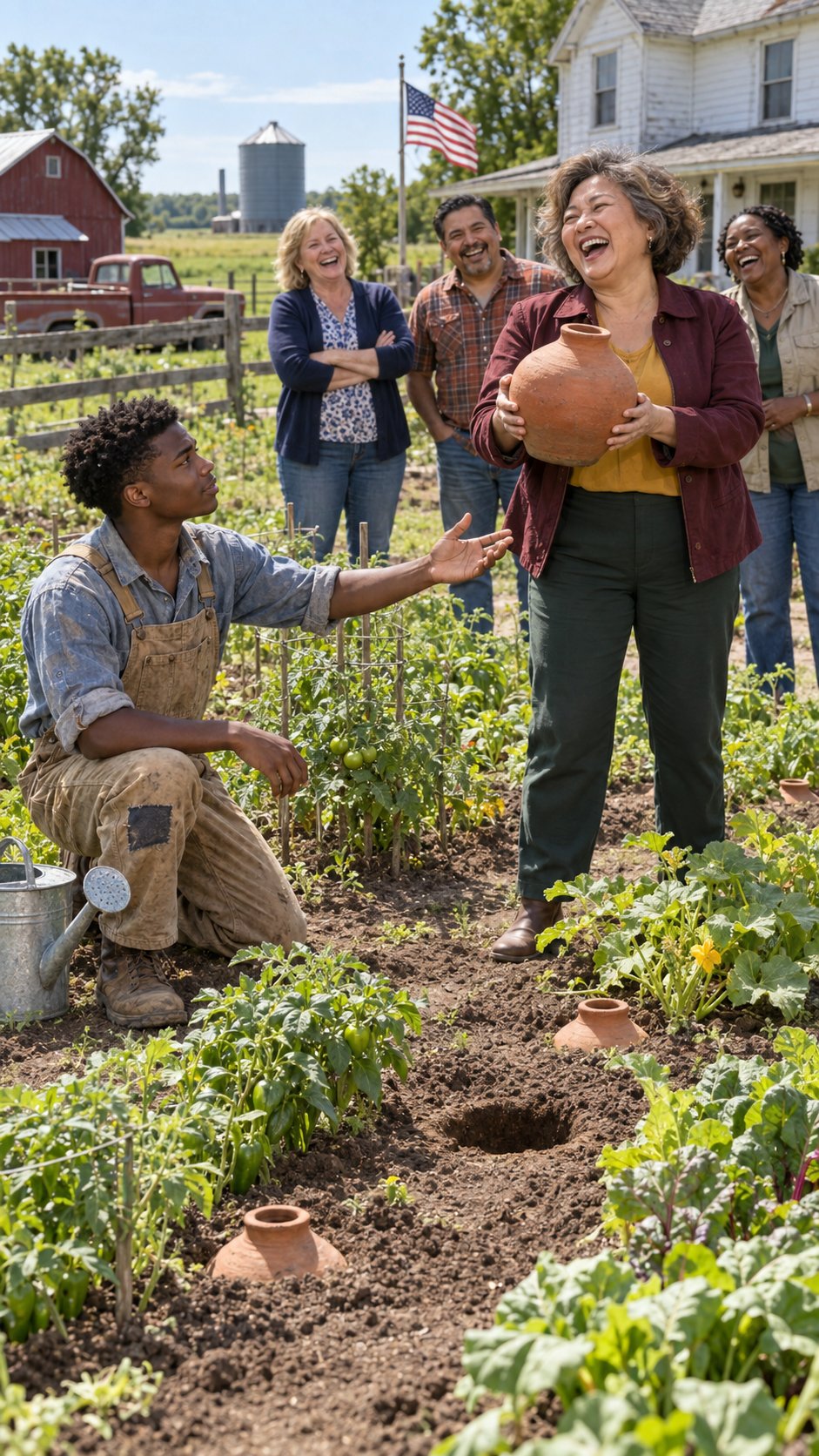
The first clay pot was already halfway into the ground when the laughter started.
Eighteen-year-old Caleb Rivera didn't look up.
He was kneeling between two vegetable rows behind his family's farmhouse, both hands covered in red Virginia soil.
Beside him sat six unglazed terracotta pots.
No flowers.
No plants.
Just empty clay pots.
Caleb lowered another one into the hole he'd dug between a row of tomatoes and a line of young peppers.
Then he packed soil firmly around it until only the narrow opening remained above ground.
That was when Denise Caldwell stopped beside the fence.
The president of the neighboring Brookstone Ridge homeowners association wasn't alone.
Three residents had followed her down the gravel lane.
Howard Pike.
Melissa Grant.
And Frank Delaney.
Denise stared at the buried pot.
Then at Caleb.
Then back at the pot.
“What on earth are you doing?”
Caleb pressed soil around the rim.
“Morning.”
“That isn't an answer.”
Caleb reached for the next pot.
“Working.”
Howard laughed.
Denise stepped closer.
“You're burying flowerpots.”
“Yes.”
“Empty flowerpots.”
“For now.”
Melissa covered her mouth.
Frank chuckled.
Denise pointed dramatically toward the vegetable rows.
Then she burst out laughing.
“HE'S PLANTING EMPTY POTS!”
The other three laughed harder.
Caleb finally looked up.
He didn't appear embarrassed.
That seemed to disappoint them.
Denise opened the small gate beside the lane.
Caleb stood.
“Please stay outside the garden.”
She ignored him.
She walked directly between the rows.
“Denise.”
She bent down.
Wrapped both hands around the rim of the clay pot Caleb had just buried—
and YANKED it from the soil.
Dirt broke loose around it.
A young pepper plant bent sideways.
Denise held the pot above her head.
“Look!”
Howard laughed.
“What's it going to grow?”
Melissa called:
“Maybe he's expecting a pottery tree!”
Frank slapped the fence.
Caleb walked toward Denise.
Not quickly.
Not angrily.
He held out one hand.
“Give it back.”
Denise looked at the pot.
Then at him.
“You seriously think burying these things is gardening?”
“Give it back.”
“Your grandfather actually lets you do this?”
Caleb didn't answer.
He kept his hand extended.
Denise finally shoved the pot toward him.
“There.”
Caleb took it.
Then knelt.
He put it back into the same hole.
Packed the soil around it again.
Straightened the pepper plant.
Then picked up a watering can.
Denise folded her arms.
“Oh, this should be good.”
Caleb poured water directly into the clay pot.
The water rose almost to the rim.
Then he placed a small terracotta saucer over the opening.
Denise stared.
Caleb stood.
“It feeds the roots.”
There was a brief silence.
Then Denise laughed again.
“Through a flowerpot?”
“The clay is porous.”
Howard called:
“You know hoses exist, right?”
Caleb nodded.
“Yep.”
Melissa pointed toward the irrigation line near the shed.
“You already have water out here.”
“Yep.”
Denise shook her head.
“Then this is ridiculous.”
Caleb picked up the next pot.
“Okay.”
Her expression tightened.
She had expected an argument.
Instead, Caleb walked three yards farther down the row and began digging another hole.
Denise followed.
“You're wasting your time.”
“Could be.”
“You're wasting water.”
“That's what I'm trying not to do.”
She laughed.
“By putting it underground?”
“Yes.”
“You learned this online, didn't you?”
“Partly.”
Howard groaned theatrically.
“Oh, God.”
Denise smiled.
“Of course.”
Caleb continued digging.
She pointed at him.
“This is what happens when kids watch three gardening videos and think they're farmers.”
Caleb looked at her.
“My family has been growing vegetables here for thirty-eight years.”
Denise's smile faded slightly.
He added:
“And people were using buried clay irrigation long before the internet.”
Then he returned to digging.
Denise stared at him.
She had no answer ready.
So she used the one she'd been using against the Rivera family for months.
“We'll see what the HOA has to say.”
Caleb pushed his shovel into the soil.
“You can ask them.”
“I am the HOA president.”
Caleb nodded toward the gravel lane separating the garden from Brookstone Ridge.
“Then you probably already know our farm isn't in your HOA.”
Howard stopped laughing.
Melissa looked at Denise.
Caleb lifted another shovel of soil.
“But you're welcome to watch.”
Denise's jaw tightened.
She turned.
“Come on.”
The four walked back toward the subdivision.
Howard was still chuckling.
Before they disappeared behind the hedges, Caleb heard Denise say:
“Three months from now those plants will be dead.”
Caleb looked down at the clay pot.
Then at the young tomato vines barely reaching his knees.
He filled the next pot with water.
Covered it.
And went back to work.
Three months later, Denise Caldwell returned.
She wasn't laughing.
Nobody was.
Because by then, almost everything around Caleb's garden was brown.
The grass along the roadside had gone dormant.
Lawns inside Brookstone Ridge were fading.
Decorative shrubs drooped beneath a brutal August sun.
The county had issued voluntary conservation notices after weeks without meaningful rain.
And beyond the Rivera fence—
Caleb's vegetable rows were still green.
Not magically green.
Not untouched by heat.
But alive.
Thick tomato vines climbed their supports.
Pepper plants held glossy fruit.
Eggplants hung beneath broad leaves.
Pole beans climbed trellises.
Squash leaves spread over mulch.
And beneath the soil, almost invisible, the same clay pots Denise had laughed at were slowly releasing water where the roots could use it.
Caleb was carrying a harvest basket when Denise reached the fence.
Tomatoes.
Peppers.
Cucumbers.
Beans.
Two eggplants.
He set the basket down.
THUMP.
Denise stared at it.
Then at the garden.
Then at the brown landscape behind her.
Caleb wiped his hands on his jeans.
“Morning.”
Nobody laughed.
But to understand why that silence mattered, you have to understand what had happened during the three months between those two mornings.
And why Denise Caldwell had cared so much about a few clay pots that weren't even on her property.
The Rivera farm sat just outside Lexington, Virginia.
Thirty-one acres.
Not enormous.
Not tiny.
Caleb's grandfather, Mateo Rivera, had bought the original twenty-two acres in 1988 after working for years on other people's farms.
Later he purchased another nine.
The property wasn't a picturesque hobby farm designed for photographs.
It was a working place.
Barn with patched siding.
Equipment shed.
Two greenhouses.
Packing area.
Vegetable fields.
Small orchard.
Chicken house.
A roadside farm stand.
And behind the farmhouse, a roughly half-acre intensive garden where the family tested varieties and growing methods before deciding whether to use them on larger plots.
That was Caleb's favorite part.
The test garden.
Mateo called it:
“The place where mistakes are cheap.”
Caleb had grown up there.
He wasn't the kind of eighteen-year-old who claimed to know everything about farming because he'd spent summers pulling weeds.
If anything, living with Mateo had taught him how much he didn't know.
His grandfather could look at soil and tell whether it had enough moisture to cultivate.
Caleb needed to touch it.
Mateo could smell approaching rain.
Caleb checked three weather apps.
Mateo remembered planting dates from twenty years earlier.
Caleb kept spreadsheets.
They teased each other constantly.
But they also learned from each other.
The clay pots had been Caleb's idea.
Not because he'd invented anything.
He hadn't.
The concept was ancient.
Unglazed clay vessels buried in soil can allow water to move gradually through porous walls as surrounding soil dries, particularly when roots develop nearby.
Caleb first encountered the idea in an agricultural-history article.
Then he found extension materials and modern gardening demonstrations discussing variations of buried clay-pot irrigation, often called olla irrigation.
He became curious.
Not convinced.
Curious.
That's an important distinction.
The Rivera farm already used drip irrigation in several production areas.
Caleb wasn't trying to replace every irrigation system with pottery.
That would've been impractical.
He wanted to test whether buried clay vessels could help reduce surface watering in the smaller demonstration garden.
The previous summer had been hot.
Water costs weren't their biggest farm expense because they had a permitted well and pond system, but pumping still cost money.
Time cost money.
And the family had begun discussing how to make the test garden more resilient during dry periods.
So Caleb designed an experiment.
Mateo's response was predictable.
“How much?”
“About two hundred dollars.”
“For flowerpots?”
“They're not for flowers.”
“That did not answer my question.”
“About two hundred.”
Mateo stared at him.
Then asked:
“What are we comparing it against?”
Caleb smiled.
That was approval.
Not of the method.
Of the experiment.
They divided sections.
Some rows would continue with drip irrigation.
Some would use buried clay vessels supplemented as needed.
Some would receive conventional hand watering for comparison.
They'd track:
Water added.
Soil moisture at different distances.
Plant condition.
Yield.
Labor.
Refill frequency.
And problems.
Because every method has problems.
Mateo insisted on that column.
“If your chart only has benefits, it's advertising.”
Caleb added:
PROBLEMS / LIMITATIONS
Mateo nodded.
“Now you're farming.”
The clay pots themselves required preparation.
Some commercially made irrigation vessels were available, but Caleb wanted a low-cost test using unglazed terracotta.
For several units, he sealed drainage openings appropriately so the water wouldn't simply pour straight out the bottom.
He tested them first.
One leaked badly.
One cracked.
Two lost water faster than expected.
Mateo pointed at the cracked one.
“Ancient technology.”
Caleb laughed.
“Ancient people probably didn't buy the cheapest pot at the hardware store.”
“There's your first lesson.”
Then Brookstone Ridge noticed.
The subdivision had been built seven years earlier along the eastern edge of the Rivera property.
One hundred seventy-six homes.
Stone entrance sign.
Walking trails.
Community pavilion.
Decorative pond.
Strict landscaping rules.
Most residents had no problem with the farm.
Many bought produce there.
Children visited during pumpkin season.
Some residents even volunteered at the farm's annual food-bank harvest day.
The conflict was not:
Farm versus suburb.
It was much narrower.
Denise Caldwell versus anything she believed looked uncontrolled.
Denise was fifty-eight.
Former regional manager for a commercial property company.
Organized.
Confident.
Efficient.
She had become HOA president two years after moving into Brookstone Ridge.
At first, residents liked her.
She renegotiated landscaping contracts.
Fixed an accounting problem.
Got the retention pond maintained.
Organized reserve studies.
She was good at administration.
The problem came when she began treating administrative competence as universal authority.
If Denise could organize something, she began believing she should control it.
The Rivera farm frustrated her.
Not because it was poorly maintained.
It wasn't.
Because it existed outside the visual logic of Brookstone Ridge.
Rows changed seasonally.
Cover crops grew tall.
Equipment moved.
Compost piles appeared and disappeared.
Plastic mulch sometimes reflected sunlight.
Tractors started early.
Farm trucks used the county road.
A greenhouse roof was replaced with different-colored material.
To Denise, variation looked like disorder.
To Mateo, it looked like agriculture.
The first conflict involved sunflowers.
The Riveras planted a strip near the subdivision boundary.
Residents loved it.
People took photographs.
Then the flowers finished blooming.
Mateo left the stalks temporarily because birds were feeding on the seed heads.
Denise emailed the farm.
The dead vegetation adjacent to Brookstone Ridge is becoming unsightly.
Mateo replied:
Those are mature sunflowers. We'll remove them after the seed heads are finished.
Denise responded with a section of HOA landscaping rules.
Mateo wrote back:
Our property is not part of Brookstone Ridge.
That should have ended it.
It didn't.
Next came compost.
Then a portable shade structure.
Then a trailer.
Then Caleb's trellises.
Each time, Denise sent language that sounded official.
Each time, Mateo politely asked what authority she believed applied.
Each time, the answer became vague.
“Community standards.”
“Property values.”
“Neighborhood expectations.”
“Visual impact.”
Those might be concerns worth discussing.
They weren't jurisdiction.
Caleb had watched these exchanges for years.
Mateo's rule was simple:
“Never confuse someone being wrong with you needing to be rude.”
Caleb tried.
At eighteen, he wasn't always successful.
But he tried.
That was why Denise's laughter irritated her more than his anger would've.
He wouldn't give her the fight she wanted.
After the clay-pot incident, Caleb told Mateo what happened.
His grandfather was repairing a cultivator.
“She pulled one out?”
“Yep.”
“Damaged?”
“Not really.”
“Plant?”
“Bent. I staked it.”
Mateo wiped grease from his hands.
“Camera?”
“Garden camera caught some of it.”
“Save it.”
Caleb frowned.
“You think we'll need it?”
Mateo shrugged.
“I think storage is cheap.”
That was Mateo's version of legal strategy.
Caleb asked:
“Should we tell her not to come back?”
“I already told the HOA management company nobody from the association has permission to enter working areas.”
“She'll ignore it.”
“Then document.”
“You're not mad?”
Mateo looked at him.
“I am seventy-four years old. If I spend anger every time someone does something stupid, I'll be bankrupt by lunch.”
Caleb laughed.
Then Mateo added:
“But if she touches your irrigation again, come get me.”
That sounded more like his grandfather.
For the next two weeks, the system looked unimpressive.
That delighted Denise.
She walked the public trail along the subdivision edge almost every morning.
Sometimes alone.
Sometimes with neighbors.
Caleb could see her through the fence.
The clay pots were nearly invisible except for their covered openings.
The plants looked ordinary.
Some tomatoes struggled after transplanting.
Two pepper plants developed leaf damage.
One squash plant died.
Denise noticed.
Of course she did.
She stopped at the fence.
“Lost one.”
Caleb was mulching.
“One what?”
“Squash.”
“Yep.”
“So much for the magic pots.”
Caleb looked at her.
“I never said they were magic.”
“You said they'd feed the roots.”
“They're releasing water.”
“Then why did the plant die?”
“Stem damage.”
She smiled.
“Convenient.”
Caleb stood.
“Do you think irrigation makes plants immortal?”
Denise frowned.
He went back to spreading mulch.
The mulch was another part of the system.
Caleb laid straw around several rows to reduce evaporation and moderate soil temperature.
Denise photographed it.
Later that afternoon, the HOA community group had a post:
Question: Is loose straw beside residential property a fire hazard during summer?
No farm was named.
It didn't need to be.
Residents knew.
Comments divided quickly.
Some agreed.
Others defended the Riveras.
One wrote:
They've farmed there longer than our neighborhood has existed.
Another:
I bought strawberries there yesterday. Please leave them alone.
Denise locked comments.
Mateo read the thread.
Then put his phone down.
“Don't answer.”
Caleb said:
“I wasn't going to.”
“You were typing.”
“I was deleting.”
“You type very aggressively when deleting.”
Caleb smiled.
Instead, Mateo called the county extension office.
Not because Denise had authority.
Because he wanted their practices reviewed anyway.
An extension agent named Dr. Hannah Price visited the following week.
She walked the garden with Caleb.
Looked at the buried vessels.
Mulch.
Spacing.
Soil.
Drip comparison rows.
She asked questions.
“How are you measuring water use?”
Caleb showed her his log.
“How far apart?”
“Depends on crop and pot size. We're testing.”
“Good answer.”
She examined one vessel.
“Any root intrusion yet?”
“Not much.”
“Watch for it.”
“Yep.”
“Any clogging?”
“Not yet.”
“Mosquito access?”
“Covered.”
She nodded.
Denise happened to see Dr. Price's county vehicle.
Within fifteen minutes, she appeared at the fence.
“Is there a problem?”
Dr. Price looked at her.
“Excuse me?”
“With the garden.”
“No.”
“Why is the county here?”
Caleb tried not to smile.
Dr. Price said:
“Extension visit.”
Denise relaxed slightly.
“So you're inspecting it.”
“No.”
“Then what are you doing?”
“Providing agricultural education and technical assistance.”
Denise looked disappointed.
She pointed toward the buried pots.
“Did you see those?”
“Yes.”
“Is that approved?”
Dr. Price paused.
“Approved by whom?”
“The county.”
“For burying unglazed irrigation vessels in a private vegetable garden?”
“Yes.”
Dr. Price looked at Caleb.
Then back at Denise.
“That's not an approval category I'm aware of.”
Caleb looked down so Denise wouldn't see him smiling.
Denise continued:
“Do they actually work?”
Dr. Price answered carefully.
“They can be useful in certain settings.”
Denise looked triumphant.
“Can.”
“Yes.”
“So you don't know.”
“I don't know how this particular trial will perform because it's a trial.”
Caleb liked her immediately.
Dr. Price continued:
“Water delivery depends on vessel characteristics, soil, roots, crop demand, weather, spacing, installation, and management.”
Denise folded her arms.
“So it's not proven.”
Dr. Price smiled politely.
“Many forms of buried clay-pot irrigation have been used for a very long time. Caleb is testing how useful this configuration is here.”
Denise's expression tightened.
Again, reality refused to become the simple answer she wanted.
After Denise left, Caleb said:
“Thank you.”
“For what?”
“Not telling her it'll definitely work.”
Dr. Price looked at him.
“Will it?”
“I hope.”
“Hope isn't data.”
Mateo, listening nearby, pointed at her.
“I like this woman.”
By late June, the first meaningful difference appeared.
The clay-pot rows needed less frequent surface watering.
Not zero.
Less.
Caleb refilled vessels based on observed conditions and tracked how quickly water levels dropped.
Near established plants, the pots emptied faster.
After rain, slower.
The pattern fascinated him.
Mateo was more interested in labor.
“How long to refill?”
Caleb checked his notes.
“Twenty-six minutes for this section.”
“Drip?”
“Setup is faster once it's running.”
“Then why use pots?”
“Smaller zone. Targeted water. No pressure requirement once filled. Maybe useful where we don't want lines everywhere.”
Mateo nodded.
“Maybe.”
Caleb grinned.
“That's almost praise.”
“Don't get excited.”
One problem emerged.
A pot cracked after Caleb hit it with a hand cultivator.
Water disappeared quickly.
He dug it up.
Replaced it.
Added the failure to his spreadsheet.
Another pot developed algae near the opening because the cover didn't fit well.
He fixed that.
One row performed no better than drip.
He wrote that down too.
Mateo approved.
“Never fall in love with your experiment.”
“I'm not.”
“You named the spreadsheet.”
“That's organization.”
“You called it OLLA MASTER.”
Caleb closed the laptop.
Then July arrived.
Hot.
Dry.
At first, normal summer dry.
Then abnormal.
A high-pressure system settled over the region.
Rain chances appeared on forecasts and disappeared.
Storms formed west of the county and broke apart.
One afternoon, thunder rolled for forty minutes.
The Rivera farm received nine drops.
Mateo counted them sarcastically.
“Good rain.”
Caleb looked at the dust.
“Should carry us to September.”
Temperatures climbed.
The pond level dropped.
Pastures faded.
Roadside grass browned.
The farm's larger vegetable plots continued through irrigation, but pumping increased.
Caleb began watching water use more closely.
His small clay-pot test suddenly mattered more.
Not because it would save the farm.
It wouldn't.
Half an acre of experimentation couldn't solve a regional dry spell.
But it could reveal something useful.
He expanded mulch around the test rows.
Adjusted refill intervals.
Used shade cloth selectively over vulnerable young greens.
Harvested early in the morning.
Removed severely stressed plants rather than wasting water trying to rescue everything.
The garden remained healthy.
Not perfect.
Healthy.
That's an important distinction.
Leaves wilted temporarily during the hottest afternoons.
Some tomatoes developed cracking after one uneven watering event.
Squash production slowed.
A cucumber vine developed bacterial wilt and had to be removed.
The clay pots didn't prevent disease.
Didn't lower air temperature.
Didn't create rain.
They simply delivered water gradually into the root zone.
Combined with everything else Caleb was doing, that mattered.
Brookstone Ridge had its own problems.
Lawns browned.
The HOA's irrigation contractor reduced watering after county conservation requests.
Residents complained.
Denise received dozens of emails.
Why are the entrance flowers dying?
Why are we still paying landscaping fees?
Why can't irrigation run every night?
My lawn looks terrible.
For the first time, Denise was responsible for something she couldn't administratively command away.
Rain.
Howard Pike, one of the men who had laughed at Caleb, stopped by the farm stand in July.
Caleb was sorting tomatoes.
Howard looked uncomfortable.
“Your garden looks good.”
“Thanks.”
“Those pots?”
“Partly.”
Howard nodded.
“My raised beds are getting cooked.”
“What are you growing?”
“Tomatoes. Peppers.”
“Mulched?”
“No.”
Caleb looked at him.
Howard sighed.
“Go ahead.”
“What?”
“Tell me I'm an idiot.”
Caleb smiled.
“Mulch them.”
“That all?”
“No.”
Caleb explained deep watering.
Soil moisture.
Mulch.
Shade during extreme conditions if appropriate.
Checking plants instead of following a rigid schedule.
Howard listened.
Then asked:
“And the pots?”
“You could test one.”
“Where do I buy them?”
Caleb pointed toward the hardware store down the highway.
Howard laughed.
“The same flowerpots we made fun of?”
“Those work for small tests if you prepare them properly.”
Howard shook his head.
“Don't tell Denise I asked.”
“I don't care enough to tell Denise anything.”
Howard laughed again.
This time Caleb joined him.
Two weeks later, Melissa Grant came.
She bought cucumbers.
Then lingered.
“Howard says you helped him.”
“With tomatoes.”
“He put one of those pots in.”
“Okay.”
“He says it's working.”
“Good.”
She looked toward the test garden.
“Can I see?”
Caleb hesitated.
Then opened the gate.
“Stay on the path.”
She did.
Unlike Denise.
Caleb showed her the covered openings.
Explained the water moved through the unglazed clay gradually.
He was careful not to oversell it.
Melissa asked:
“So I could bury these all over my lawn?”
“No.”
“Why not?”
He laughed.
“This isn't a lawn irrigation replacement.”
“What about shrubs?”
“Maybe for some situations, but you'd need to think about root zones, vessel size, soil, maintenance.”
She looked disappointed.
“You sound less exciting than the internet.”
“That's farming.”
Melissa crouched beside a pepper plant.
“Denise said this was nonsense.”
Caleb shrugged.
“She can think that.”
“She also said your garden stays green because your family ignores the water restrictions.”
Caleb looked at her.
“What?”
Melissa immediately regretted saying it.
“She thinks you're pumping whenever you want.”
“Our agricultural water use isn't the same as HOA lawn irrigation, but we're still conserving.”
“I know.”
“No, apparently she doesn't.”
Melissa stood.
“I shouldn't have said anything.”
“Did she say it publicly?”
“Board meeting.”
Caleb's expression changed.
That was different.
Mocking clay pots was irritating.
Suggesting the farm was irresponsibly using water during a drought could damage its reputation.
Mateo contacted the HOA management company.
Short email.
No threats.
No social-media fight.
He asked that any statements regarding the farm's water use be based on verified information and reminded them that the Rivera property was outside the association.
The management company responded professionally.
The board minutes were later corrected to clarify that no evidence had been presented showing unlawful or prohibited water use by the farm.
Denise hated the correction.
She came to the fence the next morning.
Caleb was harvesting beans.
“Your grandfather complained about me.”
“He corrected something.”
“You people are incredibly defensive.”
Caleb looked at her.
“You told a meeting we're ignoring water restrictions.”
“I raised a question.”
“You stated it.”
“I said it appeared—”
“The minutes didn't say appeared.”
Denise folded her arms.
“Your garden is suspiciously green.”
Caleb almost laughed.
“Suspiciously?”
“Everything else is dying.”
“That's why we're managing water.”
“Or using more than everyone else.”
Caleb set down the harvest bucket.
“Do you want to see the records?”
She hesitated.
“What records?”
“Water logs for the test garden.”
“I don't need your homemade spreadsheet.”
“Then don't accuse us.”
Her eyes narrowed.
“You're eighteen.”
“Yes.”
“You need to learn how to speak to adults.”
Caleb looked around.
“Any around?”
Denise's mouth opened.
Caleb regretted it immediately.
Not because it wasn't funny.
Because Mateo was standing behind him.
His grandfather had heard every word.
Caleb slowly turned.
Mateo raised one eyebrow.
“Inside.”
“Grandpa—”
“Inside.”
Caleb went.
Ten minutes later, Mateo entered the packing shed.
Caleb expected a lecture.
Mateo picked up a tomato.
Inspected it.
Then said:
“That was funny.”
Caleb stared.
“But?”
“But don't do it again.”
“Why?”
“Because she's wrong. Don't make it easier for her to pretend the problem is your attitude.”
Caleb sighed.
“She talks to me like I'm five.”
“I know.”
“She came onto our property.”
“I know.”
“She pulled the pot out.”
“I know.”
“And I can't say anything?”
“You can say anything you want.”
Mateo bit into the tomato.
“You just have to decide whether being satisfying for five seconds is useful.”
Caleb hated when his grandfather was reasonable.
The drought intensified in August.
County conservation messaging became more urgent.
Some private wells in the broader region showed stress.
Streams ran low.
Farmers adjusted.
The Riveras prioritized higher-value crops.
A section of sweet corn was abandoned early because keeping it irrigated wasn't economical.
That decision hurt Mateo.
He'd grown corn every summer for decades.
But farming isn't about saving every plant.
It's about allocating limited resources.
Caleb learned that lesson watching an entire block turn brown.
Denise saw the dead corn.
She posted:
Even professional farms can't beat nature.
Caleb didn't respond.
Because she was right.
Nobody beats nature.
You adapt.
Sometimes.
And sometimes adaptation isn't enough.
The test garden kept producing.
The difference became visually dramatic because of what surrounded it.
Brown grass.
Dry field edges.
Dust.
Against that background, green vegetable rows looked almost unnatural.
But the explanation wasn't.
Water.
Mulch.
Healthy soil with organic matter.
Crop selection.
Timing.
Root development.
Shade management.
Harvest management.
And, in several rows, buried clay vessels reducing how often Caleb needed to wet the surface.
A system.
Not magic.
Dr. Price returned from Extension.
This time she brought two colleagues.
They measured.
Asked questions.
Reviewed Caleb's logs.
One colleague, an irrigation specialist named Marcus Reed, examined the pot spacing.
“You could probably increase spacing here.”
Caleb nodded.
“I think so too.”
“Eggplants?”
“Not performing as well.”
“Why?”
“Maybe demand, placement, or root distribution.”
Marcus smiled.
“Good.”
“What?”
“You didn't blame the eggplants.”
Caleb laughed.
They compared water records.
The results weren't perfect enough to publish as scientific research.
This was a farm trial, not a controlled university experiment.
But it generated useful observations.
Some clay-pot rows had used meaningfully less applied water than comparable hand-watered rows while maintaining acceptable production.
Drip remained more practical for certain larger sections.
Clay vessels required installation labor.
Refilling.
Monitoring.
They could break.
They occupied space.
Scaling them across acres would've been absurd.
But for small beds, demonstration gardens, remote areas, or certain household gardens?
Interesting.
Useful.
Worth further testing.
That conclusion made Caleb happier than:
You proved it works.
Because it was real.
Then came the morning Denise returned with Howard, Melissa, and Frank.
The same four people.
Almost exactly three months after the laughter.
Caleb was harvesting before the heat intensified.
He heard voices near the lane.
Looked up.
Denise stood at the fence.
Howard beside her.
Melissa.
Frank.
Caleb recognized the arrangement immediately.
For one strange second, the scene felt staged.
Same fence.
Same people.
Same garden.
Different season.
The land outside the mulched growing area was dusty.
Brookstone Ridge's common lawn beyond the lane had turned tan.
Several ornamental shrubs near the walking trail showed heat stress.
Inside the garden, tomato vines climbed six-foot supports.
Not flawless.
Some lower leaves had been pruned.
A few fruits had sunscald.
But the vines were loaded.
Peppers hung beneath dark leaves.
Beans covered trellises.
Basil filled the air with scent.
Squash spread across straw.
Caleb lifted a full basket.
Carried it toward the packing table.
Set it down.
THUMP.
Nobody said anything.
He looked at them.
“Morning.”
Howard smiled first.
“Morning.”
Melissa waved.
Frank looked embarrassed.
Denise stared.
Her eyes moved across the rows.
Then toward the small terracotta openings visible beneath their covers.
Finally:
“How much water are you using?”
No laughter.
No:
He's planting empty pots!
Just a question.
Caleb answered:
“Less in these sections than our hand-watered comparison.”
“How much less?”
“Depends on the row.”
She frowned.
“That's vague.”
“We're still compiling it.”
Howard said:
“My tomatoes improved.”
Denise turned.
“What?”
Howard pointed at Caleb.
“I tried one.”
Melissa smiled.
“So did I.”
Denise stared at both of them.
Frank cleared his throat.
“My wife wants me to ask where to buy them.”
Caleb looked down.
He didn't want them to see the smile.
Denise opened the gate.
Caleb immediately looked up.
“Please stay outside unless I invite you in.”
She stopped.
That sentence hung between them.
Three months earlier, she'd ignored it.
This time she stepped backward.
“Can I come in?”
Caleb looked at her.
Then nodded.
“Stay on the path.”
She did.
That mattered more to him than the garden.
They walked between the rows.
Caleb removed one cover.
Denise looked into the pot.
Water level low.
“So you just fill it?”
“Yes.”
“And the water goes through the sides?”
“Gradually.”
“How?”
“Unglazed clay is porous.”
She touched the rim.
“So the roots grow toward it?”
“That's part of what can happen.”
“How often do you fill them?”
“Depends on weather, vessel size, crop, soil, and demand.”
Denise looked annoyed.
“Can't you give one straight answer?”
Caleb smiled.
“Gardening doesn't like straight answers.”
Mateo, approaching from the shed, laughed.
“Now he's learning.”
Denise looked at Mateo.
“You knew this would work?”
Mateo shook his head.
“No.”
That surprised her.
“You let him bury all these without knowing?”
“Yes.”
“Why?”
Mateo looked at Caleb.
“Because not knowing is why you test.”
Denise became quiet.
Mateo continued:
“Some rows are useful. Some aren't worth the labor. Drip still wins for much of what we do.”
Denise pointed toward the lush peppers.
“But this worked.”
Caleb answered:
“This combination worked pretty well here.”
“Combination?”
“Pots. Mulch. soil. spacing. timing. crop choice. management.”
Howard laughed.
“He really doesn't want to take the win.”
Caleb shrugged.
“If I say the pots did everything, somebody copies it badly, their plants die, and then they say I lied.”
Mateo nodded.
“Now he's definitely learning.”
Frank crouched near a tomato.
“Can I pick this?”
“No.”
Frank stood immediately.
Everyone laughed.
Even Denise.
A little.
Then she asked:
“Why didn't you explain all this when we were here before?”
Caleb looked at her.
“I did.”
Denise opened her mouth.
Then closed it.
He continued:
“I said it feeds the roots.”
“You didn't explain the science.”
“You were holding my pot over your head and laughing.”
Howard looked away.
Melissa studied a pepper plant.
Frank scratched his neck.
Denise's face reddened.
Caleb wasn't yelling.
That made the sentence land harder.
“I shouldn't have pulled it out,” Denise said.
Caleb waited.
She added:
“That was inappropriate.”
Mateo looked at her.
“Entering the garden after being told not to was also inappropriate.”
Denise nodded reluctantly.
“Yes.”
“And accusing us of ignoring water restrictions without evidence.”
She stiffened.
“I corrected that.”
“The board corrected it.”
Silence.
Then Denise said:
“I shouldn't have said it.”
That was closer.
Caleb replaced the pot cover.
Denise looked across the garden.
“I thought it looked ridiculous.”
“It did.”
She turned.
He smiled.
“When I first buried them, it looked ridiculous.”
That surprised her.
“You admit that?”
“Of course.”
“You weren't embarrassed?”
“No.”
“Why?”
“Plants don't care if Howard laughs.”
Howard put a hand over his chest.
“Why am I the villain now?”
Everyone laughed.
Again, even Denise.
The scene could have ended there.
Perfectly.
Karen learns lesson.
Young farmer wins.
Full basket.
Nobody laughs.
CUT.
That's how a fifteen-second video would tell it.
Real life kept going.
And the next part was more important.
Brookstone Ridge's landscaping committee asked Caleb to give a short presentation.
He said no.
Howard asked again.
Still no.
Melissa asked.
“No.”
Finally Mateo said:
“Why not?”
Caleb looked at him.
“Because they spent months making fun of us.”
“Three people did.”
“Denise.”
“Is Denise one hundred seventy-six households?”
“No.”
“Then?”
Caleb sighed.
“You want me to do it.”
“I want you to decide whether your goal is to be right or useful.”
Again with the reasonable grandfather.
Caleb hated it.
He agreed.
The presentation was held at the HOA pavilion.
About forty residents attended.
Caleb brought one clay pot.
No dramatic slides.
No giant claim:
CUT YOUR WATER USE 80%!
He hated claims like that.
He began:
“This is not a replacement for every irrigation system.”
Denise sat in the second row.
Caleb continued:
“It's also not something I invented.”
He explained buried clay irrigation.
The concept.
The test.
The limitations.
He showed photographs.
Installation.
Mulch.
Cracked pot.
Root development.
Different crop responses.
Then he showed the water log.
A resident asked:
“So should we all do this?”
Caleb answered:
“No.”
People laughed.
He continued:
“You should first decide what problem you're trying to solve.”
That was Mateo talking through him.
For container gardens?
Different approach.
Large lawns?
Probably not.
Small raised beds?
Maybe useful.
Vacation watering?
Potentially, depending on setup and duration.
Trees?
Requires thought about scale and placement.
Vegetable beds?
Could be useful.
Heavy clay soil?
Different behavior than sandy soil.
He repeated:
“Test.”
Someone asked:
“Why cover the opening?”
“To reduce evaporation, keep debris out, and limit access for insects.”
Another:
“Can roots clog it?”
“They can grow close and may interact with the vessel. Maintenance matters.”
Another:
“Can it crack in winter?”
“Yes. Freeze-thaw conditions matter. We're removing or managing ours seasonally depending on location.”
Another:
“How much did your garden save?”
Caleb showed the actual trial numbers rather than a slogan.
The audience appreciated that.
Then a woman in the back raised her hand.
“Is it true Denise tried to pull one out?”
The room changed.
Caleb looked at Denise.
Denise looked at him.
This was his chance.
He could embarrass her.
Everyone already suspected.
He said:
“She did pull one out.”
Murmurs.
Then:
“She gave it back.”
That was all.
The woman asked:
“Did she trespass?”
Caleb answered:
“My grandfather handled the property issue with the association.”
He moved to the next question.
Denise watched him carefully.
Later, she found him near the pavilion door.
“You could've humiliated me.”
Caleb shrugged.
“You already did that part yourself.”
She stared.
Then unexpectedly laughed.
“Fair.”
The drought eventually broke.
Not dramatically.
No giant storm.
A day of steady rain.
Then another several days later.
The smell of wet soil returned.
The farm changed color.
Pasture recovered slowly.
The abandoned sweet corn did not.
Dead plants don't negotiate with late rain.
Another farming lesson.
Caleb harvested the final tomatoes in October.
He dug up several clay vessels to inspect them.
Roots had clustered near some.
One was badly cracked.
Two had mineral buildup.
He photographed everything.
Mateo watched.
“Verdict?”
Caleb sat back on his heels.
“Useful.”
“That enthusiastic?”
“For the right situation.”
“Will you use them next year?”
“Some.”
“All?”
“No.”
Mateo smiled.
“Good.”
Caleb looked at him.
“Why good?”
“Because if you'd done the exact same thing next year, you wouldn't have learned anything.”
They redesigned.
Different vessel sizes.
Different spacing.
Fewer pots in some rows.
Drip in others.
Improved mulch.
More soil-moisture measurements.
Caleb also wanted to compare buried vessels with deep drip placement.
Mateo listened.
Then asked:
“How much?”
Caleb smiled.
“About three hundred.”
Mateo groaned.
“College would be cheaper.”
“It definitely wouldn't.”
“Let an old man dream.”
Caleb did go to college.
Virginia Tech.
Agricultural technology.
He didn't become a social-media gardening celebrity.
Didn't build a clay-pot empire.
Didn't sell a miracle irrigation course.
He studied soil science.
Crop production.
Irrigation.
Agricultural economics.
Integrated pest management.
Farm business.
Data.
He came home summers.
The test garden remained.
During his sophomore year, Denise stepped down as HOA president.
Not because of the Rivera farm.
Term fatigue.
Family responsibilities.
And, according to Howard, because she had finally realized retirement was less enjoyable when every mailbox color became her problem.
She remained in Brookstone Ridge.
She still bought vegetables.
The first time she came to the farm stand after leaving office, Caleb was home.
She placed tomatoes on the counter.
Then a bag of beans.
“Student discount?”
Caleb stared.
“You're asking the student for a discount?”
“Worth trying.”
“No.”
She smiled.
“Your grandfather would've given me one.”
“Absolutely not.”
From the packing shed, Mateo shouted:
“Absolutely not!”
Denise laughed.
Their relationship never became friendship.
But it became normal.
That was enough.
Sometimes she asked questions.
Sometimes Caleb answered.
Sometimes he didn't know.
He became increasingly comfortable saying:
“I don't know.”
College had taught him how enormous agriculture was.
Every answer opened five questions.
One afternoon, Denise brought her grandson, Tyler.
Thirteen.
He was doing a school project about water conservation.
Denise asked:
“Can you show him the pots?”
Caleb looked at her.
“You're bringing people here to see my ridiculous empty flowerpots now?”
She sighed.
“I knew this was coming.”
“You deserve at least five more years.”
“Fine.”
Tyler looked confused.
“What happened?”
Denise said:
“I behaved badly.”
Caleb raised an eyebrow.
She added:
“And I laughed at his experiment.”
Tyler looked at her.
“Why?”
Denise glanced at Caleb.
“Because I thought something I didn't understand was stupid.”
Tyler nodded with the merciless seriousness of a thirteen-year-old.
“That was dumb.”
Caleb nearly choked laughing.
Denise stared at her grandson.
“Thank you, Tyler.”
Caleb showed him the system.
This time the explanation was better.
Years of study had refined it.
He explained that water movement through porous clay is influenced by the moisture conditions around the vessel and physical properties of the materials and soil.
He didn't tell Tyler it “knew” when plants needed water.
He'd heard people say that online.
He hated it.
Pots don't know anything.
Physical processes happen.
Roots respond.
Management matters.
Tyler asked good questions.
Better than many adults.
At the end, Tyler asked:
“Did the pots save your farm during the drought?”
Caleb shook his head.
“No.”
Denise looked at him.
Tyler said:
“But Grandma said—”
“They helped this garden.”
“What's the difference?”
“The farm is thirty-one acres. This was a small test area.”
“So what saved the farm?”
Caleb thought.
“Nothing saved all of it.”
Tyler looked surprised.
“We lost crops.”
“Oh.”
“We protected some. Lost some. Sold some. Learned.”
“That sounds less cool.”
Caleb laughed.
“Reality usually does.”
Denise said quietly:
“But the garden did stay green.”
“Yes.”
Caleb looked toward the rows.
“It did.”
After college, Caleb worked for an irrigation company in the Shenandoah Valley.
Not glamorous.
He loved it.
He saw enormous center pivots.
Drip systems.
Microirrigation.
Greenhouse fertigation.
Sensors.
Pressure regulators.
Filtration systems.
Pumps.
Old systems held together by repairs.
New systems that cost more than his family's house.
He learned something his clay-pot experiment had already hinted at.
There is no universally best irrigation method.
Only methods appropriate or inappropriate for a particular situation.
Five years later, Caleb returned to the family farm.
Mateo was seventy-nine.
Still working.
Slower.
He refused the word retirement.
“Retirement is when you stop getting paid.”
“You barely pay yourself now.”
“Exactly. Can't retire.”
Caleb eventually became operations manager.
Then partner.
Ownership transferred gradually.
Accountants.
Lawyers.
Tax planning.
Business documents.
Nothing cinematic.
That's what responsible succession usually looks like.
Caleb expanded the farm's educational garden.
The clay pots remained in one section.
Not because they were the farm's most advanced technology.
They weren't.
By then, Caleb used soil-moisture sensors and modern drip systems elsewhere.
The clay section stayed because it taught an important lesson.
Simple technology isn't automatically primitive.
New technology isn't automatically better.
Old technology isn't automatically wise.
Everything gets tested against the problem.
School groups visited.
Caleb loved asking children:
“What do you think is underground?”
“Potatoes!”
“Worms!”
“Treasure!”
One child shouted:
“Grandma!”
Caleb looked at the teacher.
The teacher looked exhausted.
Then Caleb uncovered a clay opening.
“Water.”
He explained.
Children poured water in.
Watched.
Waited.
Nothing dramatic happened.
That's the funny part of slow irrigation.
The useful action is mostly invisible.
One spring morning, Denise visited.
She was sixty-eight now.
Caleb was twenty-eight.
Ten years since the first experiment.
She stood beside the original test area.
“You still have them.”
“Some.”
“Why?”
“Useful for demonstrations.”
She nodded.
Then:
“Do you remember exactly what I said?”
“Yes.”
She groaned.
“Of course you do.”
Caleb imitated her:
“HE'S PLANTING EMPTY POTS!”
Denise covered her face.
“I was terrible.”
“Howard laughed harder.”
“I blame Howard.”
“You pulled the pot out.”
“Details.”
Caleb smiled.
She became serious.
“I owe you a better apology.”
“You apologized.”
“Not really.”
Caleb waited.
Denise looked across the field.
“I treated your age like evidence that you were incompetent.”
He said nothing.
“I also treated the HOA presidency like it made me responsible for things that were none of my business.”
“That's accurate.”
She smiled slightly.
“And I entered your family's garden after you told me not to.”
“Yes.”
“I was wrong.”
Caleb nodded.
“Thank you.”
She looked almost disappointed.
“That's it?”
“What do you want?”
“I don't know.”
“A certificate?”
She laughed.
“No.”
“Then we're good.”
She started walking away.
Then turned.
“You know what bothered me most?”
“The pots?”
“No.”
“That I didn't argue?”
She pointed at him.
“That.”
Caleb laughed.
“You wanted me angry.”
“I wanted you to prove you were an immature kid.”
“And I didn't.”
“No.”
She shook her head.
“It was extremely irritating.”
“I'll take that as a compliment.”
“You shouldn't.”
“I already did.”
Mateo died when Caleb was thirty-two.
Stroke.
Fast.
He'd worked in the greenhouse that morning.
Complained about the price of fertilizer at lunch.
By evening, he was gone.
The farm suddenly felt too quiet.
Caleb found himself walking into the equipment shed expecting to hear:
“How much?”
Every new idea had begun with that question.
For months, Caleb caught himself preparing answers for a man who wasn't there.
At the funeral, Brookstone Ridge residents filled several rows.
Howard.
Melissa.
Frank.
Denise.
Dozens of others.
People who had bought tomatoes.
Pumpkins.
Eggs.
Christmas wreaths.
People whose children had visited the farm.
The subdivision and farm had spent years being described as neighbors in conflict.
Standing in that church, Caleb realized that had never been completely true.
One loud dispute had never represented hundreds of relationships.
That's another danger of dramatic stories.
They shrink communities into villains and heroes.
Real communities are messier.
Usually better.
After the service, Denise approached Caleb.
She handed him a small terracotta pot.
He stared.
“What is this?”
She said:
“Don't laugh.”
He looked at her.
She realized what she'd said.
“Oh, that's unfortunate.”
Caleb laughed.
For the first time all day.
She smiled.
“Your grandfather gave me this.”
“When?”
“The year after the drought.”
Caleb turned it over.
Mateo had written underneath in black marker:
FOR DENISE — EMPTY, BUT NOT USELESS.
Caleb started crying.
Right there.
Denise hugged him.
He let her.
He kept the pot in the farm office.
Not as a monument to proving Denise wrong.
As a reminder of Mateo.
Empty, but not useless.
That applied to more than pottery.
Experiments.
Questions.
Failures.
Silence.
Sometimes things that look like nothing are doing work you can't see yet.
Years later, another severe dry summer arrived.
Caleb was thirty-seven.
The farm had changed.
More drip irrigation.
Better filtration.
Additional storage.
Improved soil management.
Different crop mix.
A larger pond.
Weather station.
Sensors.
And yes—
a few rows still irrigated through buried clay vessels.
Not because Caleb was nostalgic.
Because they still made sense there.
A young farm employee named Mason saw him filling one.
“Why don't we just run drip here?”
“We could.”
“Wouldn't it be easier?”
“Maybe.”
“Then why do this?”
Caleb smiled.
“Because we're comparing.”
Mason groaned.
“You test everything.”
“Almost.”
“Did your grandfather do this?”
“He asked how much everything cost.”
“Smart man.”
“Unfortunately.”
That afternoon, a group from Brookstone Ridge toured the farm.
New residents.
Most didn't know the old story.
One woman saw the clay openings.
“What are those?”
Before Caleb could answer, Denise—now seventy-seven and walking with a cane—said:
“Those are the empty pots.”
Caleb looked at her.
She smiled.
A younger resident frowned.
“Empty pots?”
Denise pointed at Caleb.
“Ask him.”
Caleb explained.
The woman said:
“That's clever.”
Denise muttered:
“That's what I said.”
Caleb stared.
“You absolutely did not.”
Everyone laughed.
Denise laughed hardest.
The old story had changed.
Once it was humiliating.
Then satisfying.
Then funny.
That's what time can do when people actually learn something.
Not erase the event.
Change what it means.
Caleb eventually installed a sign in the educational garden.
Not about Denise.
She would've sued him for emotional damages, she joked.
The sign read:
BURIED CLAY-POT IRRIGATION
Then a short explanation.
At the bottom:
USEFUL TOOL. NOT MAGIC. TEST FOR YOUR SOIL, CROP, CLIMATE AND SCALE.
Mateo would've approved.
Probably after asking how much the sign cost.
One summer, Caleb's own daughter, Isabel, was helping in the garden.
She was eleven.
She watched him refill a pot.
“Dad?”
“Yeah?”
“Why don't you fill it all the way?”
“I'm about to.”
“No. Why don't you put a hose in and leave it?”
“Because I'd forget.”
“You forget everything.”
“Thank you.”
She crouched.
“Grandpa Mateo used these?”
“Yes.”
“Did he invent them?”
“No.”
“Did you?”
“No.”
“Then why does everyone say they're your pots?”
Caleb laughed.
“Long story.”
“Tell me.”
So he did.
He told her about being eighteen.
The experiment.
Denise.
Howard.
Melissa.
Frank.
The laughter.
Denise pulling the pot from the ground.
“HE'S PLANTING EMPTY POTS!”
Isabel gasped.
“She touched your stuff?”
“Yes.”
“Did you yell?”
“No.”
“Why?”
“I wanted the pot back.”
“What did Great-Grandpa do?”
“Told me to save the camera footage.”
Isabel nodded seriously.
“Smart.”
“Very.”
Then Caleb told her about the drought.
Brown grass.
Dry fields.
Green rows.
The harvest basket.
Denise returning.
The silence.
Isabel grinned.
“So you proved her wrong.”
Caleb paused.
There it was.
The tempting version.
The satisfying version.
The incomplete version.
He said:
“Sort of.”
“What do you mean?”
“The pots worked pretty well.”
“So yes.”
“But Denise wasn't wrong that experiments can fail.”
Isabel frowned.
“She laughed at you.”
“That part was wrong.”
“And pulled your pot out.”
“Definitely wrong.”
“But?”
Caleb sat beside her.
“The point wasn't that I knew everything and she knew nothing.”
“What was it?”
“I was willing to test something I didn't know would work.”
Isabel thought about that.
“And she laughed because she didn't understand it.”
“Exactly.”
“So she was still wrong.”
Caleb smiled.
“Eleven-year-olds really enjoy verdicts.”
“Was she?”
“Yes.”
Isabel smiled triumphantly.
“Thank you.”
Then Caleb pointed toward another row.
“You see those?”
Small experimental emitters.
“Yes.”
“Those might be better than the pots.”
Isabel looked shocked.
“You can't replace the famous pots.”
“They're irrigation tools, not family members.”
“Grandma Denise will be mad.”
Caleb laughed.
Denise wasn't actually her grandmother.
But she'd been around long enough that Isabel had started calling her that as a joke.
Denise secretly loved it.
That autumn, Caleb replaced half the clay vessels in one section with a newer low-pressure drip configuration.
Results improved.
Less labor.
Better distribution.
He changed the system.
No sentimentality.
That would've been the final lesson Mateo wanted.
Don't protect a method because it once proved someone wrong.
Keep testing.
But Caleb kept one original row.
Tomatoes on one side.
Peppers on the other.
Buried terracotta between them.
Every spring, he checked the pots.
Replaced cracked ones.
Filled them.
Covered them.
And every summer, visitors asked.
When Denise died at eighty-one, her family held a small memorial at Brookstone Ridge.
Caleb attended.
Howard had died years earlier.
Melissa had moved to Florida.
Frank was in assisted living.
The original laughing group had slowly scattered, as all groups do.
Denise's grandson Tyler spoke.
He was thirty-six now.
An environmental engineer.
During his remarks, he said:
“My grandmother was very confident.”
Everyone laughed.
“She became slightly less confident as she got older.”
More laughter.
“Some of you know that a neighboring farmer helped with that.”
People looked at Caleb.
He looked at the floor.
Tyler continued:
“She once told me the most useful thing she learned in retirement was that not understanding something is not the same as understanding that it's wrong.”
Caleb looked up.
That sounded like Denise.
Later Denise.
Not the woman holding his pot over her head.
People can become different versions of themselves.
After the memorial, Tyler handed Caleb an envelope.
Inside was a photograph.
The original drought year.
Caleb hadn't seen it before.
Someone had taken it from the Brookstone Ridge trail.
Eighteen-year-old Caleb stood inside the garden.
Jeans dirty.
T-shirt soaked with sweat.
A full basket at his feet.
Behind him, rows of green vegetables.
In the foreground stood Denise.
Back to camera.
Looking at the garden.
On the back, she'd written:
The morning I learned that laughing isn't evidence.
Caleb sat in his truck for a long time.
Then smiled.
He framed the photograph.
Placed it beside Mateo's little pot in the farm office.
Not because he'd won.
Because both people in the picture had learned something.
Caleb learned that useful ideas survive ridicule better than arguments.
Denise learned that confidence without curiosity becomes arrogance.
The garden taught both.
By the time Caleb was fifty, the Rivera farm looked different again.
Climate patterns had changed.
Markets had changed.
Labor had changed.
Technology had changed.
Some crops disappeared from their production plan.
Others expanded.
Water management became increasingly important.
Caleb worked with conservation specialists.
Extension.
Other farmers.
Engineers.
Young growers.
Old growers.
He never became the farmer who thought his experience meant nobody could teach him.
Whenever he felt himself drifting that direction, he looked at the photograph.
Then at the pot.
Empty, but not useless.
A young intern once proposed a strange irrigation-monitoring system using inexpensive sensors and automated valves.
Caleb listened.
The intern finished nervously.
“Well?”
Caleb's first thought was:
Too complicated.
Then he remembered Denise.
He asked:
“How much?”
The intern laughed.
“Is that a yes?”
“It's a question.”
“About four hundred for the test section.”
Caleb nodded.
“What are we comparing it against?”
The intern smiled.
Caleb froze.
Mateo.
Exactly.
For one second, the old man was back in the shed.
Caleb smiled.
“Build it.”
The test partially failed.
Two sensors malfunctioned.
A valve stuck.
Data logging dropped out for three days.
The intern was devastated.
Caleb looked at the results.
“What did we learn?”
“That it doesn't work.”
“No.”
The intern frowned.
“We learned this version doesn't work reliably.”
“Same thing.”
“Not remotely.”
Caleb pointed at the failed valve.
“Fix what failed. Test again.”
The intern stared.
“Why?”
“Because that's the job.”
Years earlier, Denise had looked at an empty pot and seen stupidity.
Caleb had looked at it and seen a question.
That difference mattered more than who eventually got the better harvest.
And yes—
Caleb always remembered that first morning.
Eighteen years old.
June sunlight.
Freshly planted peppers.
Tomatoes barely knee-high.
Six terracotta pots lined beside him.
The shovel cutting into soil.
Then laughter.
Denise at the fence.
Howard.
Melissa.
Frank.
Her voice carrying across the garden:
“HE'S PLANTING EMPTY POTS!”
The laughter getting louder.
Her gate opening.
Her shoes entering the row.
Caleb saying:
“Please stay outside the garden.”
Ignored.
Her hands gripping the rim.
Then—
YANK.
The pot tearing free.
Soil collapsing.
Pepper plant bending.
Denise holding the empty clay pot above her head like she'd discovered proof of his stupidity.
“Look at this!”
More laughter.
Caleb walking toward her.
“Give it back.”
Her asking:
“You seriously think burying these things is gardening?”
Caleb holding out his hand.
“Give it back.”
Finally getting it.
Kneeling.
Putting it back into the earth.
Packing the soil.
Straightening the pepper.
Then pouring water into the pot.
Denise watching.
“It feeds the roots.”
Her scoff.
Her certainty.
Her prediction:
“Three months from now those plants will be dead.”
Then August.
Heat shimmering above the road.
Dry grass.
Dust.
Brown lawns.
Wilted ornamentals.
The kind of afternoon where the air itself seemed thirsty.
And Denise returning to the same fence.
Same Howard.
Same Melissa.
Same Frank.
Except nobody laughed.
They looked through the fence.
Tomato vines climbed high.
Peppers hung beneath green leaves.
Beans covered the trellis.
Cucumbers filled a crate.
Squash rested beneath broad leaves.
Not perfect.
Not magical.
Alive.
Producing.
Caleb walked down the row carrying a basket so full he needed both hands.
Tomatoes pressed against peppers.
Beans spilling across cucumbers.
Two eggplants on top.
He reached the packing table.
Set it down.
THUMP.
The sound carried across the quiet garden.
Caleb looked toward the fence.
Denise stared at the basket.
Then at the little terracotta openings between the rows.
Then at the dry landscape behind her.
Caleb wiped sweat from his forehead.
“Morning.”
Howard cleared his throat.
Melissa smiled awkwardly.
Frank looked at his shoes.
And Denise Caldwell—
the woman who had once held Caleb's empty pot over her head while three people laughed—
finally asked the question she should have asked on the first day.
“How does it work?”
That was the real victory.
Not that the vegetables survived.
Not that Caleb had been right.
Not that Denise had been wrong.
It was that ridicule finally became curiosity.
Caleb walked toward the nearest clay pot.
Removed the cover.
And instead of laughing at the woman who had laughed at him—
he showed her.
Because the best answer he'd ever found to someone saying,
“That's stupid.”
wasn't:
“No, it isn't.”
It was:
“Let's test it.”