HOA Karen Kicked Over the Precision Seeder—Then the Seed Company Rep Stepped Out
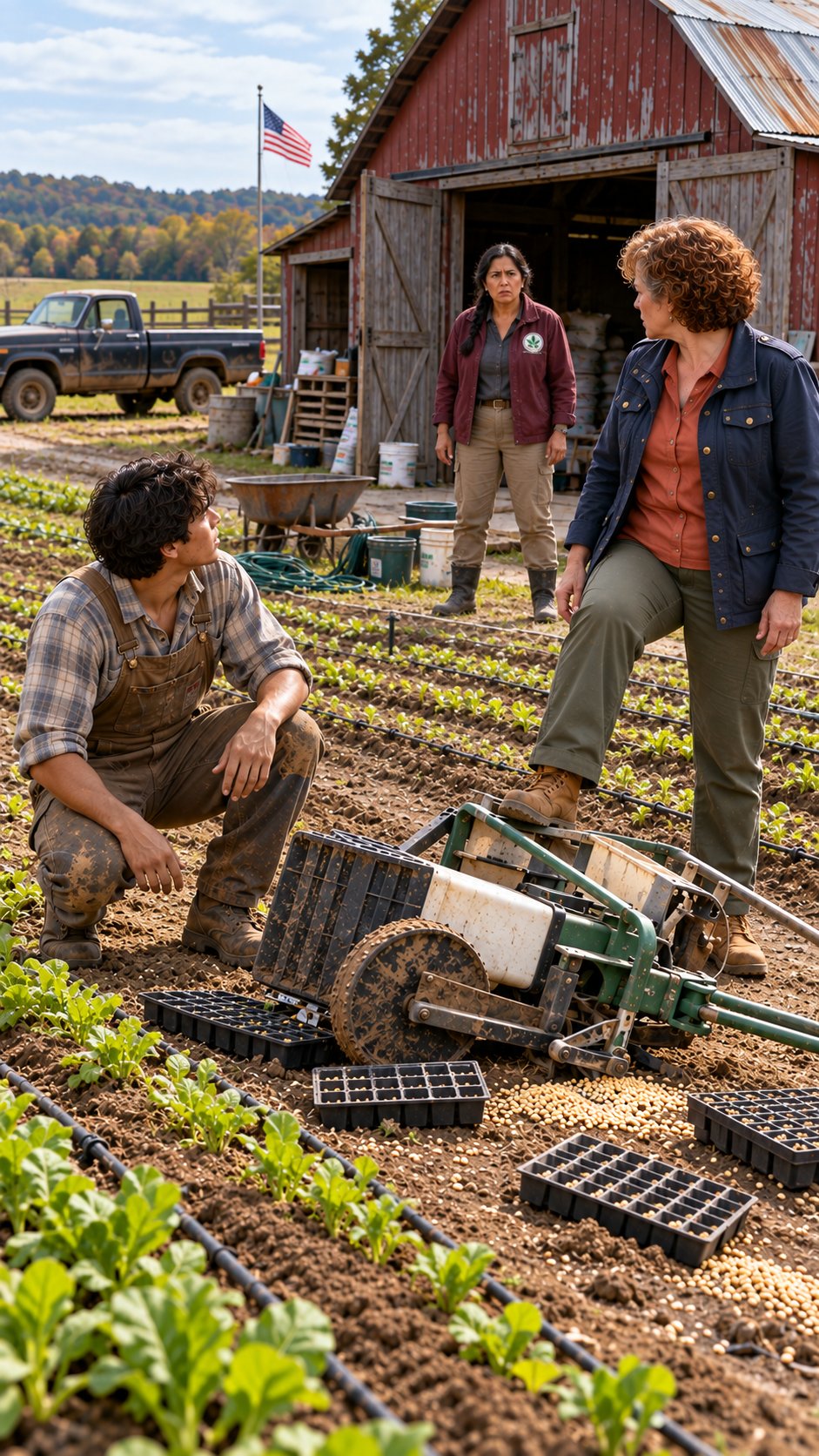
The precision seeder hit the dirt before eighteen-year-old Eli Bennett could reach it.
CRASH.
A metal handle slammed sideways.
Two seed trays shot off the loading platform.
One skidded beneath a workbench.
The other flipped once and scattered hundreds of tiny coated seeds across the dusty ground.
Eli spun around.
“What the hell?”
Denise Mercer stood beside the vegetable rows with one boot still raised.
Behind her were three neighbors from the subdivision across the county road.
All four had been watching Eli work.
Now Denise pointed at the fallen machine.
“THERE—PLANT THEM BY HAND!”
Eli dropped the tray he was carrying.
He ran toward her.
“Hey! Don't touch that!”
He reached for the precision seeder.
Denise moved faster.
She planted her boot firmly against the machine's steel frame.
“WE USE THAT EVERY MORNING!”
Denise looked down at him.
“NOT ANYMORE!”
Eli froze.
Not because he was afraid of her.
Because he understood exactly how expensive the machine beneath her boot was.
And he had no idea what she'd damaged.
“Get your foot off it.”
Denise folded her arms.
“Your little machine has been rattling beside our neighborhood since seven this morning.”
“It's farm equipment.”
“I don't care what you call it.”
“You just kicked it over.”
“I moved a nuisance.”
“You broke our seeder.”
Her friend behind her laughed.
“Looks like a fancy wheelbarrow.”
Eli stared at them.
Then looked toward the barn.
“My aunt supplied that.”
Denise smiled.
“Wonderful.”
Eli said nothing.
She spread her arms.
“THEN GO GET HER!”
One of the neighbors chuckled.
Denise pressed her boot harder against the fallen frame.
“Maybe she'll explain why your little hobby garden needs industrial equipment before breakfast.”
Eli's expression changed.
Not anger.
Almost disbelief.
“You really don't know what that is, do you?”
Denise laughed.
“I know exactly what it is.”
“No.”
He looked toward the barn again.
“You really don't.”
Behind them—
BANG.
The large sliding barn door moved.
Everyone turned.
It rolled open.
A woman stepped into the morning sunlight.
Forty-three years old.
Dark work pants.
Dusty boots.
Gray-green canvas jacket.
And across the left chest, stitched in white and gold thread:
HARTWELL PRECISION SEED SYSTEMS
Denise's smile disappeared.
The woman walked forward.
Her name was Rebecca Bennett.
Eli's aunt.
And regional field operations director for the company whose logo was printed across the machine currently lying beneath Denise Mercer's boot.
Rebecca looked at the scattered seeds.
Then the overturned trays.
Then the bent frame.
Finally—
Denise's boot.
She stopped cold.
“Take your foot off that machine.”
Denise blinked.
Rebecca didn't raise her voice.
She didn't need to.
Denise slowly lowered her foot.
Rebecca walked closer.
She crouched beside the seeder.
Didn't touch it immediately.
First she looked.
Metering assembly.
Drive wheel.
Handle.
Tray mount.
Depth-control mechanism.
Seed delivery components.
Then she saw something near the right side.
Her face changed.
Eli noticed.
“What?”
Rebecca pointed.
“Don't move it.”
Denise laughed nervously.
“Oh, please. It tipped over.”
Rebecca stood.
“No.”
She looked directly at Denise.
“You kicked over a calibrated field-demonstration unit that doesn't belong to this farm.”
Silence.
Denise glanced at the logo.
Then at Rebecca.
“What do you mean it doesn't belong to the farm?”
Rebecca pulled her phone from her jacket.
“I mean it belongs to my company.”
And suddenly nobody was talking about noise anymore.
The Bennett farm sat on forty-two acres outside Frederick, Maryland.
It wasn't the largest operation in the county.
Not even close.
But it had been in Eli's family for four generations.
Vegetables were the main business.
Sweet corn.
Beans.
Lettuce.
Spinach.
Carrots.
Beets.
Radishes.
Onions.
Squash.
Pumpkins.
Tomatoes.
And several acres devoted to specialty greens sold to restaurants and two regional grocery distributors.
The farm also maintained a roadside market from May through October.
Eli had worked there since he was old enough to carry a harvest basket.
At eighteen, he could operate a tractor, repair drip line, transplant lettuce, pack orders, manage the wash station, and identify several common crop problems before breakfast.
But he didn't call himself a farmer yet.
His grandfather did.
Eli didn't.
“I'm learning.”
That was his answer whenever somebody asked.
His grandfather liked that answer.
Rebecca Bennett had grown up on the same property.
She was Eli's father's younger sister.
Unlike her brother, Daniel, she hadn't stayed on the farm.
She'd studied agricultural engineering.
Then worked for an equipment manufacturer.
Then another.
Eventually she joined Hartwell Precision Seed Systems, a Mid-Atlantic agricultural equipment company specializing in small and mid-scale planting systems.
Rebecca wasn't the company owner.
She wasn't secretly a billionaire.
She didn't step out of the barn with magical authority over the county.
She was something much more useful.
She knew exactly what the machine was.
Exactly what it was supposed to do.
Exactly what it cost.
And exactly what could happen when someone kicked it onto its side.
The machine Denise had knocked over was a prototype field-demonstration unit.
Not a giant tractor-mounted planter.
Not something worth hundreds of thousands of dollars.
It was a compact precision seeder designed for diversified vegetable operations.
Operators could configure it for different seed sizes and row spacing.
The goal was straightforward:
Place seeds more consistently.
Control depth.
Reduce waste.
Improve spacing.
Reduce the labor required for certain direct-seeded crops.
For a farm like the Bennetts', those differences mattered.
Planting by hand sounds charming until you have thousands of row-feet to plant.
A backyard gardener can spend an afternoon placing seeds individually.
A commercial vegetable farm calculates labor differently.
If seeds go in too close, thinning costs labor.
Too far apart, production space is wasted.
Too deep, emergence suffers.
Too shallow, moisture can become a problem.
Uneven placement means uneven stands.
Uneven stands complicate cultivation and harvest.
Precision isn't about making farming look technological.
It's about controlling variables that cost money.
Rebecca had arranged for the farm to test the unit for six weeks.
Eli loved it.
Not because it looked impressive.
Because it made straight rows.
Painfully straight rows.
The first morning he used it, he called Rebecca.
“This thing is ridiculous.”
“Good ridiculous?”
“My carrots look like somebody used a ruler.”
“That is generally the point.”
“I want one.”
“You've used it for forty minutes.”
“I've seen enough.”
“Ask your father.”
“I already know what he'll say.”
“How much?”
“Exactly.”
Rebecca laughed.
Daniel Bennett did ask how much.
Then he asked better questions.
Maintenance?
Parts?
Crop compatibility?
Changeover time?
Accuracy?
Durability?
Labor savings?
Expected service life?
Could they justify purchasing one based on acreage?
Rebecca loved her brother because he never confused liking technology with needing technology.
She told Eli:
“Your dad is asking the questions that keep farms alive.”
Eli replied:
“He also still uses a wrench Grandpa bought in 1987.”
“If it works?”
“It barely works.”
“Then hide it.”
“I tried.”
“He found it.”
“Of course.”
The trial was supposed to provide data.
Eli logged planting speed.
Seed usage.
Adjustments.
Emergence.
Problems.
He photographed stands.
Measured spacing.
Rebecca visited twice a week.
The company planned to use feedback from several farms before making final changes to the design.
Then Denise Mercer kicked it over.
Denise lived in Willow Creek Estates.
The subdivision had been built twelve years earlier along the southern side of the Bennett property.
Two hundred and eight homes.
Pool.
Clubhouse.
Walking paths.
Decorative entrance walls.
The usual mix of people.
Teachers.
Nurses.
Engineers.
Contractors.
Retirees.
Families.
Most residents liked living beside the farm.
They bought pumpkins there.
They brought children to pick strawberries.
Some complained about tractors.
Some complained about manure.
Some complained about dust.
Most accepted that living beside farmland occasionally involved farming.
Denise struggled with that concept.
She was fifty-five.
Former corporate compliance manager.
Highly organized.
Very persuasive.
She'd become HOA president eighteen months earlier after campaigning on:
Protecting Community Standards.
Initially, residents appreciated her.
She reviewed vendor contracts.
Got broken streetlights repaired.
Updated emergency contacts.
Pushed the developer to fix drainage problems near the clubhouse.
She was effective.
Then effectiveness became confidence.
Confidence became certainty.
Certainty became interference.
Denise began photographing things beyond HOA property.
Farm trailers.
Temporary irrigation pipe.
Produce crates.
Workers' vehicles.
She emailed county departments asking whether ordinary agricultural activities required permits.
Sometimes the questions were reasonable.
Sometimes they were not.
The county usually answered politely.
The Bennett family mostly ignored her.
Daniel's philosophy was:
“Don't fight every mosquito.”
Eli preferred:
“Can we at least swat one?”
“No.”
“Why?”
“Because then you'll spend all summer swinging.”
The first serious disagreement happened over early-morning harvesting.
During July, farm crews sometimes started before sunrise to avoid peak heat.
Denise complained about vehicle doors and voices.
Daniel adjusted where workers parked when practical.
He asked crews to avoid unnecessary noise near the boundary.
Reasonable.
Then Denise demanded that no agricultural work begin before 8:00 a.m.
Daniel declined.
Harvesting lettuce at 10:00 during extreme summer heat simply because the neighboring HOA preferred it wasn't realistic.
The farm predated the subdivision by decades.
Agricultural operations had their own legal and practical context.
Denise didn't like hearing that.
Then came the precision seeder.
It wasn't especially loud.
The compact unit made mechanical clicking and rolling sounds as Eli pushed it.
No engine.
No roaring motor.
But Denise could see it from the walking path.
That was enough.
The first time she noticed it, she stopped.
“What is that?”
Eli answered:
“Seeder.”
“Motorized?”
“No.”
“Then why is it making that noise?”
“Because it's a machine.”
She frowned.
“You can't plant quietly?”
Eli looked at her.
“I can whisper to the seeds if that helps.”
He regretted the sentence immediately.
Denise didn't.
She remembered it.
Two days later, the HOA management company emailed Daniel.
A resident had reported “repetitive mechanical agricultural noise.”
Daniel read the message twice.
Then walked outside.
Eli was using the seeder.
Click-click-click-click.
Daniel stood thirty feet away.
Listened.
Then called Rebecca.
“Is this thing supposed to be louder?”
“No.”
“Good.”
“Why?”
“Our neighbor has discovered mechanical noise.”
Rebecca laughed.
“Wait until she learns about tractors.”
“She already has.”
Daniel responded professionally.
The machine was manually operated.
Used during ordinary agricultural work.
Noise was limited.
The farm would continue reasonable consideration of neighbors but could not eliminate normal farming activity.
Management acknowledged the response.
That should've ended it.
Denise didn't let it.
She began appearing near the field more often.
Sometimes with Howard Ellison.
Sometimes Cheryl Monroe.
Sometimes Peter Walsh.
Those were the three residents with her the morning she kicked the seeder.
Howard was sixty.
Retired insurance adjuster.
Cheryl was fifty-two.
Dental office manager.
Peter was forty-eight.
Home renovation contractor.
None were inherently bad people.
That became important later.
They had simply spent enough time listening to Denise that they'd begun accepting her version of the farm without checking it.
Denise described the seeder as:
“Industrial equipment.”
Then:
“Commercial machinery.”
Then:
“An automated planting system.”
By the time the story reached one HOA meeting, a resident asked whether the farm was “transitioning into manufacturing.”
Daniel heard about that and laughed for almost a full minute.
Eli didn't.
“This is insane.”
Daniel said:
“It'll pass.”
“What if it doesn't?”
“Then facts remain facts.”
“You really think facts always win?”
“No.”
Daniel looked at his son.
“But they're easier to defend.”
Rebecca suggested installing another security camera near the demonstration area.
Not because of Denise specifically.
The prototype equipment was company property.
The company wanted documentation during field testing anyway.
Daniel agreed.
A camera went beneath the equipment-shed roof.
Wide view.
Seeder storage area.
Adjacent rows.
Part of the access lane.
Nobody thought much about it.
Until the morning Denise entered the field.
She and the three neighbors had approached from the public road.
The farm's side gate was open because a delivery truck was expected.
A sign beside it read:
WORKING FARM — AUTHORIZED ACCESS ONLY
Denise walked through anyway.
Eli saw them but assumed they were heading toward the farm market.
Then Denise came between the rows.
“Can I help you?”
She pointed at the seeder.
“That.”
“What about it?”
“It started before seven again.”
Eli looked at his watch.
7:11.
“It didn't.”
“You've been out here for twenty minutes.”
“Yes.”
“You expect me to believe you weren't using it?”
“I was loading trays.”
Howard said:
“We heard something.”
Eli pointed toward the wash shed.
“Conveyor.”
Denise folded her arms.
“So now there are two machines.”
Eli almost laughed.
“Yes. It's a farm.”
Denise stepped toward the seeder.
Eli said:
“Please don't touch the equipment.”
She ignored him.
“You've been told repeatedly.”
“No. You've complained repeatedly.”
Cheryl said:
“You're being disrespectful.”
Eli looked at her.
“She's on private farm property touching equipment after I asked her not to.”
Denise grabbed the handle.
“Maybe somebody needs to show you that vegetables can be planted without turning this place into a factory.”
Eli moved forward.
“Don't—”
Her foot hit the lower frame.
Hard.
The seeder tipped.
CRASH.
Everything changed.
Rebecca remembered the sound from inside the barn.
Metal hitting packed ground.
Then Eli shouting.
She walked toward the door.
Not running.
She assumed someone had dropped a tool cart.
Then she heard Denise:
“NOT ANYMORE!”
Rebecca recognized neither the voice nor context.
She slid the barn door open.
And saw her company's prototype on its side.
That was why she stopped.
Not because she was preparing a dramatic reveal.
Because for approximately two seconds, her engineering brain was trying to understand why a calibrated machine she'd inspected forty minutes earlier was lying in the dirt.
Then she saw the boot.
“Take your foot off that machine.”
Denise did.
Rebecca approached.
She didn't ask Eli what happened immediately.
She assessed the equipment first.
One seed tray cracked.
The right-side row assembly had taken impact.
A mounting bracket looked distorted.
The drive wheel had shifted.
Whether the metering components were damaged internally wasn't obvious.
Rebecca photographed everything.
Denise became irritated.
“Are you seriously taking pictures?”
“Yes.”
“It fell over.”
Rebecca looked up.
“Did it?”
Nobody answered.
Eli pointed.
“She kicked it.”
Denise said:
“I nudged it.”
Howard looked at the ground.
Cheryl said nothing.
Peter took one step backward.
Rebecca asked:
“Were you operating it when she touched it?”
“No.”
“Was anybody injured?”
“No.”
“Good.”
Then she looked at Denise.
“Please move away from the equipment.”
Denise crossed her arms.
“This machine has been disturbing our neighborhood.”
Rebecca glanced toward Willow Creek.
“How?”
“Noise.”
“This unit has no engine.”
“It makes repetitive sounds.”
“So does a wheelbarrow.”
Denise's eyes narrowed.
“Who exactly are you?”
Rebecca pointed to her jacket.
“Rebecca Bennett. Hartwell Precision Seed Systems.”
“You work for them?”
“Yes.”
“And you're his aunt?”
“Yes.”
Denise smiled slightly.
“So this is a family arrangement.”
Rebecca understood what she was implying.
“I'm also the employee responsible for this field trial.”
That smile vanished.
“What field trial?”
“The one involving the equipment you just knocked over.”
Rebecca called her supervisor.
Then the company's equipment manager.
Then Daniel.
Daniel arrived from another field six minutes later.
He looked at the machine.
Then Eli.
“You okay?”
“Yes.”
“Anybody hurt?”
“No.”
Then Daniel looked at Denise.
“What happened?”
She said:
“Your son became confrontational.”
Eli's mouth opened.
Daniel raised one hand.
“Eli.”
He looked at Denise.
“What happened to the seeder?”
“I moved it.”
“With your foot?”
“It was blocking the row.”
Eli laughed once.
“Dad—”
Daniel again:
“Eli.”
Then to Denise:
“Why were you in the field?”
“We came to discuss the noise.”
“Why were you touching equipment?”
“You people weren't listening.”
Daniel nodded slowly.
“Okay.”
Denise seemed relieved.
She mistook calmness for agreement.
Then Daniel pointed toward the shed.
“Camera covers this area.”
Denise's face changed.
Just slightly.
Enough.
Rebecca noticed.
Howard noticed too.
Peter spoke first.
“She kicked it.”
Everyone turned.
Denise stared at him.
“What?”
Peter shrugged uncomfortably.
“You did.”
“I pushed it with my foot.”
“You kicked the bottom.”
“Peter.”
“I'm not lying about it.”
Cheryl looked at Denise.
Howard exhaled.
Denise said:
“It doesn't matter. I wasn't trying to break it.”
Rebecca answered:
“Intent will matter to whoever reviews this. So will what actually happened.”
That was the first moment Denise seemed to understand the problem wasn't going away because she called the machine annoying.
Daniel asked everyone to leave the working area.
Peter left immediately.
Cheryl followed.
Howard hesitated.
Then said to Eli:
“Sorry.”
Denise turned on him.
“For what?”
Howard pointed toward the scattered seed.
“That.”
Then he walked away.
Denise remained.
Daniel said:
“Please leave.”
“I represent the neighborhood.”
“You represent an HOA across the road.”
“Our residents have rights.”
“Yes.”
“So do we.”
She pointed toward the seeder.
“This could've been resolved weeks ago if you'd cooperated.”
Daniel stared at her.
“Leave my property.”
That ended it.
The sheriff's office was contacted.
Not because Rebecca expected deputies to perform an agricultural-equipment inspection.
Because company property had potentially been damaged after an unauthorized person entered the farm and intentionally made physical contact with it.
The responding deputy documented statements.
Photographed the scene.
Reviewed the relevant security footage.
Nobody was dragged away dramatically.
No instant handcuffs.
No shouting.
Just documentation.
That frustrated Eli.
“She's just leaving?”
Rebecca looked at him.
“What did you expect?”
“She kicked over equipment.”
“And now it's documented.”
“That feels like nothing.”
“It's been forty minutes.”
Rebecca looked at him.
“Consequences are not fast-food orders.”
Eli almost smiled.
The seeder was transported to Hartwell's service facility.
The damage was worse than it looked.
Not catastrophic.
Repairable.
But significant enough to remove the unit from the trial temporarily.
A bracket was bent.
A wheel assembly needed replacement.
The tray support had cracked.
The metering system required recalibration and inspection.
The company documented labor and parts.
More importantly, the farm lost use of the machine during an active planting window.
That created a second kind of cost.
Delay.
Eli was furious about that.
They had planned another planting of baby carrots.
Without the prototype, they used their older equipment.
It worked.
Of course it worked.
Farms existed before the prototype.
But the trial data became incomplete.
Rebecca had to record the interruption.
The company had to decide whether to extend the trial.
Everything became inconvenient because Denise had wanted to make a point with her boot.
Three days later, Denise posted a message to the HOA community portal.
Regarding Recent Farm Incident
She described the situation as:
“A disagreement over equipment noise.”
Then:
“An agricultural device accidentally tipped during discussion.”
Howard saw the post.
He called Peter.
Peter called Cheryl.
Within an hour, all three had contacted the HOA management company.
Their statements were simple.
It wasn't accidental.
Denise had kicked it.
The HOA board called a special meeting.
Not to discipline the farm.
To determine why its president had entered neighboring private property while apparently acting in the name of the association.
The management company was concerned.
The association's attorney was more concerned.
Denise insisted she had acted as a private resident.
The camera complicated that claim.
Before entering, she had said:
“We've warned you about this.”
Later:
“Our neighborhood has had enough.”
And:
“You people weren't listening.”
She had also brought three residents who believed they were accompanying the HOA president to address a community issue.
That blurred the line Denise wanted to draw afterward.
At the meeting, Peter spoke.
“I thought we were going to talk.”
Denise interrupted.
“You knew why we were there.”
“I knew we were going to ask about the noise.”
“You've complained about it too.”
“Yes.”
Peter looked around the room.
“But I didn't agree to go onto the farm and kick their equipment.”
Cheryl nodded.
“Neither did I.”
Howard added:
“I shouldn't have gone through the gate at all.”
That mattered.
Accountability spreads differently than blame.
Once Howard admitted his part, Cheryl did too.
Peter had already done so.
Denise became isolated not because everyone turned against her—
but because the others stopped letting her version replace their own memory.
The board voted to remove Denise from direct authority over external communications pending review.
She remained a board member temporarily.
The management company sent a formal notice to residents:
HOA officers had no authority to enter neighboring private property to enforce association rules.
Complaints involving off-site activities should go through appropriate management, owner-to-owner communication, or relevant public authorities where genuinely applicable.
It was astonishing that this needed to be written.
But now it was.
Denise hated the notice.
She believed it made her look foolish.
Her husband, Mark, disagreed.
“You made yourself look foolish.”
She stared at him.
“You're supposed to support me.”
“I do.”
“This doesn't sound supportive.”
“Support isn't pretending you didn't kick somebody's machine.”
Denise walked away.
That conversation would matter later.
Hartwell sent a damage claim.
The amount wasn't life-destroying.
But it wasn't trivial.
Repair.
Inspection.
Calibration.
Replacement components.
Damaged trays.
Transport.
Associated costs tied directly to the incident.
Insurance became involved.
Attorneys exchanged letters.
Denise learned an unpleasant lesson:
Calling specialized equipment “a fancy wheelbarrow” doesn't make repairs cost what a wheelbarrow costs.
The seeder returned eleven days later.
Eli was waiting.
Rebecca unloaded it.
He walked around the machine.
“Looks new.”
“It isn't.”
“Better?”
“Calibrated.”
He touched the handle.
Then looked at Rebecca.
“You think she'll come back?”
“Yes.”
He stared.
“Seriously?”
“She lives across the road.”
“I mean here.”
Rebecca smiled.
“Probably not.”
They resumed the trial.
The carrots emerged.
Rows straight.
Spacing consistent.
Eli measured.
Recorded.
Compared.
The machine didn't become perfect simply because someone had attacked it.
It still had issues.
The seed hopper was awkward to clean.
Changing configurations took too long.
One adjustment lever loosened during use.
Eli wrote every complaint down.
Rebecca laughed.
“You were more complimentary before Denise kicked it.”
“I've matured.”
“In eleven days?”
“Trauma changes a man.”
“You are eighteen.”
“Exactly.”
Hartwell engineers modified two components based partly on field feedback.
That was the actual purpose of the trial.
Not proving a machine was wonderful.
Finding what needed improvement.
Eli liked that.
Machines could be useful and flawed simultaneously.
People too, although he wasn't ready to apply that second lesson yet.
The farm continued.
Spring became summer.
Lettuce finished.
Tomatoes came in.
Sweet corn hit the stand.
The seeder moved through several planting cycles.
Residents from Willow Creek still visited the market.
Some apologized for Denise.
Daniel always said:
“You don't owe us an apology for someone else's behavior.”
That surprised them.
But he meant it.
Two hundred people didn't kick the machine.
One did.
Howard came one Saturday.
He bought corn.
Then asked for Eli.
Eli walked out.
Howard looked embarrassed.
“I owe you something.”
“You already apologized.”
“Not properly.”
Eli waited.
Howard said:
“I laughed.”
“Yes.”
“And I went through the gate.”
“Yes.”
“I thought Denise knew what she was doing.”
Eli leaned against the counter.
“Why?”
Howard laughed bitterly.
“That's a good question.”
Then:
“I let somebody else's confidence replace my judgment.”
Eli remembered that sentence.
Years later, he would repeat it.
Cheryl apologized separately.
Peter did too.
None became close friends with the Bennetts.
They didn't need to.
Sometimes resolution is simply people behaving better afterward.
Denise did not apologize.
Not then.
She appealed every HOA action.
Argued the board had overreacted.
Argued the farm had used the incident to embarrass her.
Argued the video lacked context.
Argued Hartwell's claim exaggerated damage.
Some points were negotiated.
Some rejected.
Months passed.
Then something happened nobody expected.
Mark left.
Not because of the seeder alone.
That would be too simple.
Their marriage had been struggling for years.
The incident merely exposed a pattern.
Denise controlled.
Corrected.
Escalated.
Then reframed conflict so that she became the injured party.
Mark told her:
“I've spent fifteen years apologizing to people after you decide being certain means being right.”
That sentence devastated her.
She stopped attending HOA meetings.
Eventually resigned.
For several months, neighbors barely saw her.
Eli heard about it.
He felt satisfaction for approximately thirty seconds.
Then guilt.
Rebecca noticed.
“You okay?”
“Denise's husband left.”
“I heard.”
“I thought I'd be happy.”
“Are you?”
“No.”
“Good.”
Eli looked at her.
“Good?”
“You can want accountability without enjoying somebody's life falling apart.”
He nodded.
That was another lesson he wasn't expecting from a seeder.
The criminal side of the incident resolved without a dramatic trial.
The documentation, footage, witness statements, and property damage were addressed through the applicable local process.
Denise ultimately accepted responsibility for entering the property and intentionally knocking over the equipment.
Financial restitution and other conditions followed through the resolution.
The HOA's insurer and her personal coverage handled portions of the civil costs after negotiations.
Nobody became rich.
Nobody's life was magically destroyed.
The machine got repaired.
The bills got addressed.
The farm kept planting.
Reality is usually less theatrical than revenge fantasies.
And healthier.
The following spring, Hartwell released an updated version of the compact seeder.
Rebecca brought one to the farm.
Eli stared.
“You're leaving that here?”
“Trial.”
“Again?”
“Scared?”
“Of the machine?”
“Of footwear.”
Eli laughed.
This version had a reinforced tray support.
Improved adjustment hardware.
Faster configuration changes.
Better access for cleaning.
Not every change came from the Bennett trial.
Several farms had contributed.
But Eli's notes were reflected in some modifications.
He ran his hand across the frame.
“That is cool.”
Rebecca nodded.
“Now find what's wrong with it.”
“You really know how to ruin happiness.”
“That's why they pay me.”
Eli enrolled in community college while continuing to work on the farm.
Agribusiness and crop production.
He wasn't sure whether he'd stay forever.
Daniel encouraged him to leave if he wanted.
“Don't inherit my life because you're afraid to choose your own.”
Eli eventually transferred to a four-year program.
Studied agricultural systems management.
Rebecca pretended not to be proud.
Failed badly.
During his second year, a professor discussed precision planting.
Seed singulation.
Spacing.
Depth.
Emergence uniformity.
Labor efficiency.
Machine calibration.
Eli thought about Denise's boot.
THERE—PLANT THEM BY HAND!
He almost laughed in class.
The student beside him whispered:
“What?”
“Nothing.”
His final project examined equipment adoption on diversified vegetable farms.
Not whether technology was “good.”
When it made economic sense.
When labor savings justified investment.
When simpler tools were better.
When scale mattered.
When repair access mattered.
When complexity became a burden.
Daniel read the paper.
Then asked:
“How much did college cost for you to conclude expensive equipment isn't always worth buying?”
Eli groaned.
“Dad.”
“Just asking.”
After graduation, Eli worked two years for an agricultural equipment dealer.
Then returned to the farm.
Daniel was fifty-six.
Not old.
But tired of managing everything.
They began transferring responsibility gradually.
Eli handled production planning.
Labor.
Equipment.
Technology purchases.
He was much less excited about new machinery at twenty-six than he'd been at eighteen.
Rebecca noticed.
“You've become your father.”
“Take that back.”
“You asked me for a five-year cost projection.”
“That's normal.”
“You used the phrase ‘return on investment.’”
“Stop.”
“Daniel Junior.”
“I hate you.”
One morning, a salesman demonstrated an expensive automated transplanter.
Eli loved it.
Beautiful machine.
Fast.
Precise.
Then he looked at acreage.
Labor.
Maintenance.
Financing.
He said no.
Daniel almost cried with pride.
“My boy.”
“Don't.”
“He finally learned.”
“Dad.”
“Somebody get a camera.”
The original seeder stayed at Hartwell.
Eventually it was retired from field trials.
Rebecca asked Eli whether the farm wanted to purchase it at a reduced price.
He surprised her.
“No.”
“You begged for it at eighteen.”
“We've got a newer model now.”
“Sentimental value?”
“Sentiment doesn't plant carrots.”
Rebecca smiled.
“Your grandfather would like that answer.”
But Hartwell kept the damaged tray.
The cracked one.
Rebecca mounted it in her office.
Underneath she placed a small label:
FIELD TESTING CAN BE UNPREDICTABLE.
Nobody outside the family understood the joke.
Six years after the incident, Denise returned to the Bennett farm.
Alone.
Eli was twenty-four.
He was home for summer.
She parked near the market.
Bought nothing.
Asked:
“Is Eli here?”
The employee pointed toward the wash shed.
Eli came out.
He recognized her immediately.
She looked older.
Not dramatically.
Just tired.
“Hello.”
“Hi.”
There was a long silence.
Then Denise said:
“I came to apologize.”
Eli didn't rescue her from the awkwardness.
She continued.
“I shouldn't have entered the farm.”
He nodded.
“I shouldn't have touched the machine.”
Another nod.
“I shouldn't have kicked it.”
Eli waited.
She swallowed.
“And I shouldn't have treated you like you were stupid because you were eighteen.”
That part surprised him.
“Okay.”
“I thought because I had managed people for years, I could tell when somebody didn't know what they were doing.”
Eli almost smiled.
“You couldn't.”
“No.”
Then she said:
“I also thought being HOA president meant I had to solve every complaint.”
“That wasn't your property.”
“I know.”
“Now.”
“Yes.”
She looked toward the vegetable rows.
“Is your aunt still with that company?”
“Yep.”
“Does she hate me?”
Eli laughed.
“You'd have to ask her.”
“I'd rather not.”
“Smart.”
Denise smiled faintly.
Then:
“Do you?”
“What?”
“Hate me?”
Eli considered lying.
Instead:
“I did.”
She nodded.
“And now?”
“I don't think about you enough to hate you.”
Denise actually laughed.
“That may be worse.”
“Probably.”
She reached into her purse.
Pulled out an envelope.
Eli didn't take it.
“What is it?”
“Nothing legal.”
“That is exactly what someone says before handing you something legal.”
She smiled.
“It's a check.”
“For?”
“The seed.”
He stared.
“What seed?”
“The trays I knocked over.”
“Restitution covered damages.”
“I know.”
“Then why?”
“Because I remember those little seeds all over the dirt.”
Eli looked at her.
“They bothered me more than the machine.”
“Why?”
“Because you had work to do.”
She looked toward the fields.
“And I walked in and made it harder because I wanted to prove I had authority.”
Eli slowly took the envelope.
The amount was modest.
He handed it back.
“No.”
“Eli—”
“Buy vegetables.”
“What?”
“If you want to make it right, buy vegetables.”
She stared.
Then nodded.
“Okay.”
Denise bought tomatoes.
Beans.
Corn.
A watermelon.
Far more than one person needed.
Eli watched her struggle with the bags.
“You want help?”
“I've got it.”
“You sure?”
“I kicked over a precision seeder. I can carry tomatoes.”
“That logic is terrible.”
“I know.”
That was the first normal conversation they ever had.
Denise became an occasional customer.
Nothing more.
She never joined the farm.
Never became a beloved family friend.
Never transformed overnight into a different person.
She simply stopped behaving like the woman who had walked into a field believing authority followed her everywhere.
Sometimes that's enough change to matter.
Years later, Eli became the farm's operations manager.
Daniel stepped back.
Rebecca became vice president of field development at Hartwell.
Her hair grayed.
She hated when Eli mentioned it.
The farm expanded its specialty vegetable production.
They used precision seeders regularly.
Not for everything.
Some crops were transplanted.
Some jobs still made sense by hand.
Some machines were too expensive.
Some technology paid for itself quickly.
The lesson was never:
Machines beat people.
It was:
Use the right tool for the work.
One summer, Eli hired a seventeen-year-old named Noah.
First farm job.
Hard worker.
Terrified of machinery.
Eli showed him the seeder.
Noah asked:
“What if I break it?”
“Then we'll figure out what broke.”
“What if it's my fault?”
“Then you'll learn why.”
“What if you fire me?”
“Are you planning to kick it over?”
Noah looked confused.
“What?”
Eli smiled.
“Long story.”
He taught Noah calibration.
Seed plates.
Depth.
Spacing.
Cleaning.
Maintenance.
Then let him plant one row.
The line wandered slightly.
Noah looked devastated.
“I messed it up.”
Eli examined it.
“No.”
“It isn't straight.”
“Vegetables can grow in curves.”
“But yours are straight.”
“I've been doing it longer.”
Noah relaxed.
That mattered.
Eli remembered being eighteen and having his age used against him.
He decided early that he would never manage young workers that way.
Inexperience was real.
It wasn't stupidity.
That became one of the lasting consequences Denise never knew she'd created.
Eli became unusually patient with young workers.
He corrected mistakes.
Expected responsibility.
But never mocked ignorance.
If somebody asked a basic question, he answered it.
If he didn't know, he said:
“I don't know.”
Rebecca once watched him train three teenagers.
Afterward she said:
“You're good at that.”
“At what?”
“Not making them feel stupid.”
Eli shrugged.
“I remember what it feels like.”
She knew exactly what he meant.
When Eli was thirty-four, Hartwell held a field demonstration at the Bennett farm.
Dozens of growers attended.
Several equipment manufacturers.
Extension staff.
Students.
The newest precision seeder was on display.
Much more advanced than the unit Denise had kicked.
Eli gave a short talk.
Afterward, an older farmer raised his hand.
“My grandfather planted all this stuff by hand.”
Eli smiled.
“So did mine.”
“Then why do we need that?”
“We might not.”
The farmer looked surprised.
Eli continued:
“The question isn't whether a machine exists. The question is whether it solves a problem economically and reliably for your operation.”
Rebecca stood behind the crowd smiling.
That was exactly the answer she wanted.
Another farmer asked:
“Can it replace labor?”
“For some tasks, it can reduce labor.”
“Replace workers?”
“That's a different question.”
Eli explained.
Machines change jobs.
Sometimes eliminate specific repetitive tasks.
Sometimes create maintenance and technical tasks.
Sometimes they aren't worth the investment.
Sometimes they allow a farm facing labor shortages to keep producing.
No slogans.
No worship of technology.
Just tradeoffs.
At the end of the demonstration, Rebecca walked beside him.
“You know what I remember?”
“What?”
“The look on your face when that machine hit the ground.”
“I thought you were going to kill her.”
“I thought I was going to kill you.”
“Me?”
“You were about three seconds from grabbing the machine while her foot was still on it.”
“I was saving it.”
“You were eighteen.”
“You use that against me constantly.”
“Because you were eighteen constantly for an entire year.”
Eli laughed.
Rebecca became serious.
“You handled it better than I would've.”
“No, I didn't.”
“You didn't touch her.”
“Low standard.”
“Important standard.”
He nodded.
She was right.
Daniel retired officially at sixty-eight.
Nobody believed him.
He still arrived every morning.
Eli finally changed the office lock.
Daniel had another key.
Nobody knew where he got it.
Some battles cannot be won.
The farm's hundredth anniversary approached.
Local newspapers wrote about it.
The county agricultural office recognized the family.
Old photographs came out.
Horse-drawn equipment.
Early tractors.
Hand planting.
Harvest crews.
Packing lines.
Modern irrigation.
Precision seeders.
Eli arranged several photographs in the market.
One showed him at eighteen beside the prototype.
The photograph had been taken the day before Denise kicked it over.
He was smiling.
One hand on the handle.
No idea what would happen twenty-four hours later.
Denise saw the picture.
She was seventy-three now.
She stood in front of it for a long time.
Then found Eli.
“You should put the other picture up.”
“What other picture?”
“The security-camera image.”
He laughed.
“Of you kicking it?”
“Yes.”
“Why?”
“People would enjoy it.”
“I'm sure.”
She smiled.
Then:
“It belongs to the history.”
Eli looked at her.
“You really want your worst morning on the wall?”
Denise thought.
“No.”
Then:
“But pretending it didn't happen doesn't improve it.”
That sounded like something Rebecca would say.
Or Daniel.
Or maybe Denise had simply learned it herself.
They didn't put the security image on the wall.
Instead, Eli added a small card beside the photograph:
FIELD TRIAL, AGE 18. THIS MACHINE TAUGHT US ABOUT PRECISION PLANTING, EQUIPMENT COSTS, CALIBRATION, PATIENCE—AND THE IMPORTANCE OF KEEPING UNAUTHORIZED BOOTS AWAY FROM FARM MACHINERY.
Denise read it.
“You couldn't resist.”
“No.”
“Fair.”
She bought corn.
Again.
When Eli eventually had children, they grew up on the farm much as he had.
His daughter Grace loved animals.
His son Matthew loved machinery.
At six, Matthew discovered the precision seeder.
“Can I drive it?”
“You push it.”
“Can I push it?”
“No.”
“Why?”
“You're six.”
“That's age discrimination.”
Eli stared.
“Who taught you that phrase?”
“Grandma Rebecca.”
“Of course.”
When Matthew was twelve, Eli finally told him the story.
His son couldn't believe it.
“She kicked the machine?”
“Yes.”
“Why?”
“She was angry.”
“Did it belong to you?”
“No.”
“That's worse.”
“Yes.”
“What happened?”
“Long process.”
“Did Aunt Rebecca yell?”
“Not much.”
Matthew looked disappointed.
“That's boring.”
“Reality frequently is.”
Then Matthew asked:
“What did you do?”
“I got angry.”
“Did you yell?”
“A little.”
“Did you fight her?”
“No.”
“Why?”
“Because putting hands on somebody would've turned one problem into two.”
Matthew nodded.
That lesson mattered more to Eli than the machine.
Years passed.
Denise eventually moved away from Willow Creek.
Her daughter lived in Pennsylvania.
Grandchildren.
Health issues.
Before leaving, she visited the farm one last time.
Eli was forty-one.
She was seventy-eight.
The farm market had changed.
Larger.
Refrigerated cases.
Online orders.
Card readers.
But the vegetable rows still began behind the barn.
Denise looked toward them.
“Do you still use those things?”
“Seeders?”
“Yes.”
“Every week.”
She nodded.
“I suppose planting them by hand never caught on.”
Eli smiled.
“Some things we still plant by hand.”
She pointed at him.
“Don't ruin my apology.”
They walked toward the barn.
Denise stopped near the exact place where the prototype had fallen twenty-three years earlier.
Of course the dirt was different.
Rows shifted.
Buildings changed.
But Eli remembered.
So did she.
“I can still hear it,” Denise said.
“The crash?”
“Yes.”
Eli nodded.
“Me too.”
“I thought I'd made a point.”
“You did.”
She looked at him.
“Not the one I intended.”
“No.”
She laughed softly.
Then said:
“I was so angry that morning.”
“Why?”
“The noise complaint.”
“No.”
Eli looked at her.
“Why were you really angry?”
Denise became quiet.
Age had softened her face.
Not erased it.
Just changed the edges.
Finally she said:
“Because nobody was listening to me anymore.”
Eli waited.
“The board had rejected two things I wanted. Residents were criticizing landscaping costs. Mark told me I was turning every disagreement into a battle.”
She looked toward Willow Creek.
“I came over here expecting you to obey me.”
“You weren't my boss.”
“I know.”
“You weren't even on our property legally.”
“I know.”
“So when I didn't…”
“I felt powerless.”
She looked at him.
“And I hated feeling powerless.”
Eli nodded.
That made sense.
Not justification.
Explanation.
There is a difference.
Denise continued:
“So I kicked the machine.”
“Yes.”
“Then your aunt walked out.”
Eli smiled.
“You should've seen your face.”
“I have.”
“What?”
“The security footage.”
“Oh.”
“Several times.”
“Why?”
“At first because of the legal case.”
She paused.
“Later because I wanted to understand what I looked like.”
Eli said nothing.
“I looked ridiculous.”
“You looked angry.”
“Same thing sometimes.”
He laughed.
She reached into her handbag.
For one terrible second, Eli expected another check.
Instead, she pulled out a small photograph.
The old prototype.
She had printed a still from the video.
Not the kick.
The moment afterward.
The seeder on the ground.
Seeds scattered.
Eli approaching.
Rebecca standing near the barn.
Denise beside the machine.
She handed it to him.
On the back she'd written:
THE MOST EXPENSIVE LESSON I EVER LEARNED ABOUT OTHER PEOPLE'S BOUNDARIES.
Eli smiled.
“Financially?”
“Emotionally.”
“Insurance covered some of the financial part.”
“Thank God.”
She looked at the barn.
“Tell Rebecca I'm sorry again.”
“Tell her yourself.”
“She still scares me.”
“She should.”
Denise laughed.
Then hugged Eli.
This time he hugged her back.
Not because the past disappeared.
Because it didn't control the present anymore.
She left that afternoon.
Eli watched her car turn onto the county road.
Then he went back to work.
There were beans to harvest.
Invoices to approve.
A broken irrigation fitting.
Three employees asking questions.
And a seeder that needed cleaning before tomorrow morning.
Life rarely waits for symbolic endings.
The next day, Eli arrived before sunrise.
The air was cool.
Mist hovered above the low field.
He rolled the precision seeder from the equipment shed.
Not the original.
That machine was long retired.
This one was newer.
Lighter.
More accurate.
Better designed.
He checked calibration.
Loaded seed.
Adjusted depth.
Then started down the row.
Click.
Click.
Click.
The sound traveled through the morning.
The same kind of repetitive mechanical sound Denise had once believed shouldn't exist near her neighborhood.
Eli smiled.
Not because he'd defeated her.
Because he finally understood something he'd been too young to understand at eighteen.
The machine had never been the real conflict.
Authority was.
Denise believed being concerned gave her control.
She believed being president of an HOA gave her influence beyond its boundaries.
She believed age gave her more credibility than an eighteen-year-old worker.
And when none of those things made Eli obey her—
she used her boot.
One second.
One kick.
CRASH.
Then came consequences that lasted years.
Eli reached the end of the row.
Turned.
Checked placement.
Good.
He remembered the original morning perfectly.
Seed trays sliding across dirt.
Tiny seeds scattering.
Denise shouting:
“THERE—PLANT THEM BY HAND!”
Him rushing forward.
“WE USE THAT EVERY MORNING!”
Her boot against the frame.
“NOT ANYMORE!”
His anger.
His helplessness.
Then his glance toward the barn.
“My aunt supplied that.”
Denise laughing.
“THEN GO GET HER!”
The barn door opening.
Rebecca stepping into sunlight.
Company logo across her jacket.
Denise's smile fading.
For years, Eli had thought that was the best part.
The reveal.
The moment Denise realized she'd kicked equipment belonging to the company represented by the woman walking toward her.
It was satisfying.
No question.
But it wasn't the most important part.
The most important part happened afterward.
Nobody magically fixed everything.
Rebecca's jacket didn't grant her police authority.
The company logo didn't make Denise instantly guilty of anything.
Daniel didn't threaten her.
The sheriff didn't arrive and perform some dramatic roadside arrest.
Instead, people did the boring things.
They took photographs.
Saved camera footage.
Collected witness statements.
Inspected damage.
Filed reports.
Called insurers.
Reviewed HOA authority.
Calculated repair costs.
Repaired the machine.
Recalibrated it.
Extended the trial.
Planted the next crop.
That was how the problem was actually solved.
Not through one dramatic reveal.
Through documentation and patience.
Eli appreciated that more as he got older.
Farming taught the same lesson.
You can have one dramatic moment.
A storm.
A breakdown.
A pest outbreak.
A perfect harvest.
But agriculture is mostly what happens afterward.
Fix.
Adjust.
Plant.
Measure.
Learn.
Repeat.
He reached the next row.
A young worker named Lucas waited with seed trays.
Eighteen years old.
Same age Eli had been.
Lucas handed him one.
“Ready?”
“Yep.”
Lucas looked at the machine.
“You ever worry this thing will break?”
“Constantly.”
“You don't act like it.”
“Worrying doesn't tighten bolts.”
Lucas laughed.
Then:
“My grandfather says machines make people lazy.”
Eli smiled.
“Your grandfather ever use a tractor?”
“Every day.”
“Interesting.”
Lucas laughed again.
Eli loaded the tray.
Lucas asked:
“Why do we use this instead of planting by hand?”
There it was.
Twenty-three years later.
Same question.
Without the ridicule.
Without the boot.
Without someone already convinced they knew the answer.
Just curiosity.
Eli pointed toward the long vegetable rows.
“Because for this crop, at this scale, consistent spacing saves seed, labor, and time.”
Lucas nodded.
“So machines are better?”
“No.”
Lucas frowned.
Eli continued:
“The right tool is better.”
“What if hand planting is the right tool?”
“Then we plant by hand.”
“What if this is?”
“Then we use this.”
Lucas looked satisfied.
Simple.
Eli started pushing.
Click.
Click.
Click.
Morning sunlight reached across the field.
Behind him, the barn door stood open.
For a moment, he could almost see Rebecca standing there twenty-three years earlier.
Gray-green jacket.
Hartwell logo.
Looking down at the fallen machine.
Then at Denise's boot.
Stopped cold.
He could still hear her first sentence.
Not:
Do you know who I am?
Not:
You're going to jail.
Not some dramatic threat.
Just:
“Take your foot off that machine.”
Clear.
Specific.
A boundary.
That was what the entire story had really been about.
At eighteen, Eli thought the victory was watching Denise's smile disappear.
At forty-one, he knew better.
The victory was that the machine got repaired.
The seeds went back into the ground.
The next crop was planted.
The farm continued.
And eventually even the woman who had kicked the seeder learned that another person's property did not become hers to control simply because she disapproved of it.
Eli reached the end of another row.
He stopped.
Looked behind him.
A straight line stretched across the dark soil.
Seeds beneath it.
Invisible.
Waiting.
Tomorrow morning, the seeder would be back.
And the morning after that.
Not because technology had won some argument.
Because it was useful.
Because it did the job.
Because the farm had tested it.
Measured it.
Improved it.
Chosen it.
That choice belonged to the people doing the work.
Not the people standing across the road laughing at it.
Eli rested both hands on the seeder handle.
Lucas called:
“Next row?”
Eli smiled.
“Next row.”
He turned the machine.
Loaded another tray.
And started forward.
Click.
Click.
Click.
The same sound Denise had once tried to silence.
Only now, nobody was shouting.
Nobody was laughing.
Nobody was kicking anything over.
There was only an eighteen-year-old worker beside him, watching carefully and learning how the machine worked.
Exactly as Eli had once done.
And somewhere in Pennsylvania, an old woman still kept a photograph of the morning she learned the difference between having an opinion—
and having authority.
The seeds disappeared beneath the soil in a straight, measured line.
Eli kept walking.
The work continued.