Dirty Cops Robbed an 81-Year-Old Veteran—Then Two Military Vehicles Pulled Up
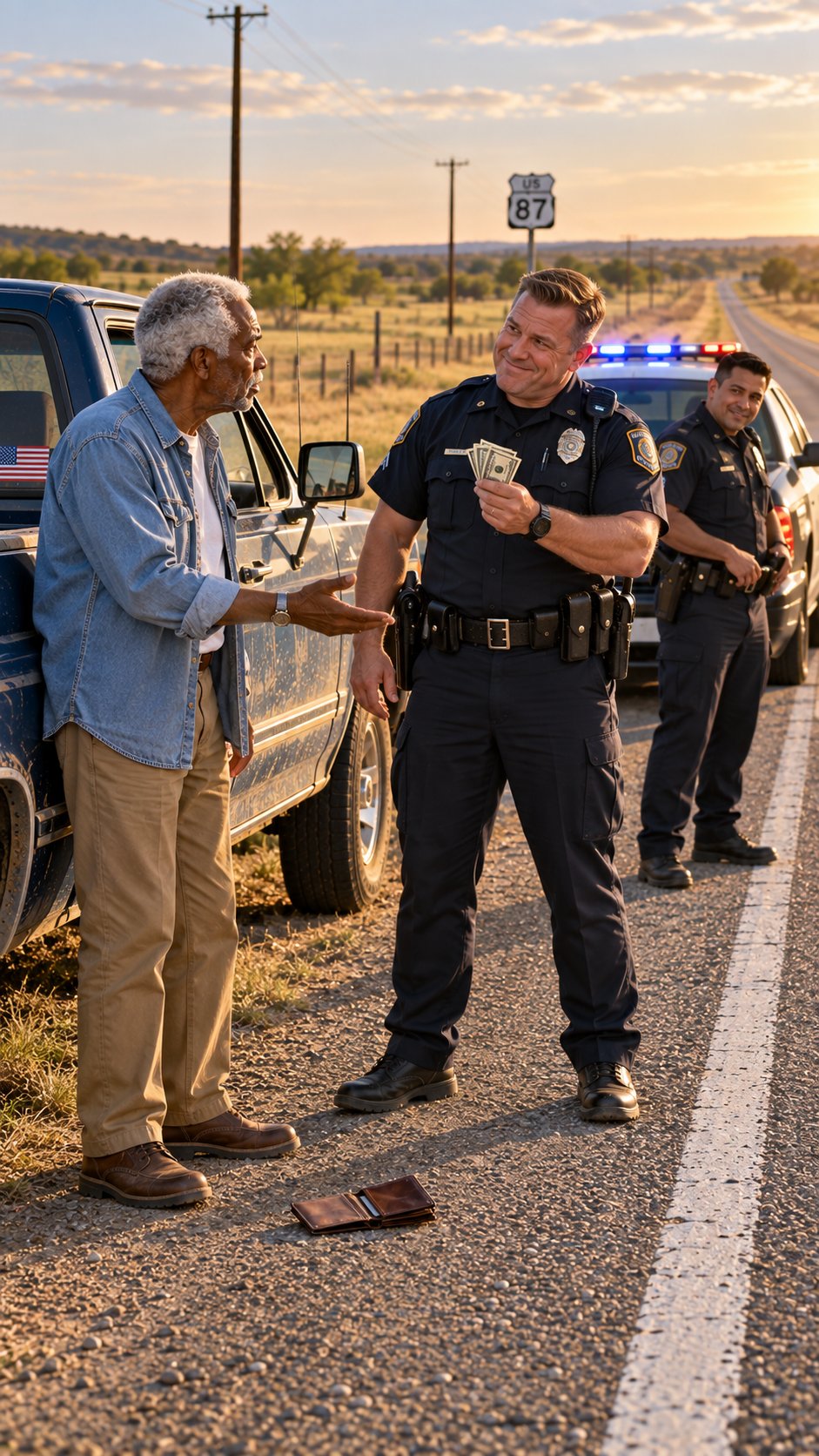
The officer counted the money twice.
Not because he needed to.
Because he wanted the old man to watch.
“One hundred.”
He peeled another bill away.
“Two hundred.”
Another.
“Three.”
Eighty-one-year-old Walter Bennett stood beside his faded blue pickup on a quiet stretch of highway in Virginia and said nothing.
The second officer leaned against the patrol cruiser.
He was smiling.
Walter looked from him to the officer holding his wallet.
“Are you finished?”
The first officer grinned.
“Not even close, old man.”
His nameplate read D. MERCER.
Officer Daniel Mercer held Walter's wallet in one hand and the cash in the other.
He raised the bills.
“Roadside tax.”
His partner laughed.
Walter didn't.
He extended his hand.
“My wallet.”
Mercer looked at the open palm.
Then at Walter.
“Say please.”
Walter's expression didn't change.
“Give me my property.”
The second officer pushed away from the cruiser.
“Careful.”
Walter looked at him.
His nameplate read HOLT.
Officer Kevin Holt.
Holt tapped the body camera mounted to his chest.
“You want to make this difficult?”
Walter glanced at the camera.
No light.
Mercer noticed.
His grin widened.
“Something interesting?”
Walter said nothing.
Mercer removed the remaining cash from the wallet.
Then he dropped the wallet.
It struck the asphalt beside Walter's boot.
Photographs spilled out.
Driver's license.
Insurance card.
A faded photograph of Walter's late wife.
Mercer pointed down.
“Pick it up.”
Walter stared at him.
For a second, Holt seemed almost disappointed.
Maybe he'd expected anger.
Maybe resistance.
Maybe the old man to reach toward Mercer so they could turn the encounter into something else.
Walter didn't.
He slowly bent down.
His left knee didn't cooperate the way it once had.
He placed one hand on the side of his pickup for support.
Then picked up his wallet.
One card at a time.
The photograph of his wife last.
Mercer and Holt walked back toward their cruiser.
Holt called over his shoulder:
“Drive safe, Grandpa.”
The doors slammed.
Walter stood beside the pickup.
He opened his wallet.
The money was gone.
Three hundred and eighty dollars.
Cash he'd withdrawn that morning to pay a mechanic who still preferred paper money.
Walter looked toward the police cruiser.
Neither officer was watching him anymore.
He climbed into his pickup.
Closed the door.
Sat quietly.
Then reached into the center console.
He removed an old flip-style notebook.
Inside were several phone numbers.
Walter chose one.
Dialed.
A man answered on the third ring.
“Colonel Hayes.”
Walter looked through the windshield at the cruiser parked twenty yards ahead.
“Robert.”
There was a pause.
“Walter?”
“Yes.”
“Everything all right?”
“No.”
The voice immediately changed.
“Where are you?”
Walter read the highway marker.
Then said:
“Two police officers stopped me.”
Another pause.
“Are you injured?”
“No.”
“What happened?”
“They took my cash.”
“What?”
Walter watched Mercer step out of the cruiser.
The officer looked back.
Walter lowered his phone slightly.
“They're coming back.”
“Walter, stay in your vehicle.”
“I intend to.”
“I'm nearby. Don't argue with them.”
Walter almost smiled.
“I wasn't planning to.”
He ended the call.
Mercer approached the driver's window.
Walter lowered it halfway.
Mercer leaned down.
“Who were you calling?”
“My mechanic.”
Mercer studied him.
Then smiled.
“Good.”
He tapped the roof twice.
“Get moving.”
Walter started the engine.
But before he shifted into drive—
Holt shouted from behind the cruiser.
“Mercer.”
Mercer turned.
Far down the highway, two dark vehicles had appeared.
Large.
Boxy.
Military markings visible as they approached.
The first was a government utility vehicle.
The second was a military police vehicle from a nearby installation.
They slowed.
Turn signals flashed.
Both pulled onto the shoulder behind the police cruiser.
Mercer stared.
Holt straightened.
The driver's door of the first vehicle opened.
A man in uniform stepped out.
Silver hair.
Colonel insignia.
Behind him came a military police officer.
Then another.
Mercer's smile disappeared.
Walter remained inside his pickup.
Because the men arriving were not there to arrest anyone on Walter's command.
Walter had no such authority.
Colonel Robert Hayes had no authority to storm onto a state highway and punish civilian police officers either.
What he did have was something Mercer and Holt hadn't expected.
A reason to stop.
A witness.
A phone.
And access to people who knew exactly which civilian agency needed to hear what Walter Bennett was about to report.
Walter Bennett had spent twenty-seven years in the United States Army.
He enlisted at nineteen.
Retired at forty-six.
Then spent another twenty years working as a diesel mechanic.
He had never been a general.
Never been famous.
Never been the sort of veteran whose photograph appeared in newspapers.
He had been a maintenance soldier.
Later a senior noncommissioned officer.
The kind of man who believed machines usually told you what was wrong if you stopped talking long enough to listen.
His final rank had been command sergeant major.
He rarely mentioned it.
After retirement, most people in town simply knew him as Walter.
He lived alone outside a small Virginia community about forty minutes from a major military installation.
His wife, Evelyn, had died six years earlier.
His son lived in Texas.
His daughter lived in Maryland.
Walter refused both of their repeated suggestions that he move closer.
“My house works,” he'd tell them.
That was Walter's standard for most things.
If something worked, he saw little reason to replace it.
His pickup was seventeen years old.
His coffee maker was older.
His kitchen table had survived three houses.
His wallet had been a gift from Evelyn on their fortieth anniversary.
That was why seeing it hit the asphalt bothered him almost as much as the missing money.
The morning of the traffic stop had started with a transmission problem.
Walter's truck had developed a vibration.
His mechanic, Earl Simmons, told him to bring it in.
Walter stopped at his bank first.
Earl's shop accepted cards.
Walter knew that.
Earl also complained about processing fees every time Walter used one.
So Walter withdrew four hundred dollars.
He spent twenty at a diner.
That left three hundred and eighty in his wallet.
At 11:17 a.m., he turned onto State Route 214.
At 11:26, a police cruiser appeared behind him.
Lights activated.
Walter checked his speed.
Fifty-one.
Speed limit fifty-five.
He signaled.
Pulled onto the shoulder.
Put the truck in park.
Lowered his window.
Hands visible.
The cruiser belonged to the small town of Bellweather, though the stop occurred near the outer edge of its jurisdiction.
Walter knew the area.
He also knew enough not to begin a roadside argument over boundaries.
If there was a problem, there were proper ways to challenge it later.
Mercer approached first.
“License and registration.”
Walter handed them over.
“Do you know why I stopped you?”
“No.”
“You crossed the center line.”
Walter thought back.
“I don't believe I did.”
Mercer's face changed slightly.
Not anger.
Interest.
Like he'd found the opening he wanted.
“You calling me a liar?”
“No.”
“What are you saying?”
“That I don't believe I crossed the center line.”
Holt arrived at the passenger side.
He shined a flashlight through the window despite the bright morning.
Walter looked at him.
“Is there a reason for that?”
Holt said:
“Keep your eyes forward.”
Walter did.
Mercer examined his license.
“Walter Bennett.”
“Yes.”
“Eighty-one.”
“Yes.”
“You still driving?”
Walter looked at him.
“You're holding my driver's license.”
Holt laughed.
Mercer didn't.
“Step out.”
Walter asked:
“Why?”
“Driver impairment check.”
Walter paused.
Then complied.
Slowly.
His left knee was stiff.
Mercer watched him climb down.
“You been drinking?”
“No.”
“Medication?”
“Prescription medication, yes.”
“What kind?”
Walter named his blood-pressure medication.
Mercer asked:
“Anything that makes you dizzy?”
“No.”
“You sure?”
“Yes.”
Mercer looked at Holt.
Then back at Walter.
“Mind if I take a look in the vehicle?”
“Yes.”
Mercer blinked.
Walter clarified.
“I do not consent to a search.”
The atmosphere changed.
Holt walked around the truck.
Mercer said:
“Why not?”
“Because you asked if I minded.”
“Got something to hide?”
“No.”
“Then what's the problem?”
“I don't consent to a search.”
Walter's voice remained level.
That seemed to irritate Mercer more than shouting would have.
The encounter lasted longer than it should have.
Questions.
Waiting.
More questions.
Mercer returned to the cruiser.
Came back.
Asked Walter where he was going.
Where he'd been.
Why he carried cash.
Walter hadn't mentioned cash.
That made him pay closer attention.
Then Mercer said:
“I need to verify your identification.”
“You already have my license.”
“Wallet.”
Walter hesitated.
“Why?”
Mercer held out his hand.
“Wallet.”
Walter should not have had to decide whether refusing would make things worse.
But that was exactly what he found himself deciding.
He handed it over.
Mercer opened it.
Saw the cash.
And smiled.
That was the moment Walter understood this was not an ordinary bad traffic stop.
The body cameras mattered.
Both officers wore them.
Neither appeared active during the critical portion of the encounter.
Walter noticed because his grandson had once shown him how his own department's cameras indicated recording.
Walter's grandson was a sheriff's deputy in another state.
Different equipment.
Different policy.
Walter knew not to assume the systems worked identically.
So he didn't accuse them.
He simply observed.
Mercer removed the cash.
Walter asked:
“What are you doing?”
Mercer said:
“Possible evidence.”
“Evidence of what?”
“Whatever we find.”
Holt laughed.
Then Mercer counted it.
That was when he made the “roadside tax” comment.
Walter understood something else.
These men were comfortable.
Too comfortable.
People doing something reckless for the first time often look nervous.
Mercer didn't.
Holt didn't.
They acted bored.
Routine.
That frightened Walter more than the money.
Colonel Robert Hayes knew Walter from a veterans' mentorship program associated with the nearby installation.
Robert was fifty-three.
Walter had met him twelve years earlier when Robert was still a lieutenant colonel.
Their friendship had little to do with rank.
Walter volunteered several times a month with a program helping young service members transition into civilian technical careers.
Robert occasionally attended.
Walter had helped one of Robert's soldiers find a diesel apprenticeship.
Later, Walter helped Robert himself restore a 1972 pickup.
That created the sort of friendship that survives long gaps without conversation.
Robert had called Walter three days earlier asking whether he wanted lunch.
They planned to meet that afternoon.
When Walter called from the roadside, Robert happened to be traveling back toward the installation in an official vehicle after a training visit.
A military police vehicle was traveling with his group for unrelated duty.
That coincidence would later make the arrival look much more dramatic than it actually was.
The military vehicles weren't dispatched because an elderly veteran commanded them.
Robert didn't send troops to confront civilian police.
He heard an elderly friend report that officers had taken his money.
He told Walter to remain calm.
Then he stopped because he was already nearby.
And while approaching, he contacted the appropriate civilian dispatch center.
That decision mattered.
Mercer stood between Walter's pickup and the first military vehicle.
Colonel Hayes approached.
He didn't shout.
“Officer.”
Mercer looked at his uniform.
Then at the military police vehicle.
“This is a traffic stop.”
Robert nodded.
“Understood.”
“Then stay back.”
Robert stopped.
“Mr. Bennett called me and reported that money was taken from him during this stop.”
Mercer's face didn't move.
“He's confused.”
Walter heard that from inside the pickup.
His jaw tightened.
Robert said:
“He sounded clear to me.”
Holt approached.
“Sir, you need to leave.”
Robert looked at him.
“I've already contacted civilian dispatch. A supervisor is on the way.”
Mercer said:
“We don't need a supervisor.”
Robert replied:
“I wasn't asking whether you did.”
Holt's expression hardened.
“You military?”
Robert didn't answer the unnecessary question.
His uniform already did.
He said:
“Mr. Bennett is eighty-one. He reports that cash was removed from his wallet. I'm staying at a safe distance until the appropriate civilian supervisor arrives.”
Mercer glanced toward Walter.
For the first time since the stop began, Walter saw uncertainty.
Holt walked back toward the cruiser.
Mercer followed.
They spoke quietly.
Robert remained where he was.
One of the military police officers stood near the government vehicle.
He didn't approach Mercer.
Didn't touch a weapon.
Didn't claim jurisdiction.
Didn't make threats.
Walter appreciated that.
This wasn't a movie.
A colonel couldn't appear and order civilian officers arrested because his old friend had called.
Walter didn't want that anyway.
He wanted the truth documented.
That required discipline.
A county sheriff's supervisor arrived eleven minutes later.
Then a second county unit.
Bellweather's police lieutenant arrived shortly afterward.
By then, Mercer and Holt had changed their explanation.
The cash, they said, had been temporarily removed during an investigation.
Walter asked:
“Investigation of what?”
Mercer ignored him.
The Bellweather lieutenant, Angela Morris, did not.
She was forty-five and had been with the department seventeen years.
She asked Mercer:
“What was the basis for the stop?”
“Lane violation.”
“Citation?”
“Warning.”
“Where's the warning?”
Mercer said he hadn't completed it yet.
Morris looked at the time.
The stop had been going on nearly forty minutes.
She asked:
“Why was cash removed?”
Mercer said:
“Possible contraband proceeds.”
“Based on?”
Silence.
Holt said:
“His behavior.”
Morris looked at Walter.
Walter stood beside his truck.
Cane in one hand now.
Colonel Hayes several yards away.
“What behavior?”
Holt said:
“He was evasive.”
Walter almost laughed.
Morris didn't.
“Was there a search?”
Mercer answered:
“Limited.”
“Consent?”
Mercer looked toward Walter.
Walter said:
“No.”
Morris raised one hand.
“Mr. Bennett, I'll speak with you separately in a moment.”
“Understood.”
Then she looked at Mercer.
“Probable cause?”
Mercer started explaining.
The explanation moved.
First lane violation.
Then possible impairment.
Then suspicious cash.
Then officer safety.
Morris listened.
She didn't accuse him of anything yet.
She simply kept asking for specifics.
People who rely on intimidation often do poorly when someone calmly requests a sequence.
Then Walter said something that changed the direction of the inquiry.
“Lieutenant?”
Morris turned.
“I have a camera.”
Mercer looked at him.
Holt did too.
Walter pointed toward his pickup.
“Dash camera.”
Nobody spoke.
Walter had installed it after a minor accident two years earlier.
His daughter insisted.
It recorded forward-facing video and cabin audio.
The camera wasn't hidden.
It sat behind the rearview mirror.
Mercer had apparently never noticed.
Holt's face changed.
Morris asked:
“Was it recording?”
Walter said:
“I believe so.”
Mercer immediately said:
“We need to secure that.”
Morris turned toward him.
“No.”
One word.
Then:
“You and Officer Holt are going to step away from Mr. Bennett's vehicle.”
Mercer started:
“Lieutenant—”
“Now.”
They moved.
Not arrested.
Not handcuffed.
Separated from the evidence and the complainant while supervisors determined what had happened.
That was the first moment Walter felt the situation turn.
Not when the military vehicles arrived.
When somebody responsible for the civilian process protected the evidence.
Walter retrieved the dash camera's memory card with Lieutenant Morris watching.
He didn't hand it to Robert.
Robert didn't ask.
The evidence went through civilian channels.
A county investigator arrived.
The original card was documented.
A copy was made appropriately.
Walter later retained his own copy through the proper process.
The recording wasn't perfect.
The camera faced forward.
It didn't show Mercer removing the cash because that occurred outside the driver's-side field of view.
But the microphone captured much of the encounter.
Mercer's voice.
Walter's refusal to consent.
The demand for the wallet.
The counting.
Then, clearly:
“Roadside tax, old man.”
Holt laughing.
Walter asking for his wallet.
And Mercer:
“Pick it up.”
Silence filled the roadside after the audio played.
Lieutenant Morris looked at Mercer.
Mercer said:
“It was a joke.”
Walter finally spoke.
“Where is my money?”
Mercer stared at him.
Morris repeated:
“Officer Mercer, where is Mr. Bennett's cash?”
Mercer said:
“In the cruiser.”
“Where?”
“Console.”
Morris walked toward the cruiser with another supervisor.
They returned with cash.
Three hundred and eighty dollars.
Exactly what Walter reported missing.
The bills were documented rather than casually handed back immediately because the situation had become an investigation.
Walter understood.
He'd waited eighty-one years.
He could wait a little longer.
Mercer tried to explain the phrase.
Gallows humor.
Bad joke.
Misunderstanding.
Holt said he believed the money had been lawfully seized.
Then investigators asked the obvious question.
If it was evidence, where was the documentation?
Why had Mercer put it in the center console?
Why wasn't there a receipt?
What suspected offense generated the seizure?
Why was the dash-camera audio inconsistent with their first explanation?
Why did their body-camera records require review?
Those questions couldn't be answered with swagger.
Walter's traffic stop ended without a citation.
But he didn't drive to Earl's repair shop.
Robert followed him to a diner parking lot.
The military vehicles continued toward the installation after civilian authorities confirmed they were no longer needed as witnesses to the arrival circumstances.
Robert got into Walter's passenger seat.
For a minute, neither man spoke.
Then Robert said:
“You okay?”
Walter stared through the windshield.
“No.”
It was the first time he'd admitted it.
Robert nodded.
Walter's hands began shaking.
He put them on his thighs.
“They wanted me to get angry.”
Robert looked at him.
“I know.”
“I could feel it.”
“You did the right thing.”
Walter shook his head.
“I did the careful thing.”
“Same result.”
“No.”
Walter looked at him.
“Sometimes doing the right thing gets people hurt.”
Robert understood.
Walter continued.
“I was lucky.”
The dash camera.
The phone.
Robert nearby.
A supervisor willing to listen.
Those were advantages.
Walter knew other people might not have them.
That thought bothered him more than the missing cash.
“If they've done this before…”
Robert didn't finish.
He didn't need to.
The investigation expanded.
Not because Walter was a veteran.
That distinction mattered deeply to him.
His service brought attention because of Robert's arrival and because people in the military community knew him.
But the allegation had to stand on evidence available to anyone.
The dash audio.
The recovered cash.
The officers' reports.
Body-camera data.
Vehicle systems.
Dispatch logs.
Prior stops.
Complaints.
Records.
Investigators began reviewing them.
Walter gave a formal statement.
He repeated exactly what happened.
No exaggeration.
When asked whether Mercer threatened to kill him, Walter said no.
When asked whether Holt touched him, Walter said no.
When asked whether Mercer physically forced him to the ground, Walter said no.
When asked whether he feared the situation could escalate, Walter said yes.
Truth didn't need improvements.
News of the investigation reached town quickly.
That created another problem.
People began inventing details.
A social media post claimed Walter was a retired general.
He wasn't.
Another claimed the colonel arrived with “armed troops” and personally arrested the officers.
False.
Another said the officers stole thousands of dollars.
False.
Another claimed Walter had called the Pentagon.
Walter laughed when his daughter read that one.
“The Pentagon?”
“Apparently.”
“Who'd I ask for?”
She laughed.
Then became serious.
“Dad, people are sharing this everywhere.”
Walter frowned.
He hated attention.
His daughter, Claire, had driven down from Maryland the morning after the incident.
She wanted him to stay with her.
He refused.
“Dad.”
“My house still works.”
She rolled her eyes.
“Of course it does.”
Then she sat beside him.
“You scared me.”
“I didn't call you because I knew you'd worry.”
“That is not how children work.”
“You're fifty-four.”
“Still your child.”
Walter smiled.
Evelyn would have said the same thing.
Claire watched the dash-camera recording once.
Then refused to hear it again.
The part that upset her wasn't the money.
It was Mercer telling her father to pick up his wallet.
She knew that wallet.
Her mother had given it to him.
Inside was the photograph Walter carried everywhere.
Claire found him cleaning dirt from it at the kitchen table.
“Mom's picture?”
Walter nodded.
The photograph had acquired a small scratch.
Claire sat across from him.
“Are you angry?”
“Yes.”
“You don't look angry.”
“I've had practice.”
“At what?”
“Not giving angry people control over my decisions.”
That sounded like military wisdom.
It wasn't.
Evelyn had taught him.
She'd been much better at arguments than Walter.
The investigation found something more concerning than Walter expected.
There had been previous complaints.
Not identical.
Similar enough.
Drivers reporting cash missing after searches.
Drivers claiming officers threatened vehicle impoundment unless they “handled something roadside.”
One complaint had been withdrawn.
Another had been closed after investigators couldn't substantiate it.
A third involved a man who couldn't establish exactly how much cash he'd possessed.
Walter didn't know whether every allegation was true.
Neither did investigators at first.
That's why records mattered.
They reviewed traffic stops involving Mercer and Holt.
Location patterns.
Searches.
Seizures.
Body-camera activation.
Reports.
Evidence logs.
Dispatch records.
The process took months.
Walter became impatient.
Robert reminded him:
“You wanted process.”
“I want faster process.”
“Everybody does.”
Walter grumbled.
But he knew Robert was right.
Lieutenant Morris visited Walter several weeks after the stop.
Off duty.
She called first.
Walter invited her for coffee.
She sat at the same kitchen table where Claire had listened to the recording.
Morris said:
“I wanted to apologize.”
Walter looked at her.
“You didn't stop me.”
“No.”
“Then why are you apologizing?”
“They wore our uniform.”
“Your department's.”
“Yes.”
Walter considered.
“Did you know?”
“No.”
“Should you have?”
Morris didn't answer quickly.
That impressed him.
Finally:
“I should've recognized some warning signs sooner.”
“That's different from knowing.”
“Yes.”
She told him there had been complaints she had not personally handled.
Information had been fragmented.
Different supervisors.
Different shifts.
Different allegations.
Nothing alone had forced the picture into focus.
Walter said:
“Machines do that.”
Morris smiled slightly.
“What?”
“One vibration means nothing. Three vibrations and heat in the same bearing mean something.”
“You comparing my department to a bad transmission?”
“Yes.”
She laughed.
“Fair.”
Then Walter said:
“Fix the bearing.”
Her smile disappeared.
“We're trying.”
Walter didn't become anti-police after the incident.
He didn't become blindly pro-police either.
He'd lived too long for categories that easy.
His grandson wore a badge.
Lieutenant Morris had treated him professionally.
The county investigators did their jobs.
Mercer and Holt's alleged misconduct wasn't evidence that every officer behaved the same way.
But their uniforms had given them power during the stop.
That made accountability more important, not less.
Walter repeated that whenever someone tried to turn his story into a slogan.
One local reporter asked:
“Has this changed how you feel about law enforcement?”
Walter replied:
“It changed how I feel about two officers.”
The reporter pushed.
“Nothing broader?”
Walter said:
“Systems should catch people who misuse authority. So I'm interested in whether the system does.”
That was his answer.
The military angle attracted attention Walter didn't want.
A veteran organization invited him to speak.
He initially refused.
Robert convinced him.
“Talk about what actually happened.”
“People want the dramatic version.”
“Then disappoint them.”
Walter smiled.
So he did.
At the event, he stood behind a lectern wearing a plain blue shirt.
No dress uniform.
No medals.
He told the audience:
“I made a phone call to a friend.”
Then he explained the coincidence.
Robert was nearby.
Military vehicles were already traveling with him.
They stopped.
Robert contacted civilian authorities.
Nobody deployed the Army to rescue Walter Bennett.
The audience laughed.
Walter continued:
“And that's important.”
The room quieted.
“Military rank doesn't place somebody above civilian law. Colonel Hayes didn't show up and order police around. He helped me get the right people there.”
Robert sat in the front row.
Walter pointed toward him.
“He also owes me twenty dollars from lunch.”
Robert shouted:
“That's a lie.”
The room laughed again.
Then Walter became serious.
“The useful part wasn't his rank. It was that I wasn't alone anymore.”
That was the sentence people remembered.
Months passed.
Mercer and Holt remained away from regular patrol duties while investigations and administrative processes proceeded.
Walter refused to speculate publicly about final criminal liability before the process concluded.
His attorney advised the same.
The investigation eventually produced formal allegations based on more than Walter's encounter.
Other motorists were interviewed.
Financial records were reviewed where relevant.
Video and audio were compared.
The exact legal proceedings took time.
There were hearings.
Attorneys.
Motions.
Disputed claims.
Some allegations were stronger than others.
Not every complaint became a proven offense.
That mattered.
Walter didn't want people convicted by rumor any more than he wanted officers protected by badges.
The evidence had to do the work.
One former complainant especially affected Walter.
His name was Marcus Reed.
Thirty-two.
Warehouse supervisor.
He'd been stopped eight months before Walter.
Marcus said he'd had six hundred dollars in cash after selling a used lawn tractor.
After a roadside search involving Mercer, he later discovered two hundred missing.
He complained.
Mercer denied taking anything.
No clear recording established the removal.
Marcus couldn't prove the exact amount he'd carried.
The complaint went nowhere.
When investigators contacted him again after Walter's stop, Marcus initially refused to participate.
Then he heard Walter's audio.
He changed his mind.
Walter met him much later.
Marcus said:
“They believed you.”
Walter knew what he meant.
“They had more evidence.”
Marcus looked at him.
“You had a colonel show up.”
Walter didn't become defensive.
“That got attention.”
“Exactly.”
Walter nodded.
Marcus expected an argument.
Instead Walter said:
“That bothers me.”
Marcus stared.
Walter continued.
“You shouldn't need a colonel.”
That was the beginning of their friendship.
Marcus explained something Walter hadn't fully considered.
During his stop, he'd been twenty minutes from work.
He feared being arrested.
Feared losing his job if he missed his shift.
Feared his car being impounded.
When he realized money was missing, filing a complaint felt risky and exhausting.
Walter had retirement income.
Time.
Family support.
A dash camera.
Friends.
Marcus had a supervisor threatening to fire him for another absence.
Same highway.
Different vulnerability.
Walter began speaking about that.
Not himself.
The conditions that made some people easier targets.
Isolation.
Fear.
Cash.
Time pressure.
Uncertainty about rights.
Lack of evidence.
He didn't claim every disputed stop was corruption.
He simply asked why complaint systems weren't better at detecting patterns.
That question produced more useful conversations than outrage did.
Bellweather's department changed several policies during and after the investigation.
Body-camera compliance received tighter review.
Supervisors conducted more random audits.
Cash seizures required clearer documentation and receipts.
Complaints involving property were cross-referenced more systematically.
The changes weren't proof the department had solved every problem.
Walter knew policies were only useful when people followed them.
Still, systems had changed.
Lieutenant Morris sent him the public policy update.
Walter called her.
“Better.”
“That's all I get?”
“What do you want?”
“Maybe ‘excellent work, Lieutenant.’”
“Implement it for five years.”
She laughed.
“You're impossible.”
“So I've been told.”
The money was eventually returned to Walter.
Three hundred and eighty dollars.
He put it in an envelope.
Claire asked:
“What are you going to do with it?”
“Pay Earl.”
“The mechanic?”
“I owed him.”
“You missed the appointment because you were reporting corrupt cops.”
“Truck still needed fixing.”
Earl refused the money.
Walter argued.
Earl won.
That rarely happened.
So Walter donated the amount to a local emergency assistance fund helping veterans and military families with transportation costs.
Robert found out.
“You couldn't just buy something fun?”
“I bought transmission fluid.”
“That is the least surprising answer possible.”
The pickup remained on the road.
Walter refused to replace it.
Two years later, at eighty-three, he finally stopped driving long distances at night.
Not because Mercer had mocked his age.
Because his night vision had genuinely worsened.
He hated admitting it.
Claire celebrated.
“Don't sound so happy.”
“I've been waiting fifteen years for you to admit you're human.”
“Still unconfirmed.”
The case changed Robert too.
He'd initially thought the dramatic moment was seeing Mercer turn around when the military vehicles arrived.
He later told Walter:
“I'll never forget his face.”
Walter said:
“I barely saw it.”
“You were in the truck.”
“I was watching Holt.”
“Why?”
“He was reaching into the cruiser.”
Robert paused.
“What did you think he was doing?”
“Didn't know.”
That uncertainty was what Walter remembered.
Not triumph.
Not revenge.
Uncertainty.
When people retold the story, they imagined Walter sitting in his pickup smiling as powerful friends arrived.
He hadn't smiled.
He'd been afraid the situation might become worse.
He didn't know how Mercer would react.
Didn't know how Holt would react.
Didn't know whether Robert's arrival would calm things or inflame them.
That's why he appreciated Robert staying back.
Restraint had protected the moment from becoming something else.
Walter eventually visited a police academy class at Lieutenant Morris's invitation.
He almost declined.
Then agreed on one condition.
“No hero introduction.”
Morris said:
“You're not a hero.”
“Perfect.”
She introduced him as a citizen whose traffic stop had become part of a misconduct investigation.
Walter stood before thirty recruits.
He placed his old wallet on the table.
“Anybody know why I brought this?”
One recruit said:
“Evidence?”
“No.”
Another:
“Symbol?”
Walter frowned.
“Don't make it dramatic.”
The class laughed.
He opened the wallet.
Removed Evelyn's photograph.
“This was inside when it hit the road.”
Then he told them what happened.
At the end, he said:
“The money mattered.”
He held up the wallet.
“But this mattered too.”
“Why?” someone asked.
“Because humiliation was part of the point.”
The room quieted.
Walter continued.
“Authority can make people comply. Professionalism determines what you do with that compliance.”
He didn't tell them all officers were dangerous.
Didn't tell them citizens were always right.
He told them:
“If someone is calm, don't mistake that for weakness.”
Then:
“If someone is angry, don't automatically mistake that for guilt.”
And finally:
“Your camera isn't your enemy if you're doing your job correctly.”
Lieutenant Morris stood at the back.
She nodded once.
Three years after the stop, Walter received a letter from someone he didn't know.
A seventy-year-old man from another county.
He'd read about the case.
The man said he'd purchased a dash camera because of Walter.
Not because he distrusted police.
Because cameras could clarify accidents, insurance disputes, road rage, and traffic stops.
Walter liked that.
Practical.
Not paranoid.
He wrote back.
Learn how it works before you need it.
That was his entire advice.
At eighty-five, Walter finally sold the blue pickup.
Earl bought it.
“Why do you want this piece of junk?” Walter asked.
Earl looked offended.
“I've kept this piece of junk alive for eighteen years.”
“Exactly.”
“It belongs with me.”
Walter handed him the keys.
Then removed the dash camera.
Earl said:
“You keeping that?”
Walter looked at it.
“Yes.”
“For sentimental reasons?”
“No.”
Earl waited.
Walter smiled.
“Maybe.”
The old camera ended up in a drawer beside Evelyn's letters.
Walter didn't watch the recording often.
Almost never.
But one afternoon, Marcus visited.
They sat on the porch.
Marcus asked:
“You ever think about what would've happened if your camera wasn't running?”
“Yes.”
“What?”
“I don't know.”
Marcus nodded.
“Me neither.”
Walter looked across the yard.
Then said:
“That's why the camera isn't the most important part.”
Marcus raised an eyebrow.
“What is?”
“The call.”
“To the colonel?”
“No.”
Walter shook his head.
“Telling somebody.”
Marcus became quiet.
Walter continued.
“They counted on me driving away.”
That was it.
Mercer and Holt had taken less than four hundred dollars.
Enough to matter.
Not enough, perhaps, to make some people endure a complaint process.
They had allegedly relied on inconvenience.
Fear.
Embarrassment.
Uncertainty.
The easiest victim wasn't necessarily the weakest.
It was the person most likely to leave.
Walter hadn't.
His age had actually worked against the officers in one unexpected way.
Walter had nowhere urgent to be.
No boss waiting.
No school pickup.
No flight.
No customer.
No shift.
Earl could wait.
Walter could spend the afternoon giving a statement.
Then another.
Then meet investigators.
Then answer calls.
Then preserve records.
At eighty-one, patience had become one of his strongest resources.
Mercer saw an old man.
Walter saw time.
Robert retired from the Army several years later.
Walter attended the ceremony.
Afterward, Robert handed him a challenge coin.
Walter examined it.
“What's this for?”
“Putting up with me.”
“Not enough.”
Robert laughed.
Then said:
“You know people still tell the highway story wrong.”
“I know.”
“They say you called me and I brought military police to arrest two dirty cops.”
Walter groaned.
“I've corrected that approximately a thousand times.”
“I know.”
“You didn't arrest anybody.”
“I know.”
“You didn't have authority.”
“I know.”
“The military vehicles were already with you.”
“I know, Walter.”
Walter narrowed his eyes.
Robert smiled.
“Still looked impressive.”
Walter finally laughed.
“Yes.”
It had.
He could admit that.
Years after the incident, a photograph from the roadside remained online.
It showed Walter's blue pickup in front.
The Bellweather cruiser behind it.
Two military vehicles farther back.
Mercer stood near the cruiser.
Robert stood near the shoulder.
Without context, the photograph looked like a confrontation between institutions.
Military versus police.
Veteran versus corrupt officers.
Power meeting greater power.
Walter hated that interpretation.
Because it missed the point.
Robert's uniform didn't prove Walter was telling the truth.
Mercer's uniform didn't prove Mercer was.
The dash recording didn't prove every allegation investigators later examined.
The complaints didn't prove guilt by themselves.
Evidence had to be evaluated piece by piece.
Uniforms identified roles.
They did not decide facts.
That distinction became Walter's favorite part of the story.
At eighty-seven, Walter moved to Maryland.
Claire finally won.
Technically.
Walter insisted the move was because maintaining the house had become inefficient.
Claire said:
“Whatever helps you sleep.”
He sold most of his belongings.
Kept the kitchen table.
Kept Evelyn's photograph.
Kept the wallet.
And kept the dash camera.
On moving day, Claire found the old wallet in a box.
“You still use this?”
“No.”
“Then why keep it?”
Walter took it.
The leather was cracked.
One corner permanently scuffed from the highway.
He opened it.
Evelyn's photograph was inside.
Claire smiled.
“That's why.”
Walter nodded.
Then she noticed the scrape.
“From that day?”
“Yes.”
She ran a finger across it.
“You know what I hated most?”
“What?”
“When he told you to pick it up.”
Walter looked at his daughter.
“So did I.”
“More than the money?”
“Different.”
“Why?”
Walter closed the wallet.
“Taking money was greed.”
He paused.
“Dropping the wallet was about making sure I knew who had power.”
Claire's face hardened.
Walter continued.
“That was his mistake.”
“Because you knew a colonel?”
“No.”
Walter shook his head.
“Because he thought power meant nobody would ask him to explain himself.”
That was what eventually failed.
Not because Walter outranked anyone.
He didn't.
Not because Robert outranked civilian police.
He didn't.
Not because military vehicles could descend on a highway and impose justice.
They couldn't.
It failed because one man made a phone call.
A second man contacted the proper civilian authority.
A supervisor arrived.
Evidence was preserved.
Records were checked.
Other people were heard.
Patterns were examined.
And two officers who expected an old driver to disappear into traffic instead found themselves answering questions.
Accountability was less cinematic than revenge.
It was also more useful.
Walter sometimes dreamed about the stop.
Not nightmares exactly.
Fragments.
Mercer's hand.
Cash.
Holt laughing.
The wallet hitting asphalt.
Evelyn's photograph face-down near his boot.
Then the approaching vehicles.
People assumed that was the satisfying part.
It wasn't.
The satisfying part came later in Walter's memory.
Lieutenant Morris asking:
“Where is Mr. Bennett's cash?”
Specific question.
No theatrics.
No rank.
No intimidation.
Just a demand for an answer that could be checked.
Walter had spent his working life around machinery.
He trusted things that could be checked.
When Walter turned ninety, Robert visited.
So did Marcus.
Lieutenant Morris, now retired, came too.
Claire organized a small party.
Someone brought a cake decorated like Walter's old blue pickup.
Walter called it ridiculous.
Then ate two pieces.
Marcus raised a glass.
“To the most stubborn old man in Virginia.”
Walter corrected him.
“Maryland.”
“Formerly Virginia.”
Robert said:
“To the man who called me instead of his daughter.”
Claire pointed across the table.
“Thank you.”
Walter said:
“That was strategic.”
“It was cowardice.”
Everyone laughed.
Then Robert asked:
“If you could do that day again, what would you change?”
Walter thought.
“Nothing I controlled.”
Claire looked surprised.
“You wouldn't call me?”
“No.”
“Dad.”
Walter smiled.
Then became serious.
“I'd want the stop not to happen.”
“Obviously.”
“But once it did?”
He thought again.
“I stayed calm. I noticed details. I didn't reach for anything. I didn't argue about jurisdiction. I called someone. I preserved the recording. I told the truth.”
Marcus nodded.
Walter added:
“I'd do that again.”
Later that night, after everyone left, Walter sat beside Claire on the porch.
She asked:
“Were you scared?”
He knew which day she meant.
“Yes.”
“You never told me that.”
“You didn't ask correctly.”
She laughed.
“How was I supposed to ask?”
“You asked if I thought they'd hurt me.”
“And?”
“I didn't know.”
“So you were scared.”
“Yes.”
Walter looked toward the dark yard.
“Courage gets exaggerated.”
“What do you mean?”
“People think if you stay calm, you weren't scared.”
He shook his head.
“Sometimes calm is just what fear looks like after eighty-one years of practice.”
Claire leaned against him.
For a moment, Walter could almost hear Evelyn laughing.
The wallet now sits in a drawer in Walter's room.
The three hundred and eighty dollars is long gone.
The blue pickup belongs to Earl.
Robert is retired.
Morris is retired.
Marcus has children nearly grown.
The highway looks exactly as ordinary as it did that morning.
Cars pass.
Trucks pass.
Nobody driving through would know anything happened there.
That's how most important places look.
Ordinary.
But if Walter tells the story, he always begins with the money.
Mercer holding it up.
The grin.
“ROADSIDE TAX, OLD MAN.”
Holt laughing.
Walter extending his hand.
Mercer dropping the wallet.
“PICK IT UP.”
Then Walter bending slowly because his knee hurt.
Gathering his license.
Insurance card.
Photographs.
Evelyn last.
He never skips that detail.
Then he tells people about climbing into the pickup.
Closing the door.
Making one phone call.
And yes—
minutes later, two military vehicles appeared behind the police cruiser.
Mercer turned.
His smile disappeared.
That's where most people want the story to end.
Walter never ends it there.
Because the vehicles weren't justice.
They were simply the moment Mercer realized the old man hadn't driven away.
The real story came afterward.
The supervisor.
The dash camera.
The recovered cash.
The questions.
The records.
The previous complaints.
The investigation.
The reforms.
Marcus.
The academy class.
Years of consequences moving through ordinary institutions instead of one dramatic roadside showdown.
That was the part Walter considered important.
And whenever someone asked him the question they always asked—
“Did you know exactly what would happen when you made that phone call?”
Walter laughed.
“No.”
He hadn't known Robert was only minutes away.
He hadn't known military vehicles would appear.
He hadn't known Mercer would turn around at exactly the right moment.
He hadn't known his dash-camera microphone had captured the words so clearly.
He hadn't known previous complaints existed.
He hadn't known where the investigation would lead.
He knew only one thing.
Something wrong had happened.
And the men responsible expected silence.
So Walter Bennett did the one thing they hadn't planned for.
He told someone.
Then he kept telling the truth.
Calmly.
Precisely.
Without adding what didn't happen.
Without removing what did.
And years later, when people still repeated the story as though an eighty-one-year-old veteran had summoned the military to punish two police officers, Walter would shake his head.
“No.”
Then he'd place the old wallet on the table.
“They saw an old man alone on the side of the road.”
He'd tap the scuffed leather once.
“They thought that meant nobody was standing behind me.”
A pause.
“They were wrong.”
Not because an army appeared.
Not because Walter was important.
Not because his past service gave him special rights.
They were wrong because nobody should have needed an army in the first place.
A witness helped.
A recording helped.
A supervisor willing to ask questions helped.
A complaint system that finally connected separate allegations helped.
And an old man who refused to quietly accept humiliation helped.
That was enough.
The image people remembered would always be the same:
Two military vehicles rolling into view.
Officer Mercer turning around.
The grin disappearing from his face.
But Walter remembered another image.
A few minutes earlier.
An empty highway.
A wallet on the asphalt.
A photograph of Evelyn lying face-down beside his boot.
And two officers walking away because they believed the encounter was finished.
Walter had bent down.
Picked up the photograph.
Brushed the dust from his wife's face.
Put it back into the wallet.
Then climbed into his truck.
Closed the door.
And reached for his phone.
That was the moment the story actually changed.
Not when the military vehicles arrived.
Not when a colonel stepped out.
Not when a supervisor found the money.
The story changed the instant Walter decided that what happened on a quiet highway would not stay on a quiet highway.
He dialed one number.
Waited.
Then said:
“Robert.”
A familiar voice answered.
“Walter?”
Walter looked through the windshield at the cruiser.
The officers were still laughing.
“Yes.”
“Everything all right?”
Walter's eyes settled on the police car.
“No.”
And for the first time that morning—
someone was listening.